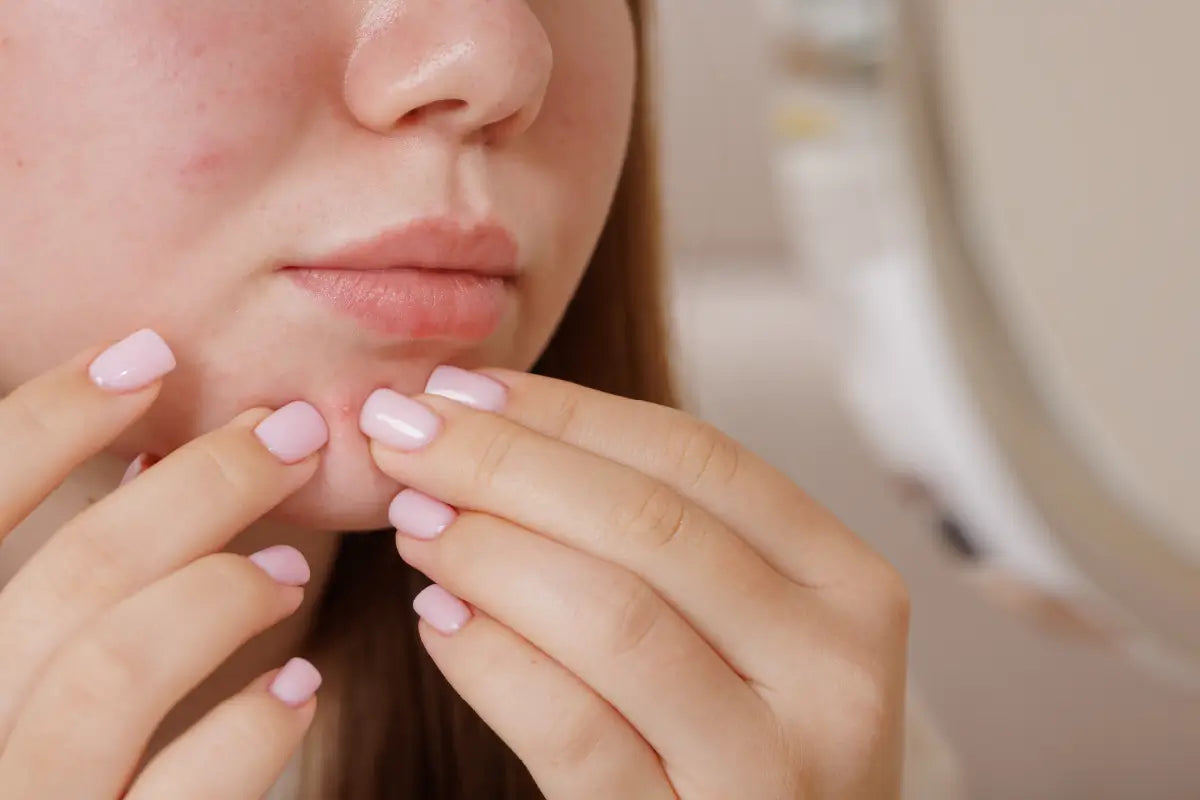
Why the chin? "Chin breakouts" are one of the most common problems that bring people of all ages to the clinic. The lower part of the face (chin and jawline) is exceptionally sensitive to hormonal fluctuations, stress, and skincare mistakes. These breakouts can appear cyclically (e.g., before menstruation), take a long time to heal, recur, and leave post-inflammatory marks.
Good news? With the right strategy (skincare + lifestyle), you can significantly reduce recurring imperfections and smooth skin texture.
In this guide, you'll find a complete plan: from diagnosing the causes, through morning and evening skincare routines, to smart prevention. Additionally – ready-made recommendations for Orientana products that support the epidermal barrier and help control inflammation without aggression.
What are chin breakouts and how to recognize them?
We're talking about inflammatory and non-inflammatory acne lesions located mainly on the lower third of the face: chin, perioral area, jawline.
Typical symptoms:
• closed comedones (small white bumps) and open comedones (black dots),
• pustules, inflammatory papules, sometimes painful nodules,
• erythema/swelling in the active inflammatory phase,
• post-inflammatory marks (darker spots) after healing.
The frequency of recurrences and their cyclical nature (e.g., just before menstruation) is an important clue that hormones and/or stress may be at play.
Why do chin breakouts occur?
Hormones and cycle fluctuations
Elevated androgens (or increased receptor sensitivity to androgens) intensify the activity of sebaceous glands. More sebum + keratinization disorders = higher risk of pore blockage and inflammation.
Stress and cortisol
Chronic stress increases cortisol levels, which destabilizes the skin barrier, promotes micro-inflammation, and can indirectly worsen seborrhea.
High glycemic diet and excessive dairy
In some individuals, highly insulinogenic products and certain dairy fractions can promote the worsening of lesions (mechanism: IGF-1, increased keratinization, and sebum).
Skincare mistakes
• overly aggressive washing (SLS, alkaline soaps),
• too heavy, comedogenic formulas,
• skipping toning and barrier repair,
• lack of SPF (photo-stress = oxidative stress).
"Maskne" and microbiome
Masks, scarves, turtlenecks → friction, microclimate, and sweat → dysbiosis and pimples around the chin.
Hand and accessory hygiene
Phone, hands, makeup brushes – mechanical transfer of impurities and bacteria to the chin area.
You have REAL INFLUENCE over at least the last four points!
Vicious circle: sebum ↔ dryness ↔ micro-inflammation
Aggressive face washing is one of the most common mistakes in caring for blemish-prone skin. Products with strong degreasing properties remove not only impurities but also natural lipids that protect the epidermis. As a result, the skin becomes dry, and the body defends itself by increasing sebum production. This "overreaction" mechanism leads to a vicious circle of oiliness and new inflammatory lesions.
Excess sebum combined with incomplete exfoliation of the epidermis promotes the formation of so-called horny-sebaceous plugs. Clogged hair follicles create ideal conditions for bacterial growth and the development of inflammation. That's why chin breakouts often appear in series and are difficult to eliminate if the skincare routine relies solely on "drying" effects.
Every inflammation is a micro-inflammation that further weakens the skin's hydrolipidic barrier. A damaged barrier means greater susceptibility to dryness, irritation, and the penetration of external irritants. The skin, trying to defend itself, produces even more sebum, which restarts the whole process.
The conclusion is clear: to break this loop, you need to act thoughtfully and multifacetedly. Gentle cleansing that removes impurities without disrupting the protective barrier is crucial. Equally important is regulating sebum secretion, rebuilding the epidermal barrier, and supporting the skin's microbiome. Only such a holistic approach allows you to break free from the vicious circle of dryness and excessive oiliness, instead of leading to constant "sterilization" of the complexion.
Ingredients that work (and how to combine them wisely)
• Gluconolactone (PHA) – gently exfoliates, has antioxidant and moisturizing properties, friendly to sensitive skin.
• Niacinamide – regulates sebum, has anti-inflammatory properties, brightens post-inflammatory marks, strengthens the barrier.
• CICA (Centella asiatica / madecassoside/asiaticoside) – soothes, accelerates regeneration, reduces redness.
• Adaptogens (e.g., ashwagandha, reishi) – support the skin's resistance to oxidative stress.
• Aloe, polysaccharides – intense hydration, soothing irritation.
• Vitamin C (stable derivatives) – antioxidant, brightens post-inflammatory hyperpigmentation (PIH).
• Ceramides / lipids – complete barrier repair processes.
• SPF – inhibits photo-stress and deepening of PIH.
Unique ingredient - Turmeric (Curcuma longa)
Turmeric is a powerful natural antioxidant and anti-inflammatory ingredient. Studies (Phytotherapy Research, 2020) confirm that curcumin reduces the production of pro-inflammatory cytokines and supports skin healing. It helps to reduce the formation of new acne lesions, accelerates skin regeneration, and evens out skin tone. In the care of chin breakouts, it works complementarily with niacinamide and PHA acids – it soothes, reduces redness, and supports a healthy epidermal barrier.
Step-by-step skincare routine (morning and evening)
Morning
Cleansing - gentle gel (SLS-free, alkaline soap-free).
Apply Soothing Date + Inulin Facial Cleansing Gel
Why: cleanses without disrupting pH and microbiome; inulin supports balance.
Toning - Moisturizing PHA Toner Essence – regulates, smoothes, reduces blackheads.
Serum - product with turmeric as a serum under cream (focus on the chin)
Orientana – Hydrocuration with Turmeric
Why: intense hydration, soothing, and reduction of inflammation for breakout-prone skin.

HydroTremella Sebum Regulating Cream - light, deeply moisturizing cream, with niacinamide and a pore-minimizing complex.

or
Sandalwood and Turmeric Face Cream – contains turmeric and sandalwood, known in Ayurveda for their cleansing and soothing properties - supports the fight against inflammation, evens skin tone, and does not weigh down the skin.
Sun protection (SPF 30–50) – daily - Choose a light SPF formula – according to your tolerance.
Evening
Cleansing – the same Soothing Date + Inulin Facial Cleansing Gel (if you wear makeup or SPF cream, always: makeup remover oil + gel.
PHA Toning – Orientana Moisturizing PHA Toner Essence
Serum - apply Niacinamide, Centella, and Antioxidant Serum-Ampoule.
Why: intensely moisturizes, supports soothing, and alleviates irritation after inflammatory changes.

Spot treatment (optional) – Hydrocuration with Turmeric – if you use it, apply only locally and avoid excessive frequency.
Sandalwood and Turmeric Face Cream – contains turmeric and sandalwood, known in Ayurveda for their cleansing and soothing properties - supports the fight against inflammation, evens skin tone, and does not weigh down the skin.
or
HydroTremella Imperfection Mask-Cream with tamanu oil and azelaic acid.
Common mistakes – and how to avoid them
• Over-cleansing ("cleaner" face after soap = more tight and reactive skin).
• Multi-ingredient "acid cocktails" without barrier repair.
• Squeezing – risk of scars and PIH.
• Too heavy, comedogenic formulas for oily skin.
• Lack of SPF – darker post-inflammatory marks and slower healing.
• Frequent touching of the chin / resting face on hands / dirty phone.
Diet, habits, and hygiene – real support
• Lower glycemic load meals (whole grains, protein, good quality fats).
• Moderate dairy – observe your skin (intolerances are individual).
• Omega-3, zinc, selenium, vit. D, polyphenols (sea fish, nuts, green tea, berries).
• Sleep and stress reduction – circadian rhythm and cortisol genuinely affect the skin.
• Accessory hygiene – phone disinfection, washing pillowcases, cleaning brushes.
• Moderation in alcohol/coffee (dehydrate, promote reactivity) – balance with water and an anti-inflammatory diet.
When to see a dermatologist?
• painful, deep, recurring nodules, cystic lesions,
• increasing scarring or widespread post-inflammatory hyperpigmentation,
• no improvement after 8–12 weeks of proper care,
• suspicion of hormonal imbalances (in women: irregular cycles, hirsutism),
• pregnancy/breastfeeding – selection of safe therapies.
A dermatologist can introduce pharmacotherapy (topical or systemic) and combine it with conscious home care (as above).
Recommended Orientana cosmetics for the "chin under control" routine
• Cleansing: [facial cleansing gel]
• Toning/regulation: [PHA Toner Essence]
• Day serum [Hydrocuration with Turmeric]
• Night serum [Antioxidant Serum Ampoule]
Day cream [Sebum-regulating cream; Sandalwood and Turmeric Face Cream]
Night cream [Imperfection mask-cream; Sandalwood and Turmeric Cream]
What you ask about:
Are chin breakouts always hormonal?
Most often – yes, but not exclusively. We often have a mix: hormones + stress + skincare mistakes.
What indicates "hormonal" changes?
Cyclicality (worsening before menstruation), location on the lower part of the face, deeper papules/nodules.
How long does it take to see improvement after changing the routine?
First signs after 3–4 weeks; fuller evaluation after 8–12 weeks.
Is gluconolactone (PHA) safe for sensitive skin?
Yes – it's the gentlest group of acids, also moisturizing and antioxidant.
Niacinamide and acne-prone skin – how does it work?
Regulates sebum, reduces redness, has anti-inflammatory properties, and brightens PIH.
Can I combine PHA with niacinamide and CICA?
Yes – this is a great, balanced set for the chin.
Do I need a separate "moisturizer"?
Not always. If the serum provides comfort, you can stick with it; if needed, add a thin layer of light cream.
Squeeze or not?
No. The risk of scars and discoloration is too high.
Does SPF worsen acne?
A well-chosen one – no. Look for light, non-comedogenic filters.
What about retinoids?
Effective, but require a plan (tolerance, moisturizing, SPF). If in doubt – consult a dermatologist.
Does a dairy-free diet always help?
Individually. A 4–6 week test and skin observation is a reasonable path.
Coffee and breakouts?
By itself, it doesn't necessarily worsen, but excess + little water = dehydration and skin reactivity.
Does makeup "suffocate" the chin?
Heavy, occlusive formulas – yes. Choose light, non-comedogenic ones and always cleanse thoroughly.
How to reduce "maskne"?
Clean masks, breaks, gentle material, PHA + barrier and avoiding friction.
Are milia the same as breakouts?
No. Milia are compact keratin cysts, not inflammation. They require a different approach.
What about zinc supplements?
Zinc can help, but doses and duration should be consulted with a specialist.
Why do I have more sebum after a "drying toner"?
Because the skin defends itself against dehydration – it produces more oil. Focus on regulation, not "degreasing."
Does vitamin C serum make sense for acne?
Yes – antioxidation + brightening PIH. Choose stable forms and combine with SPF.
How to care for post-inflammatory marks (PIH) on the chin?
Niacinamide, PHA, vitamin C, high SPF; patiently and consistently.
How many times a day should I wash my face?
Usually 2x (morning and evening). After training – gentle refreshment.
Will sonic brushes help with the chin?
In some people – yes; in others, they will worsen irritation. If you use them, do so rarely and gently.
Are "natural" cosmetics always better?
The formula and tolerance matter. At Orientana, we focus on nature + modern ingredients, but a consistent plan is key.
Is alcohol/strong antibacterial toners a good idea?
No. Dryness = more sebum = recurrence of the problem.
When to absolutely see a dermatologist?
Deep, painful nodules, scarring, spreading inflammation, no improvement after 8–12 weeks of conscious care.
Does turmeric really work on breakouts?
Yes – it contains curcumin, which has anti-inflammatory and antibacterial properties, reducing the formation of lesions and supporting regeneration.
Do cosmetics with turmeric stain the skin?
No – cosmetic formulas are prepared so that turmeric works actively but does not leave yellow marks.
Is turmeric safe for sensitive skin?
Yes, it has a soothing and anti-inflammatory effect, and combined with sandalwood, it further soothes irritation.
When should you reach for a cream or hydrocuration with turmeric?
When you have skin with breakouts, redness, inflammation, or post-inflammatory marks from acne.
Summary and quick checklist
Chin breakouts are a multifactorial problem. Effectiveness comes from consistency and balance: gentle cleansing, smart exfoliation, sebum regulation, barrier repair, and SPF – plus a calmer lifestyle and hygiene habits.
Checklist (for printing):
• Gentle cleansing (morning/evening) - Orientana Date + Inulin
• PHA Toning - Orientana Lotion with gluconolactone
• Hydrocuration with turmeric - for breakout areas
• Niacinamide serum at night – Antioxidant Serum-Ampoule
• SPF 30–50 daily
• Phone and hands away from the chin; clean pillowcases and brushes
• Lower glycemic load, omega-3, green tea
• 7–8 hours of sleep, stress reduction
• Progress evaluation after 8–12 weeks; if needed – dermatologist
See also related entries:
• Skin microbiome – how to strengthen it?
• Facial pores - how to reduce their visibility