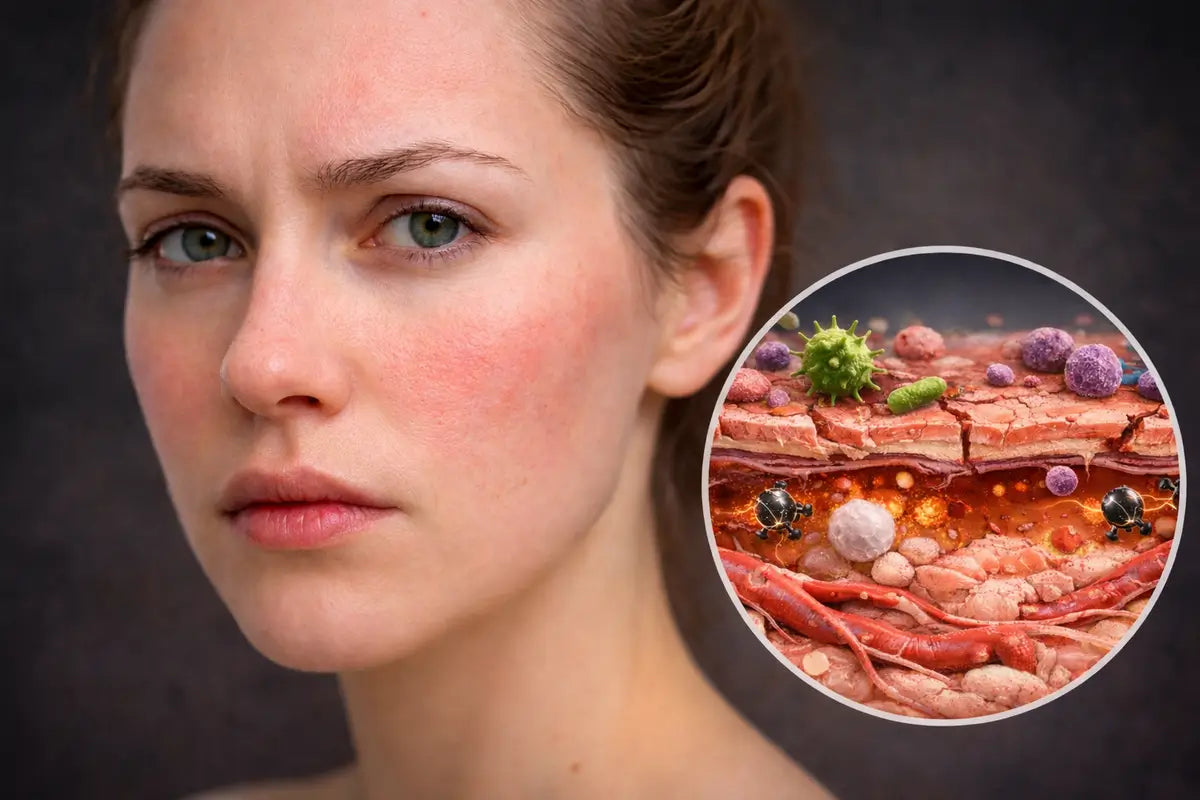
More and more people are investing in advanced serums, peptide creams, and acid treatments, yet they still struggle with burning, tight skin, excessive oiliness, or recurring blemishes. Very often, the cause isn't a "bad cosmetic," but something much more fundamental— imbalanced skin pH .
pH is one of the foundations of healthy skin. If it's imbalanced, even the best skincare routine won't work optimally. Skin becomes more permeable, susceptible to irritation, and loses water more quickly. As a result, it begins to "send out alarm signals," which many people mistakenly interpret as a need for stronger cleansing or stronger active ingredients. Unfortunately, this often exacerbates the problem.
- In this article we will focus not on theoretical definitions (which I discuss here) , but on practice :
- how to recognize disturbed skin pH,
- what destroys them most often,
- what the skin looks like when balance begins to return,
- and how to rebuild it step by step in daily care.
Disturbed skin pH - what does this mean in practice?
Healthy skin has a slightly acidic pH. This environment promotes proper enzyme function, microbiome maintenance, and the integrity of the hydrolipid barrier. As the pH shifts toward a more alkaline pH, the skin:
- loses water faster,
- regenerates worse,
- reacts more easily with inflammation,
- tolerates active ingredients less well.
Importantly, a pH imbalance doesn't always mean dry skin . It also often affects oily and combination skin, which becomes excessively oily while simultaneously dehydrated.
If you want to learn exactly what skin pH is, what its norms are, and how the protective acid mantle works, read our guide to skin pH .
The most common symptoms of disturbed skin pH
pH imbalances rarely produce a single, clear symptom. Typically, a combination of several symptoms occurs:
- feeling of tightness right after washing your face,
- burning or stinging after applying cosmetics,
- skin that is dry and shiny at the same time,
- greater tendency to develop blackheads and pimples,
- periodic redness,
- flaking or roughness,
- impaired tolerance of acids and retinoids.
If you recognize several of the above points, it's very likely that your skin primarily needs pH stabilization and barrier strengthening , rather than another powerful active ingredient.
Why does pH imbalance often “pretend” to be other skin problems?
One of the reasons why pH imbalance can be difficult to diagnose is that its symptoms resemble:
- sensitive skin,
- acne-prone skin,
- dry skin,
- dehydrated skin.
In practice, this means that many people are starting to use increasingly stronger cosmetics to address the problem, instead of first rebuilding the foundation . Meanwhile, without a stable pH, even the best serums won't reach their full potential.
What most often leads to skin pH disturbances?
The most common causes include:
- washing your face with soap or highly foaming gels,
- no toning after cleansing,
- too frequent acid peels,
- hard and chlorinated water,
- cosmetics with high alcohol content,
- stress, lack of sleep, hormonal disorders,
- a diet rich in simple sugars and highly processed products.
It is worth emphasizing that even good cosmetics can stop being beneficial to the skin if they are used in too large quantities or in the wrong order .
What does the skin look like when the pH begins to normalize?
The first changes are subtle but very characteristic:
- less feeling of tightness after washing,
- better hydration without heaviness,
- less burning after applying cosmetics,
- calmer, more even complexion,
- gradually less prone to breakouts.
This is a sign that the hydrolipid barrier is beginning to rebuild and the skin is returning to its physiological functioning mode.
Restoring pH isn't about a single "miracle" cosmetic. It's a process based on a few simple but consistent steps .
With pH imbalances, it's crucial to simultaneously strengthen the skin's protective barrier. You can read more about this in our article on the skin's hydrolipid barrier.
1. Gentle cleansing instead of squeaky clean

Your skin shouldn't feel tight or squeaky after washing. This sensation usually means that its natural protective barrier has been breached.
A good choice is the Orientana Gentle Face Wash Gel Daktyl + Inulina , which:
- gently removes impurities,
- does not disturb the acid-base balance,
- supports the microbiome thanks to inulin.
Regular use of a gentle gel is the first step to stabilizing the pH.
2. Toning – the fastest way to restore pH
After each wash, it is worth using a tonic or tonic-essence.
The following products are good for Orientan care:
- Moisturizing tonic-essence with gluconolactone – supports pH, gently exfoliates and moisturizes,
- Orientana Rose Tonic – soothes, calms and helps maintain the physiological skin reaction.
Tonic acts as a “reset” for the skin after contact with water.
In your daily routine, it is worth using toners that restore the physiological pH of the skin - see Orientana facial toners.

3. Strengthening the barrier and microbiome
Stable pH goes hand in hand with a strong hydrolipid barrier.
- supports the reconstruction of the epidermis,
- strengthens the barrier,
- helps maintain the proper environment for the microbiome.
- "repairs" the hydrolipid barrier
- enhances skin hydration
- strengthens the skin structure
Disturbed pH of the body skin - a problem that we often ignore

When it comes to pH, we most often talk about the face, but the skin on the body reacts very similarly to acid-base imbalances. Itching after bathing, tightness, and flaking skin on the calves or arms are all signs that the protective acid mantle has been weakened.
The most common mistakes in body care:
- using highly foaming shower gels,
- hot, long baths,
- lack of moisturizing after washing,
- products with alcohol and intense fragrances.
In such a situation, it is crucial not only to wash gently, but also to immediately support the barrier after bathing.
A good solution is the Moisturizing Sandalwood Balm.
Regular use of emollients makes the skin regain elasticity faster and the pH gradually stabilizes.
How does lifestyle affect skin pH?
Skin condition isn't solely the result of cosmetics. The body functions as a whole, so pH imbalances often go hand in hand with:
- chronic stress,
- sleep deprivation,
- a diet high in sugars and processed foods,
- dehydration.
A diet that supports skin balance
It is worth regularly reaching for products rich in:
- zinc,
- vitamin E,
- B vitamins,
- omega-3 fatty acids.
It is also good practice to limit sweetened drinks and sweets and increase the supply of vegetables, fruit and mineral water.
Although diet does not directly “set” the skin’s pH, it significantly supports the regeneration of the barrier , and it is this barrier that stabilizes the pH.
What to avoid if you want to restore your skin's pH?
With disturbed pH, less is more. Common mistakes that slow down regeneration:
- too frequent acid peels,
- combining many active ingredients at once,
- washing your face with hot water,
- lack of toning,
- frequent changes of cosmetics.
The skin needs time to rebuild its natural protective mechanisms.
How long does it take for skin pH to normalize?
Most people see the first results after 3–7 days of gentle care.
Full stabilization of the hydrolipid barrier may take several weeks – depending on the degree of its weakening.
Consistency is more important than intensity.
Frequently Asked Questions (FAQ)
Can the tonic be used several times a day?
Yes, especially for sensitive and dehydrated skin.
Does micellar water disturb the skin's pH?
Maybe – that's why it's always worth rinsing it off and applying toner.
Does oily skin also need pH stabilization?
Yes – often even more than dry.
Are PHA acids safe at disturbed pH?
Yes, for example gluconolactone has a gentle effect and supports balance.
Does age affect skin pH?
Yes – as we age, the pH gradually increases, which is why the skin becomes more sensitive.
Imbalanced skin pH is one of the main, yet often overlooked, causes of skin problems. Without stabilizing it, it's difficult to expect spectacular results from even the best serums and creams.
Gentle cleansing, regular toning and barrier-strengthening cosmetics – such as Orientana toners and serums – allow the skin to return to its natural balance and regain a healthy appearance.
The most important information at a glance
What is impaired skin pH?
This is a condition in which the skin's protective acid mantle loses its balance, leading to dryness, hypersensitivity, imperfections and a weakening of the hydrolipid barrier.
Most common symptoms:
tightness after washing, burning, excessive oiliness, redness, peeling, poorer tolerance of cosmetics.
How to restore skin pH?
Use gentle cleansing, always use toner, strengthen the hydrolipid barrier and avoid aggressive exfoliation.
How quickly can you see improvement?
First results after 3–7 days, full stabilization usually within a few weeks.
If your skin reacts with burning, tightness, or excessive oiliness, start with the basics. Proper cleansing, toning, and barrier-strengthening products are the easiest way to restore pH balance.