Discoloration is one of the most common skin problems – it appears after summer, after acne, due to hormonal changes, inflammation, or oxidative stress. Uneven skin tone, darker spots, or post-inflammatory marks often persist for months, or even years, if the skincare regimen is not properly chosen.
What discoloration serum should you choose to genuinely even out skin tone?
Effective reduction of discoloration is not about “lightening the skin” but about influencing the melanogenesis process, reducing inflammation, and supporting natural epidermal renewal. This is why highly concentrated formulas with precisely selected active ingredients play a key role in the care of discolored skin.
In this article, we explain:
- what ingredients truly work on discoloration,
- which formulas are best for different types of pigmentary changes,
- and which Orientana brand serums are worth incorporating into your skincare to even out skin tone and prevent recurrence of discoloration.
- what to avoid if you have discoloration
What types of discoloration are most common and why is this important when choosing a serum?
In practice, we mainly encounter sunspots, post-inflammatory hyperpigmentation (PIH), and hormonal discoloration (melasma), and each of these types arises from a slightly different background. For sunspots, ingredients that inhibit excessive melanin synthesis are key; for PIH, substances that soothe inflammation and support regeneration; while for melasma, multi-directional formulas work best. Therefore, the best discoloration serum is one that combines ingredients influencing melanogenesis, reducing inflammation, and accelerating natural epidermal renewal.
What ingredients work on skin discoloration?
Not every "brightening" serum actually affects discoloration. Efficacy depends on whether it contains ingredients that target key mechanisms of pigment spot formation, primarily melanocyte activity, inflammation, and oxidative stress.
Read about the effects of vitamin C on the skin.
Vitamin C (3-O-Ethyl Ascorbic Acid)
This is one of the best-researched ingredients supporting the reduction of discoloration. It inhibits tyrosinase activity – the enzyme responsible for melanin synthesis – and acts as a powerful antioxidant, protecting the skin from photodamage.
Orientana cosmetics use a stable form of vitamin C - 3-O-Ethyl Ascorbic Acid, which:
- is well tolerated even by sensitive skin,
- does not oxidize quickly,
- works long-term and evenly.
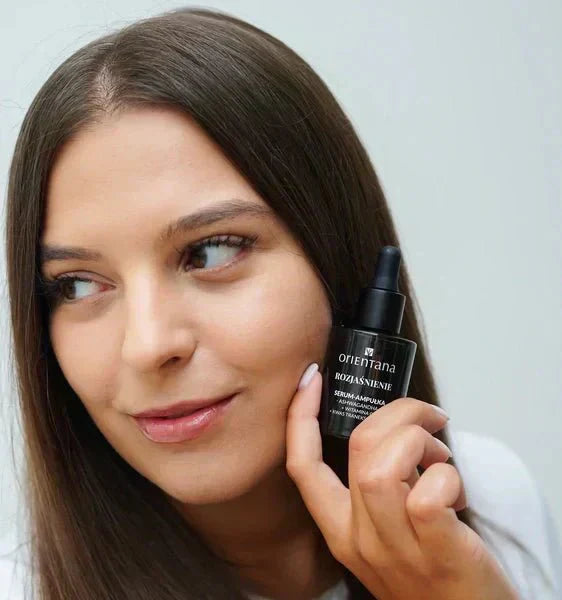
You can find it in the Ashwagandha Brightening Serum-Ampoule. 👇

Tranexamic acid
An ingredient particularly recommended for melasma and post-inflammatory hyperpigmentation. It limits excessive pigmentation by influencing inflammatory mediators and processes responsible for uneven skin tone.
The best results are observed when brightening ingredients are combined with antioxidants and soothing ingredients, which reduces the risk of irritation and recurrence of discoloration.
Additionally:
- has anti-inflammatory properties,
- reduces the risk of discoloration recurrence,
- works well with vitamin C.
It is found in Ashwagandha Brightening Serum-Ampoule
Papaya Extract (Carica Papaya Fruit Extract)
Papaya contains a natural enzyme - papain, which gently supports the exfoliation of dead skin cells. Thanks to this:
- the skin regains an even tone faster,
- brightening ingredients work more effectively,
- the complexion becomes smoother and more radiant.
You can find papaya extract in the Ashwagandha + Vitamin C + Tranexamic Acid Serum-Ampoule.
Check out ashwagandha cosmetics and read how it works on the skin.
Ashwagandha - important clarification
Ashwagandha is not a depigmenting ingredient in the strict sense.
Its action in supporting the reduction of discoloration results from:
- strong antioxidant effect,
- reduction of inflammation,
- strengthening the skin's protective barrier.
Thanks to this, ashwagandha:
- reduces the risk of new discolorations forming,
- supports skin tone evening,
- is particularly beneficial for reactive skin prone to PIH (post-inflammatory hyperpigmentation).
What discoloration serum should you choose? Orientana recommendations

Ashwagandha Brightening Serum-Ampoule
A multi-directional formula - ideal for skin with discoloration due to:
- oxidative stress,
- inflammation,
- hormonal changes.
The combination of:
- vitamin C,
- tranexamic acid,
- papain
- ashwagandha
allows for simultaneous brightening of existing spots, protecting the skin from new pigmentary changes, and strengthening its immunity.
Check out all Orientana face serums
How to use discoloration serum to see results?
For effective skincare, regularity and sun protection are crucial.
Basic rules:
- apply serum to cleansed, slightly damp skin,
- use 1-2 times daily (as per product recommendations),
- always protect your skin with SPF cream during the day.
Without daily UV protection, even the best discoloration serum will not provide lasting results.
When do the first results appear?
With regular use for a minimum of 4-6 weeks, you can observe:
- gradual lightening of pigment spots,
- a more even skin tone,
- improved radiance and smoothness of the complexion.
Why choose Orientana discoloration serum?
- natural, vegan formulas,
- combination of phyto-ingredients and modern biotechnology,
- ingredients with proven efficacy,
- cosmetics not tested on animals,
- safety confirmed by application tests.
If you're wondering what discoloration serum to choose, opt for formulas that address the root cause, rather than masking the problem. Orientana products support the skin in regaining balance, an even tone, and a healthy glow, without aggressive action or risk of irritation.
See also: our other discoloration cosmetics
Discover: other products with vitamin C
What to avoid if you have discoloration?
One of the most common reasons for a lack of results in reducing discoloration is not so much the wrong choice of serum, but errors in daily skincare.
Lack of daily sun protection (SPF)
UV radiation strongly stimulates melanocytes to produce melanin. Without regular use of sunscreen, even the best-chosen discoloration serum will not be able to provide lasting improvement in skin tone.
Overly aggressive or too frequent exfoliation
Excessive use of acids or peels can weaken the hydrolipid barrier, intensify inflammation, and paradoxically promote the formation of new discolorations.
Frequent changes of active ingredients
Skin needs time to react to specific ingredients. Constantly rotating serums and introducing many strong substances at once makes it difficult to assess effects and increases the risk of irritation.
Check out other cosmetics for discoloration
Questions
Does discoloration serum really work?
Yes, discoloration serum can effectively reduce pigment spots, provided it contains ingredients that influence melanogenesis, such as vitamin C or tranexamic acid, and is used regularly along with sun protection.
What serum ingredients are best for discoloration?
The best-researched ingredients are stable vitamin C, tranexamic acid, and antioxidants that reduce inflammation and oxidative stress, which indirectly support skin tone evening.
Does vitamin C serum lighten discoloration?
Yes, vitamin C inhibits the activity of the enzyme responsible for melanin production, thereby gradually lightening discoloration and preventing the formation of new pigmentary changes.
Is tranexamic acid effective for discoloration?
Yes, tranexamic acid limits excessive pigmentation, especially in the case of melasma and post-inflammatory hyperpigmentation, and reduces the risk of their recurrence.
Does ashwagandha lighten discoloration?
Ashwagandha does not have a direct depigmenting effect, but through its anti-inflammatory and antioxidant properties, it supports skin tone evening and prevents the formation of new discolorations.
How long does it take to see results from using discoloration serum?
The first effects are usually visible after 4-6 weeks of regular use, while full improvement in skin tone requires several months of systematic care.
Can discoloration serum be used daily?
Yes, most discoloration serums are designed for daily use, unless the manufacturer recommends otherwise and the skin tolerates the active ingredients well.
Can discoloration serum be used in summer?
Yes, discoloration serum can be used in summer, provided a high SPF cream is applied daily to protect the skin from the formation of new pigmentary changes.
Does discoloration serum work without SPF?
No, lack of sun protection significantly reduces the effectiveness of discoloration serum, as UV radiation increases melanin production and promotes the recurrence of pigment spots.
Is one serum enough for all types of discoloration?
No, the effectiveness of a serum depends on the type of discoloration. Sunspots, post-inflammatory hyperpigmentation, or hormonal changes may require different combinations of active ingredients and a longer period of use.
Melasma - what it is and how to effectively care for skin with this type of discoloration?