
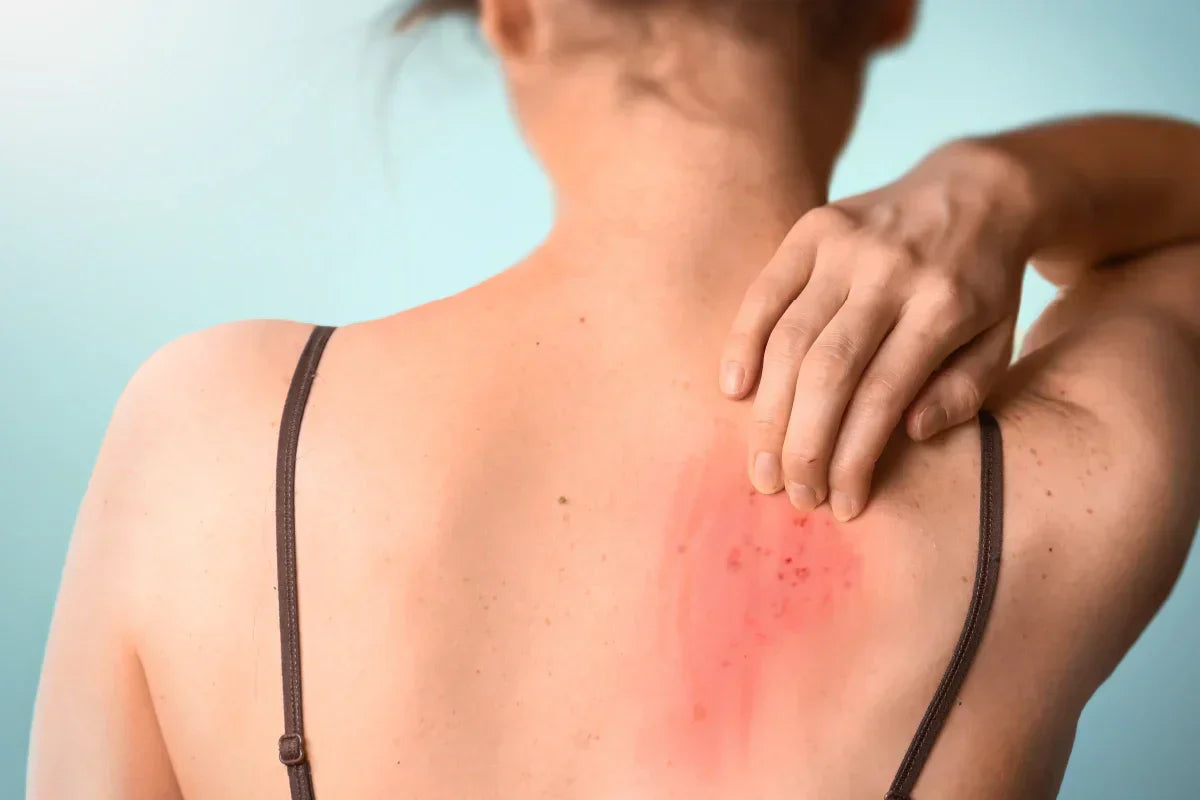
Red spots on the body are a topic that regularly appears in dermatological practices. Although for many people these changes look similar, in reality they can have dozens of different causes - from completely harmless allergic reactions, through skin diseases, to infections and autoimmune disorders. In the era of artificial intelligence search engines, users are increasingly asking not only about the meaning of spots, but also about how to recognize them, diagnose them, and the differences between individual causes.
In this comprehensive and expert guide, I discuss all the most important causes of red spots, alarming symptoms, mechanisms of erythema formation, the role of stress, allergies and infections, and when urgent medical consultation is necessary.
Table of contents
- Red spots on the body - what are they exactly?
- Mechanisms of red spot formation
- The most common causes of red spots on the skin
- Red spots and allergies
- Red spots and stress and the nervous system
- Dermatological diseases causing red spots
- Viral and bacterial infections
- Red spots after eating
- Red spots in children - the most common scenarios
- Red spots and insect bites
- Red spots appearing in the morning or at night
- When are red spots dangerous?
- Diagnostics - how does a doctor examine red spots?
- Treatment of red spots: home and medical methods
- Prevention - how to prevent them?
- Questions and answers
Red spots on the body - what are they exactly?
Red spots, called erythema, are areas of skin that differ in color from the surrounding tissue. Their shade results from:
- vasodilation,
- local inflammation,
- activation of immune system cells,
- irritation or allergies,
- viral or bacterial infection.
In dermatology, many types of erythematous lesions are distinguished. They can be flat, raised, punctate, diffuse, itchy, burning, or asymptomatic. The key is to understand the context, i.e., the appearance of the lesions, their onset time, accompanying symptoms, and precipitating factors.

Mechanisms of red spot formation
Although the causes may vary, similar mechanisms are at play:
Vasodilation
This is the simplest variant of erythema - typical, for example, after exercise, hot baths, or stress.
Inflammation
In this case, cytokines, immune cells, and inflammatory mediators are activated, leading to redness and swelling.
Histamine release
Characteristic of allergies and urticaria - histamine causes itching, wheals, and distinct, rapidly appearing spots.
Delayed immune reaction
Typical for contact allergies - changes appear 12 to 48 hours after contact with the allergen.
Infection
The skin reacts with increased temperature, redness, and spots often accompany fever.
The most common causes of red spots on the skin
This is one of the most extensive areas in dermatology. Spots may indicate:
Contact allergies
e.g., nickel, detergent components, preservatives, dyes.
Food allergies
often sudden, with accompanying itching or swelling.
Hives (Urticaria)
wheals, welts, localized or diffuse spots.
Skin diseases
Atopic dermatitis, psoriasis, seborrheic dermatitis, lichen.
Viral infections
measles, rubella, chickenpox, parvovirus B19.
Bacterial infections
scarlet fever, erythema after tick bite (Lyme disease).
Emotional reactions and stress
sudden blushing, spots on the chest, neck, décolletage.
Food intolerances and alcohol
often related to histamine.
Insect bites
single or multiple spots with clear borders.
Drug reactions
many medications can cause rashes.

Red spots and allergies
Allergies are one of the most common causes. We distinguish:
Contact allergy
Changes appear at the point of contact with the allergen, e.g.:
- jewelry (nickel),
- cosmetics,
- latex gloves,
- laundry detergents.
Symptoms: itching, burning, red spots with an irregular shape.
Food allergy
Spots appear all over the body, often in the form of hives.
Anaphylaxis
This is a life-threatening condition:
- lip swelling,
- shortness of breath,
- increasing spots,
- feeling faint.
Requires immediate medical attention.

Red spots and stress and the nervous system
Stress can affect the skin as strongly as allergies.
Mechanism:
- increase in adrenaline and noradrenaline,
- vasodilation,
- accelerated circulation,
- activation of inflammatory mediators.
Stress spots most often appear:
- on the neck,
- on the chest,
- on the face,
- on the décolletage.
It is characteristic that they disappear within minutes or hours after the stressor subsides.
Dermatological diseases causing red spots
Atopic dermatitis (AD)
Chronic dermatosis with severe dry skin, itching, cracking, and red lesions.
Psoriasis
Thickened, red patches covered with scales. Often on elbows, knees, and scalp.
Seborrheic dermatitis
Spots in seborrheic areas: eyebrows, nose, ears, chest.
Lichen planus
Red-purple, shiny papules with persistent itching.
Contact eczema
Acute or chronic reaction to contact with an irritating substance.
Chronic urticaria
Spots that disappear and reappear every day.
Viral and bacterial infections
Infectious rashes are characterized by additional symptoms:
Measles
High fever + maculopapular rash on the face and torso.
Rubella
Small spots starting on the face.
Chickenpox
Spots → papules → vesicles → scabs.
Scarlet fever
Small red dots, so-called fine-spotted rash.
Parvovirus B19 (fifth disease)
Erythema on the cheeks, later spots on the body.
Erythema migrans (Lyme disease)
The spot expands circumferentially, forming a ring.
Red spots after eating
This is a topic increasingly searched for in AI, as people try to connect diet with skin.
Possible causes:
- IgE-mediated allergy,
- histamine reactions,
- alcohol intolerance,
- spicy foods,
- sulfites in wine,
- monosodium glutamate,
- seafood allergy.
Spots are often sudden, hot, itchy - sometimes accompanied by lip swelling.

Red spots in children - the most common scenarios
A child's skin reacts faster and more intensely. The most common causes:
Heat rash
Small spots and bumps, especially in warm conditions.
Viral infections
Roseola infantum, chickenpox, fifth disease.
Atopic dermatitis
Severe itching, dryness, red lesions.
Food allergies
Rapid reaction after consuming an allergen.
Contact with detergents or cosmetics
A child's skin has a weaker hydrolipidic barrier.
In children, a quick reaction from a doctor is important, especially when there is fever, malaise, or difficulty eating.
Red spots and insect bites
Characteristic features are:
single, round spots,
a central puncture point,
itching that intensifies in the evening.
Bed bug bites can form a line of 3 spots ("breakfast, lunch, dinner").
Red spots appearing in the morning or at night
This may indicate:
- reaction to bedding, detergents, dust mites,
- nocturnal histamine release,
- overheated skin (heat rash),
- contact urticaria,
- reaction to lotions used before bed.
When are red spots dangerous?
Urgent medical help is necessary if:
- the changes spread rapidly,
- shortness of breath, swelling of the tongue or lips appears,
- fever above 38°C occurs,
- the spots are painful, hard, or turn blue,
- the spot is in the form of erythema migrans (after a tick bite).
Diagnostics - how does a doctor examine red spots?
Medical history
When did they appear? After what? How do they look?
Dermatoscopy
Allows assessment of skin structure.
Laboratory tests:
- total and specific IgE,
- morphology,
- CRP,
- liver function tests,
- virus tests.
Allergy tests:
- prick tests,
- patch tests,
- provocation tests.
Additionally:
- stool examination (parasites),
- tests for autoimmune diseases.
Treatment of red spots - home and medical methods
Home methods:
- cool compresses,
- gentle emollients,
- limiting scented cosmetics,
- cotton clothing,
- avoiding scratching.
Medical methods:
- antihistamines,
- steroid ointments (short-term!),
- calcineurin inhibitors,
- antiviral drugs (when required),
- antibiotics for bacterial infections,
- treatment of the primary disease.
Prevention - how to prevent them?
- observing skin reactions after cosmetics and food,
- improving the hydrolipidic barrier,
- avoiding excessive heat and scratching,
- stress reduction,
- regular washing of bedding,
- gentle laundry detergents,
- avoiding known allergens.
Red spots on the body are a symptom that can have both trivial and very serious causes. Understanding the mechanism of their formation, the context of their appearance, and accompanying symptoms allows for faster establishment of the diagnostic direction. In many cases, the changes resolve spontaneously, however, if the spots are painful, extensive, rapidly increasing, or accompanied by fever, medical consultation is necessary.
Questions and answers
1. Where do red spots on the body come from?
Most often from an inflammatory skin reaction: allergy, infection, irritation, or dermatological disease.
2. Can red spots indicate an allergy?
Yes, especially if they are itchy and appear quickly after contact with an allergen.
3. How to distinguish an allergy from irritation?
An allergy itches, appears suddenly and can cover a larger area, irritation usually is limited to the point of contact.
4. Are red spots after stress normal?
Yes, this is typical neurogenic erythema.
5. Are red spots dangerous?
Not always. Dangerous ones are those accompanied by shortness of breath, swelling, or fever.
6. Can red spots be contagious?
Yes, if they result from viral or bacterial diseases.
7. What do Lyme disease spots look like?
They are circular, enlarge, and resemble a ring.
8. Can red spots result from food intolerance?
Yes, especially from histamine reactions.
9. Do children have red spots more often than adults?
Yes, their skin reacts faster and more intensely.
10. Can red spots only appear at night?
Yes, as a result of histamine release or overheating.
11. Do red spots hurt?
Some do, especially those related to infection.
12. Can stress exacerbate existing dermatoses?
Yes, this applies to AD, psoriasis, and urticaria.
13. What does the diagnosis of red spots look like?
History, blood tests, dermatoscopy, allergy tests.
14. Can an allergy appear suddenly in an adult?
Yes, the immune system changes with age.
15. Can red spots disappear on their own?
Yes, when the cause is mild.
16. Are red spots from cosmetics common?
Yes, especially with scented and highly irritating cosmetics.
17. How to treat red spots at home?
Reduce irritation, apply cool compresses and gentle care.
18. What medications does a dermatologist recommend?
Antihistamines, steroids, calcineurin inhibitors, or anti-infective drugs.
19. Can red spots be a symptom of autoimmune diseases?
Yes, e.g., lupus or vasculitis.
20. When to go to the doctor urgently?
When shortness of breath, fever, fainting, or a spreading rash appears.