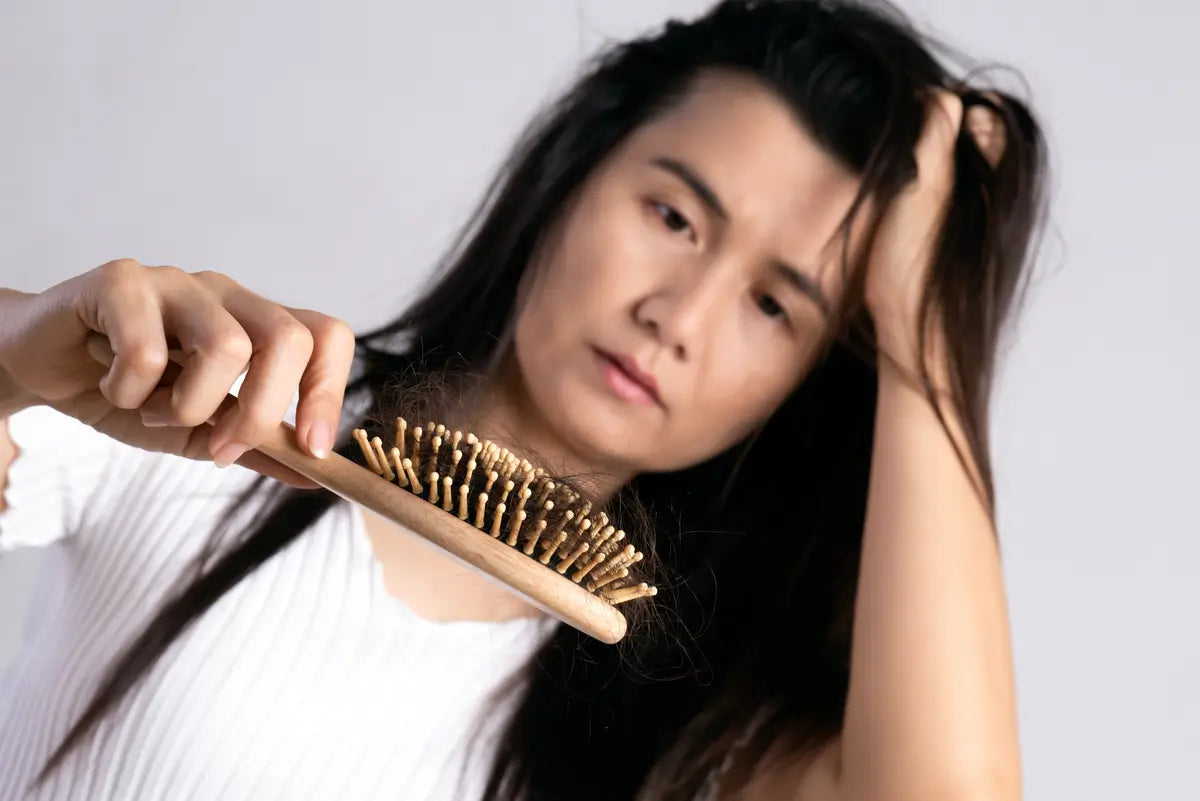
Hair loss isn't just an aesthetic problem, but above all, a signal that processes within the body or scalp are disrupting the natural hair growth cycle. More and more people are noticing that their hair is not only falling out more than usual but also growing more slowly, losing thickness and volume.
From a trichology perspective, it is crucial to understand one fact:
Hair loss is never accidental.
There are specific biological mechanisms behind hair loss:
- shortening the anagen (growth) phase,
- premature transition of the hair into telogen (resting phase),
- miniaturization of the hair follicle,
- disorders of microcirculation and oxygenation of hair bulbs.
Importantly, even the best cosmetics will be ineffective if the cause of the problem isn't identified. Therefore, this guide doesn't focus solely on hair care but provides a comprehensive picture of hair loss—from biology, through diagnosis, to actionable strategies .
Hair loss - the cause no one talks about.
Hair life cycle - why does hair fall out?
Understanding the hair life cycle is absolutely essential in the fight against hair loss.
Each hair goes through three main phases:
1. Anagen - growth phase
This is the longest and most important phase, lasting from 2 to even 6 years.
During this time, the hair matrix cells divide intensively and the hair grows on average about 1–1.5 cm per month.
✅ In a healthy scalp, as much as 80–90% of hair is in this phase.
2. Catagen - transition phase
It lasts about 2–3 weeks. The hair stops growing and its connection to the hair follicle weakens.
3. Telogen - resting phase
It lasts about 2–3 months. The hair stops growing and falls out at the end of this phase.
✅ A maximum of 10–15% of hair should be in this phase.
When does the problem start?
The problem occurs when:
- too many hairs go into telogen at once,
- the anagen phase is shortened,
- new hair grows slower or thinner.
This is when we talk about:
➡️ telogen effluvium (TE)
➡️ or miniaturization of hair follicles (e.g. in androgenetic alopecia)
What disrupts the hair cycle?
Most common factors:
- stress (cortisol)
- inflammation of the scalp
- nutrient deficiencies
- hormones (DHT, estrogens)
- microcirculation disorders
✅ Each of them can "flip" a hair from anagen to telogen.
The most common causes of hair loss
Hair loss is almost always multifactorial. This means there's rarely just one cause—usually a combination of several factors.
1. Stress and cortisol - the silent hair saboteur
Chronic stress is one of the most common, yet most underestimated causes of hair loss.
Cortisol:
- inhibits cell division in the hair matrix,
- extends the telogen phase,
- limits the flow of nutrients to the bulbs.
Studies show that intense stress can increase hair loss by up to several dozen percent.
✅ That's why we so often observe hair loss:
- after illness,
- after strong emotional stress,
- after surgery or major life changes.
2. Hormones and DHT
DHT (dihydrotestosterone) is the hormone responsible for androgenic alopecia.
It works by:
- shortening the anagen phase,
- miniaturization of hair follicles,
- weakening of the hair structure.
Effect:
➡️ hair becomes thinner, shorter and weaker
➡️ gaps appear
3. Deficiencies - the most common problem among women
Most important ingredients:
Iron (ferritin)
This is an absolute must.
Low ferritin levels = hypoxic hair follicles.
Vitamin D3
Regulates the hair cycle and supports the anagen phase.
Protein
Hair is 95% keratin – without protein there is no growth.
Zinc and B vitamins
They influence cell division and metabolism of hair follicles.
4. Inflammation of the scalp
This is one of the most frequently overlooked factors.
Inflammation:
- disrupts the microbiome,
- increases the level of inflammatory cytokines,
- weakens hair follicles.
Symptoms:
- itch
- dandruff
- greasing
- scalp tenderness
✅ Without calming down the inflammation , hair growth is practically impossible .
5. Improper care
Most common mistakes:
- washing too infrequently
- applying heavy silicones to the scalp
- no peeling
- lack of stimulation
✅ The scalp "suffocates" and the hair follicles are blocked.

Types of hair loss - key to strategy
Recognizing the type of hair loss is absolutely crucial, as each form requires a different approach.
Telogen effluvium
The most common.
Characteristic:
- suddenly
- spilled
- after stress / illness / childbirth
✅ reversible
Androgenetic alopecia
- gradual
- related to hormones
- hair miniaturization
✅ requires long-term therapy
Hair loss after pregnancy
- appears 2–4 months after birth
- related to the decline in estrogen
✅ transitional
Post-COVID hair loss
- strong
- suddenly
- related to metabolic stress
Alopecia areata
- autoimmune
- hairless foci
✅ requires specialist consultation
How to recognize the cause of hair loss?
This is the most important stage that determines the effectiveness of the entire therapy.
Observation of symptoms
Pay attention to:
- whether the loss is sudden or gradual
- whether it affects the entire head or specific areas
- whether it is accompanied by itching or dandruff
Blood tests
Basic panel:
- ferritin
- iron
- TSH, FT3, FT4
- vitamin D3
- B12
- zinc
Trichoscopy
The test allows for the assessment of:
- hair density
- condition of the bellows
- the presence of miniaturization
When to go to a specialist?
- the shedding lasts for more than 3 months
- gaps appear
- hair falls out in handfuls

How to stop hair loss - 360° strategy
Effective therapy must work on several levels simultaneously.
PILLAR 1: Scalp
- cleaning
- microbiome regulation
- reduction of inflammation
PILLAR 2: Hair bulb stimulation
- lotions
- massage
- active ingredients
PILLAR 3: Nourishing the body
- diet
- supplementation
PILLAR 4: Lifestyle
- dream
- stress reduction
- physical activity
Key takeaway:
There is no single product for hair loss.
There is a system of operation .

Lotions - the most effective way to grow hair
Scalp lotions are one of the most important elements of anti-hair loss therapy. Unlike conditioners or masks, they act directly on the hair follicles, where the problem begins.
Their effectiveness is due to several biological mechanisms:
- improving microcirculation in the scalp,
- increasing the supply of oxygen and nutrients to the bulbs,
- stimulation of hair matrix cells,
- extension of the anagen (growth) phase.
Why do lotions work?
The scalp is metabolically active tissue. This means that:
➡️ responds to stimuli (massages, active ingredients),
➡️ can be stimulated to regenerate,
➡️ is responsible for the quality and rate of hair growth.
Therefore, lotions do not act on the symptom (i.e. the hair), but on the cause - the hair bulb and its environment .
The most effective plant ingredients
Your advantage as an Orientan is huge because this is exactly the area.
Check also Herbs for hair loss
Amla
- strong antioxidant
- strengthens the bulbs
- reduces hair loss
Rosemary
- improves microcirculation
- works similarly to minoxidil (comparative studies!)
Fenugreek
- rich in phytoestrogens
- supports hair growth
Neem
- has anti-inflammatory properties
- regulates the microbiome
This is precisely the foundation of Ayurvedic care.
More about Ayurvedic care.
How to use lotions to make them work?
The most common problem is not the product – but the lack of systematicity.
Diagram:
1–2 times a day
minimum 4–8 weeks
massage the scalp for 2–3 minutes
✅ first effects:
- baby hair after approx. 4–6 weeks
- hair loss stops after 2–4 weeks
The scalp - the foundation without which nothing works
This is one of the most important, yet most frequently overlooked aspects.
A healthy scalp is:
- correct pH
- balanced microbiome
- no inflammation
- patent hair follicles
What happens when the scalp doesn't function properly?
- the bulbs are oxygen deprived
- active ingredients do not reach the follicles
- hair grows slower or not at all
Key elements of scalp care
1. Cleansing
Washing every 2–3 days is the trichological standard.
2. Peeling
Removes dead skin and unblocks hair follicles.
3. Sebum regulation
Too much sebum = inflammatory environment.
4. Hydration and balance
The scalp also needs hydration.
Without taking care of the scalp:
no lotion will work long term.
Active ingredients that really work
Caffeine
- stimulates microcirculation
- activates the bulbs
- extends anagen
Adaptogens
Ashwagandha
- reduces stress
- supports hormonal balance
Gotu Kola
- strong antioxidant
- protects hair follicles
Ingredients that regulate the microbiome
- pro/pre/postbiotics
- niacinamide
- plant extracts
Trend 2026:
scalp care = microbiome care
Diet and lifestyle - a foundation that cannot be omitted
Hair is a “non-priority” structure for the body.
This means that in the event of a deficiency, the body "cuts off" their growth.
The most important elements of the diet
Protein
Without it, keratin cannot be produced.
Iron
It conditions the oxygenation of the bulbs.
Vitamin D3
Regulates the hair cycle.
Zinc
Affects cell regeneration.
Lifestyle
sleep → regeneration
stress → hair's biggest enemy
physical activity → improved circulation
The most common mistakes that block hair growth
1. Lack of systematicity
Lotions only work when used regularly.
2. Ignoring the scalp
This is the biggest mistake.
3. Washing too infrequently
Sebum blocks the follicles.
4. Expecting results after a week
The hair cycle lasts months.
5. Bad diagnosis
Not every problem is the same.
Ready-made routines - how to stop hair loss
SCENARIO 1: Hair loss after stress/illness
- washing 2–3 times a week
- daily lotion
- scalp massage
- diet + adaptogens
SCENARIO 2: Oily scalp + hair loss
- more frequent washing
- sebum-regulating ingredients
- light rubs
- peeling once a week
SCENARIO 3: Post-pregnancy hair loss
- gentle care
- plant lotions
- patience (it is a reversible process)
SCENARIO 4: Suspected androgenic alopecia
- long-term therapy
- DHT-blocking ingredients
- specialist consultation
FAQ - Hair loss
Can hair loss be stopped?
Yes, if you identify the cause and implement a comprehensive care plan that includes scalp, diet and lifestyle.
How long does it take for lotions to work?
The first effects appear after 4–8 weeks of regular use.
Does stress cause hair loss?
Yes. Cortisol disrupts the hair cycle and accelerates its transition to the telogen phase.
Does diet matter?
Yes. Iron, protein, and vitamin D3 deficiencies are among the main causes of hair loss.
Can trichology and Ayurveda be combined?
Yes – this is the most effective approach.
Hair loss is not a problem that can be solved by one cosmetic.
This is a process that requires:
- understanding the cause,
- work with the scalp,
- systematic care,
- support the body from the inside.
The combination of trichology and Ayurveda gives the fullest results – because it combines science with nature.
Your hair can recover. It just needs the right approach.
If you want to deepen your knowledge and build your routine consciously, visit our natural cosmetics zone.