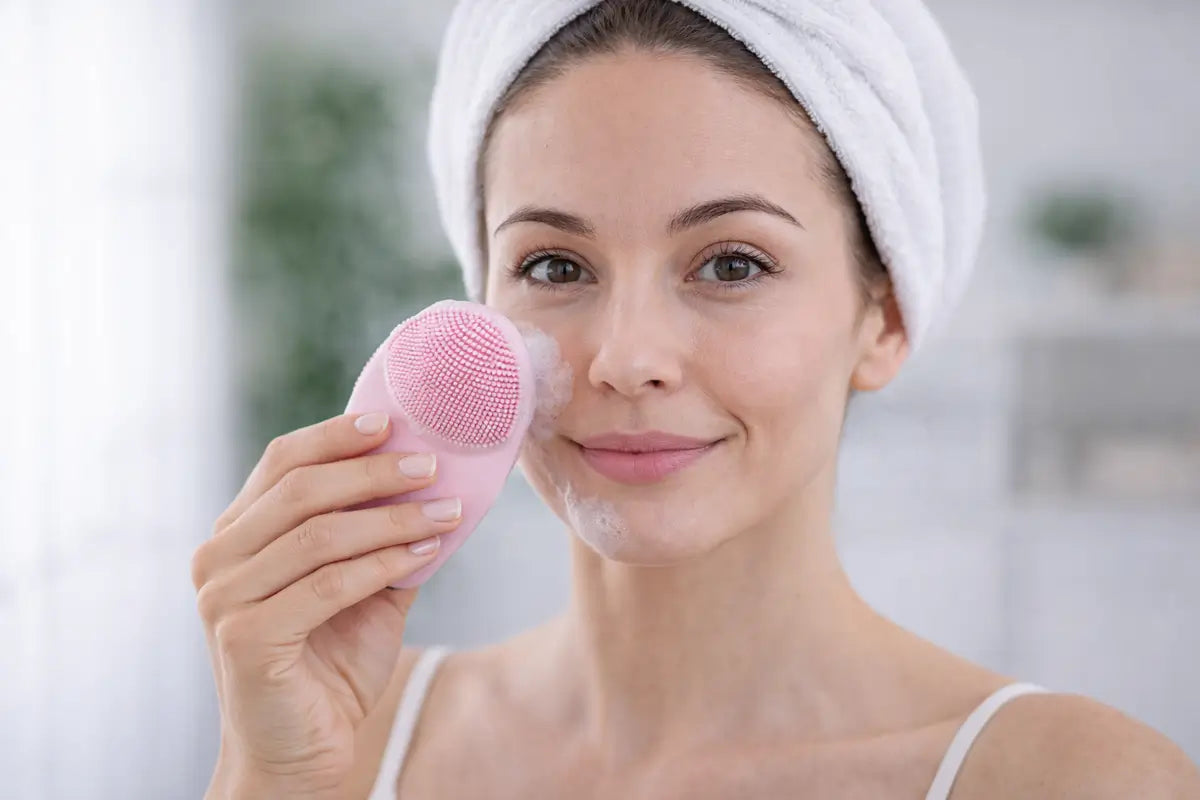
In recent years, the sonic facial brush has become synonymous with "deep cleansing." Marketing promises cleaner skin, smaller pores, and improved cosmetic absorption. At the same time, a growing body of research on skin barrier function shows that excessive mechanical stimulation can disrupt epidermal homeostasis.
Modern cosmetology shifts the emphasis from intensive exfoliation to protecting the hydrolipid barrier and microbiome .
What is TEWL and why does it matter?
TEWL (Transepidermal Water Loss) is a measure of transepidermal water loss that reflects the integrity of the skin barrier. The higher the TEWL, the more damaged the hydrolipid barrier and the greater the moisture loss.
Dermatological studies show that:
- mechanical damage to the epidermis increases TEWL,
- excessive exfoliation impairs the skin's ability to retain water,
- increased TEWL correlates with hypersensitivity and inflammation.
How does a sonic brush work on a biological level?
A sonic brush generates micropulsations that repeatedly apply micro-stress to the skin's surface. While a single use may be safe, repeated stimulation can lead to:
- microdamage to the stratum corneum,
- disturbances in corneocyte cohesion,
- increasing the permeability of the epidermis,
- activation of inflammatory mediators.
This is especially important for thin, mature or sensitive skin.
Microdamage - an invisible problem
Microdamages are subclinical disturbances of the stratum corneum structure, invisible to the naked eye but measurable by an increase in TEWL.
Effects of micro-damage:
- feeling of tightness,
- burning sensation after applying cosmetics,
- greater reactivity,
- microbiome disorders.
When using a sonic brush daily, the effect may be cumulative.
Sonic brush and the skin microbiome
The skin microbiome is a complex ecosystem of bacteria that protects against pathogens. Over-cleansing can:
- reduce beneficial bacteria,
- increase susceptibility to inflammation,
- promote acne and hyperreactivity.
The modern approach to cleansing involves not only removing contaminants, but also protecting the microbiome.
You can learn more about the skin microbiome in the article Skin Microbiome - Everything You Need to Know
Does a sonic brush improve the absorption of cosmetics?
Mechanical exfoliation may temporarily increase ingredient penetration, but at the expense of barrier integrity.
Increased skin permeability:
- does not always mean better performance,
- may increase the risk of irritation,
- accelerates water loss.
A healthy, well-functioning barrier absorbs ingredients more effectively than a damaged barrier.
And how to take care of the hydrolipid barrier you can find out here: Hydrolipid Barrier
Why does over-cleansing accelerate skin aging?
Chronic low-grade inflammation
Repetitive micro-damage can activate chronic, low-grade inflammation (inflammation). This is one of the mechanisms of biological skin aging.
Inflammation:
- activates metalloproteinases (MMPs),
- accelerates collagen degradation,
- weakens the extracellular matrix.
Increased TEWL and dehydration
Increased TEWL leads to:
- dehydration,
- loss of elasticity,
- fine dehydration wrinkles,
- dullness of the skin.
Dry, dehydrated skin ages faster.
Weakening of the lipid barrier
The hydrolipid barrier is responsible for:
- protection against oxidative stress,
- neutralization of free radicals,
- maintaining proper pH.
Its disruption promotes photoaging and degradation of the skin's supporting fibers.
Increased sensitivity to UV
A damaged barrier increases susceptibility to:
- UV radiation,
- formation of discolorations,
- collagen degradation.
As a result, the skin ages faster even with standard sun exposure.
Scientific Evidence: TEWL, Microdamage, MMP, and Skin Barrier Repair
TEWL as an indicator of barrier damage – what does the research say?
Transepidermal Water Loss (TEWL) is a standard, objective parameter for assessing epidermal barrier integrity. Methods for measuring TEWL were described by Pinnagoda et al. in Contact Dermatitis (1990), among others, and are currently the gold standard in experimental dermatology.
Research has shown that:
- mechanical damage to the stratum corneum (e.g. by tape stripping) causes an immediate increase in TEWL,
- the greater the disruption of the corneocyte structure, the higher the water loss,
- Rebuilding the barrier takes from 24 to 72 hours, depending on the depth of the damage.
Proksch, Brandner, Jensen (2008), Experimental Dermatology
The authors emphasize that the integrity of the stratum corneum is crucial for maintaining skin homeostasis and that its repeated disruption can lead to chronic barrier dysfunction.
Although these studies did not directly involve sonic brushes, the mechanism of micro-damage is analogous—repetitive mechanical friction can increase TEWL in a cumulative manner.
Tape stripping as a model of microdamage – analogy to brushes
In dermatological examinations, so-called tape stripping is often used – the controlled removal of successive layers of the stratum corneum using adhesive tape.
Denda et al., Journal of Investigative Dermatology (1998)
Removal of the stratum corneum has been shown to lead to:
- activation of proinflammatory cytokines (IL-1),
- increased keratinocyte proliferation,
- accelerated lipid synthesis in the barrier repair process.
This proves that even subclinical damage to the stratum corneum triggers an inflammatory response.
Mechanical brushing is not identical to tape stripping, but it does generate repeated micro-stress and surface abrasion – especially with daily use.
Microdamage and metalloproteinases (MMPs)
One of the key mechanisms of skin aging is the activation of matrix metalloproteinases (MMPs) , which degrade collagen and elastin.
Fisher et al., New England Journal of Medicine (1997)
The study found that exposure to UV radiation increases the expression of MMP-1 in the skin, which leads to collagen degradation.
Quan et al., Journal of Investigative Dermatology (2009)
Chronic inflammation and oxidative stress have been confirmed to increase MMP activity.
Why is this important in the context of over-purification?
Repetitive micro-damage:
- activate inflammatory mediators,
- increase cytokine levels,
- may indirectly influence the expression of MMPs,
- accelerate the degradation of the extracellular matrix.
This is one of the mechanisms of so-called inflammaging .
Inflammaging - chronic low-grade inflammation
The term inflammaging was introduced by Franceschi et al. (2000).
📚 Franceschi et al., Annals of the New York Academy of Sciences (2000)
The concept of chronic, low-level inflammation has been described as one of the main mechanisms of aging.
In the skin, inflammaging is associated with:
- collagen degradation,
- decrease in elasticity,
- deterioration of barrier function,
- severity of discoloration.
Although sonic brushing is not a systemic factor like aging or UV, repeated micro-damage can maintain local micro-inflammation.
Read the article Inflammaging - a silent process that accelerates skin aging
Hydrolipid barrier and its repair (Barrier Repair)
Elias & Feingold, Skin Barrier (2005)
The authors emphasize that the stratum corneum acts as an “intelligent barrier,” the damage of which initiates a repair cascade.
Fluhr et al., British Journal of Dermatology (2006)
Research shows that once the barrier is damaged:
- lipid synthesis increases,
- enzymes responsible for reconstruction are activated,
- full recovery may take several days.
However, if damage is repeated (e.g., daily vigorous brushing), the repair process may not be fully completed before another breach occurs. This leads to chronic barrier dysfunction.
The Skin Microbiome and Over-Cleansing
Grice & Segre, Nature Reviews Microbiology (2011)
The role of the microbiome in maintaining the immune balance of the skin has been described.
Too intense cleansing:
- changes the skin's pH,
- disturbs the balance of commensal bacteria,
- increases susceptibility to pathogen colonization.
There are no studies directly relating sonic brushes to the microbiome, but there is evidence that aggressive cleaning agents and mechanical damage can disrupt the microbiome.
In the natural cosmetics section, we discuss the topic of conscious care and the role of natural ingredients in the daily routine.
Are there clinical studies confirming the advantages of sonic brushes?
To date, there are no strong, independent clinical trials (RCTs) confirming that a sonic toothbrush:
- significantly reduces acne,
- reduces pores,
- improves skin structure in the long term,
- works better than gentle manual cleansing.
Most of the data comes from studies sponsored by device manufacturers.
This does not mean that brushes are "harmful", but that their advantage over a well-chosen cleansing gel has not been clearly proven.
Why does modern cleansing focus on barrier protection?
Modern aesthetic dermatology increasingly talks about:
- minimizing inflammation,
- protection of the lipid barrier,
- microbiome support,
- avoiding excessive exfoliation.
Therefore, gentle cleansing formulas that do not cause a feeling of tightness are considered safer in the long run.
In care based on balance (as in the phytocosmetic philosophy), cleansing is not an aggressive treatment, but a step that restores homeostasis.
Scientific conclusions
Based on available research, it can be concluded that:
- Repeated damage to the stratum corneum increases TEWL.
- Damage to the barrier activates inflammatory mediators.
- Chronic microinflammation can accelerate aging.
- Rebuilding the barrier takes time.
- Over-cleansing can disrupt the microbiome.
There is no strong evidence that a sonic brush is necessary for effective cleansing.
Is a sonic brush necessary in modern care?
No. Modern cosmetic formulas enable effective cleansing without mechanical stimulation.
Well-chosen gel:
- dissolves sebum,
- removes makeup,
- does not violate the barrier,
- supports the microbiome.
In the phytocosmetology approach, cleansing is a harmonizing, not aggressive, step. 
Alternative: gentle cleansing to support the barrier
Orientana cleansing formulas combine effectiveness with care. Instead of intensive mechanical exfoliation, they use:
- mild surfactants,
- moisturizing ingredients,
- plant extracts with a soothing effect,
- support skin balance.
Cleansing should not be a “battle with your skin”, but the beginning of regeneration.

A model for safe skin cleansing
Safe skin cleansing should:
- Remove dirt without friction.
- Do not increase TEWL.
- Don't disturb the microbiome.
- Do not cause a feeling of tightness.
- Prepare your skin for care, do not irritate it.
If your skin burns after washing, your cleansing method is too aggressive.
When can a sonic brush be used?
Can be used:
- occasionally,
- for resistant skin,
- without active inflammation,
- without simultaneous treatment with retinoids and acids.
It should not be a daily part of your routine.
Scientific Summary
Sonic facial brush:
- works mechanically,
- may increase TEWL,
- may cause micro-damage,
- may accelerate the aging process if used excessively.
Modern cosmetology promotes:
- protection of the hydrolipid barrier,
- minimizing inflammation,
- gentle but effective cleansing.
Bibliography
- Pinnagoda J, Tupkek RA, Agner T, Serup J. Guidelines for transepidermal water loss (TEWL) measurement: a report from the Standardization Group of the European Society of Contact Dermatitis. Contact Dermatitis . 1990;22(3):164–178.
- Proksch E, Brandner JM, Jensen JM. The skin: an indispensable barrier. Experimental Dermatology . 2008;17(12):1063–1072.
- Denda M, Wood LC, Emami S, Calhoun C, Brown BE, Elias PM, et al. Topical glucocorticoids accelerate permeability barrier disruption and delay barrier recovery in murine epidermis. Journal of Investigative Dermatology . 1998;111(4):601–606.
- Elias PM, Feingold KR. Skin barrier. In: Elias PM, Feingold KR, editors. Skin Barrier . New York: Taylor & Francis; 2005.
- Fluhr JW, Darlenski R, Surber C. Glycerol and the skin: holistic approach to its origin and functions. British Journal of Dermatology . 2008;159(1):23–34.
- Fisher GJ, Datta SC, Talwar HS, Wang ZQ, Varani J, Kang S, et al. Molecular basis of sun-induced premature skin aging and retinoid antagonism. Nature . 1996;379(6563):335–339.
- Fisher GJ, Kang S, Varani J, Bata-Csorgo Z, Wan Y, Datta S, et al. Mechanisms of photoaging and chronological skin aging. Archives of Dermatology . 2002;138(11):1462–1470.
- Quan T, Qin Z, Xia W, Shao Y, Voorhees JJ, Fisher GJ. Matrix-degrading metalloproteinases in photoaging. Journal of Investigative Dermatology Symposium Proceedings . 2009;14(1):20–24.
- Franceschi C, Bonafè M, Valensin S. Inflamm-aging: an evolutionary perspective on immunosenescence. Annals of the New York Academy of Sciences . 2000;908:244–254.
- Grice EA, Segre JA. The skin microbiome. Nature Reviews Microbiology . 2011;9(4):244–253.
- Madison K.C. Barrier function of the skin: “la raison d'être” of the epidermis. Journal of Investigative Dermatology . 2003;121(2):231–241.
- Rawlings AV, Harding CR. Moisturization and skin barrier function. Dermatological Therapy . 2004;17(Suppl 1):43–48.
- Voegeli R. The effect of washing and surfactants on skin barrier function. Dermatology . 2007;215(Suppl 1):26–30.
- Angelova-Fischer I, Mannheimer AC, Hinder A, Ruether A, Franke A, Neubert RH, et al. Distinct barrier integrity phenotypes in filaggrin-related atopic eczema following sequential tape stripping and lipid analysis. Experimental Dermatology . 2011;20(4):351–356.