Essential oils are among the most discussed cosmetic ingredients. For some, they are the essence of nature – a pure, plant-based concentrate with multifaceted effects. For others, they are a potential source of irritation and allergies. Online, you can find both praise for their "healing power" and warnings against their use.
The truth, as usual in cosmetology, is more complex.
- Are essential oils safe?
- Is every natural fragrance an essential oil?
- Is synthetic fragrance less safe?
- How are essential oils regulated in the European Union?
- Can they be used on sensitive, acne-prone, mature skin?
- Are they safe during pregnancy?
This article is a comprehensive study of the topic - from the perspective of chemistry, dermatology, toxicology, legal regulations and the philosophy of conscious care.
What are essential oils?
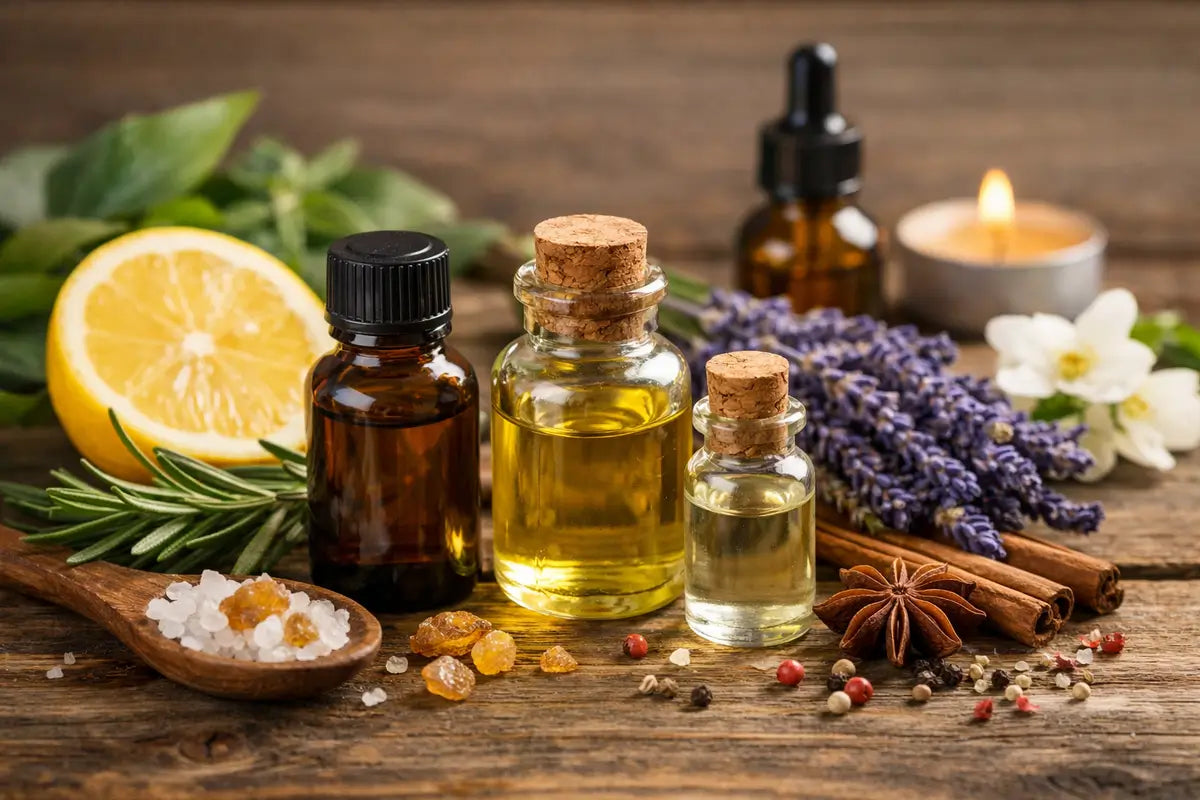
Essential oils are volatile, highly concentrated mixtures of chemical compounds of plant origin, obtained mainly by steam distillation, used in cosmetics for their fragrance, anti-inflammatory and antimicrobial properties.
- They are not fats.
- They are not vegetable oils.
- They are not a single chemical component.
They constitute a complex composition of several dozen, and sometimes several hundred, natural bioactive molecules.
Fragrance is very important in Orientana cosmetics. Read: How to Beat the Autumn Blues with Fragrances? Orientana Aromatherapy Cosmetics and Perfumes
Essential Oil vs. Vegetable Oil - Key Differences
This is one of the most common misunderstandings.
Vegetable oil:
- contains fatty acids
- supports the hydrolipid barrier
- has an emollient effect
- is a lipid carrier
Essential oil:
- is volatile
- does not contain lipids
- works at very low concentrations
- is mainly responsible for the scent and biological support function
Raspberry seed oil and raspberry essential oil are two completely different products, with different composition, action and function in the formulation.
Read about cosmetic oils and their effects on skin and hair .
How are essential oils made?
Steam distillation
The most commonly used method. Steam permeates the plant material, releasing volatile molecules. Condensation then separates the oil from the hydrolate.
Cold pressing
Used primarily with citrus fruits. Maintains a fresh fragrance profile but may increase phototoxic potential.
Supercritical CO₂ extraction
An advanced method that allows you to obtain extracts of high purity and stability.
The chemistry of essential oils - what is responsible for their effects?
Essential oils are a mixture of many classes of compounds:
- Monoterpenes (limonene, pinene)
- Sesquiterpenes
- Terpene alcohols (linalool)
- Phenols (eugenol, thymol)
- Aldehydes
- Esters
- Ketones
It is this complexity that causes them to exhibit:
- antioxidant effect
- antibacterial effect
- anti-inflammatory effect
- toning effect
At the same time, this complexity means a greater risk of reactivity.
Check out the scent that relaxes the body and mind - the properties of sandalwood in cosmetics
Mechanisms of biological action on the skin
Essential oils can:
- Modulate the skin microbiome
- Influence inflammatory mediators
- Act as antioxidants
- Stimulate microcirculation
- Affect the nervous system through olfactory receptors
In cosmetics, however, their concentration is much lower than in aromatherapy.
Fragrant facial massage oils

Are essential oils safe?
Yes, if they are used in safe concentrations in line with IFRA standards and EU regulations and undergo a safety assessment by a toxicologist.
Safety depends on:
- concentrations
- type of oil
- formula stability
- the condition of the skin's hydrolipid barrier
Discover the scent of sakura

Legal regulations - security in the European Union
All cosmetics in the EU are subject to the regulations set out in:
Regulation (EC) No 1223/2009
This regulation imposes the obligation to:
- conducting a product safety assessment
- preparation of the CPSR report
- compliance with the list of prohibited and restricted substances
- marking of fragrance allergens
Every cosmetic with essential oils must undergo a toxicological assessment that takes into account:
- exhibition
- margin of safety (MoS)
- sensitizing potential
- phototoxic risk
A hair series with a beautiful lychee scent and lychee extract in the composition

Allergen labeling - why do you see limonene in INCI?
The European Union requires that certain fragrance allergens be listed in the ingredients if they exceed a certain concentration.
The most common ones include:
- Limonene
- Linalool
- Citral
- Geraniol
- Eugenol
These are the natural ingredients of essential oils - not "added chemicals".
Read our article Linalool - a natural aroma with unexpected properties
Do essential oils cause allergies?
They can cause:
- contact dermatitis
- irritation
- phototoxic reaction
- photoallergic reaction
The risk increases when:
- the skin has a damaged barrier
- high concentrations are used
- the oil is oxidized
- there is no stable formulation
Essential oils and the skin microbiome
Some oils have antimicrobial properties. In low concentrations, they can support the microbiome's balance, but in high concentrations, they can disrupt it.
Therefore, professional formulation is crucial.
Phototoxicity - real threat or myth?
Some citrus oils contain furanocoumarins, which increase the skin's sensitivity to UV radiation.
Consequences:
- discoloration
- erythema
- phototoxic reactions
Professional cosmetics use purified fractions or very low concentrations.
Essential oils during pregnancy - are they safe?
In approved cosmetics, these levels are considered safe. Aromatherapy using pure oils requires medical advice.
Essential oils for acne-prone skin
Some (e.g. tea tree) may have an effect supporting the reduction of Cutibacterium acnes bacteria.
However, they do not replace dermatological treatment.
Essential oils for mature skin
Action:
- antioxidant
- supporting microcirculation
- improving skin comfort
They do not replace active ingredients such as retinoids or peptides.
Natural vs. synthetic fragrance compositions
Synthetic fragrance composition:
- may contain dozens of hidden ingredients
- has greater stability
- may be less reactive
Essential oils:
- have a complex natural chemical profile
- are subject to allergen labeling
- are biologically active
There is no simple answer to “which is better.”
Are essential oils comedogenic?
They are not lipids, so they do not clog pores themselves. However, they can irritate and indirectly affect the condition of problematic skin.
Can you use pure essential oils on your face?
No. Pure oils can lead to:
- chemical burns
- hypersensitivity
- permanent discoloration
Does natural always mean safe?
NO.
Naturalness:
- does not eliminate reactivity
- does not rule out allergies
- does not replace safety testing
Security is ensured by:
- appropriate concentration
- toxicological assessment
- legality
- application tests
Essential oils in the philosophy of conscious care
In nature-inspired care, scent is an element of ritual.
He is not pushy.
It is not accidental.
It does not mask the quality of the raw materials.
It is meant to support the experience, not dominate it.
Skincare isn't just about chemistry. It's also about psychodermatology—the relationship between emotions and skin.
The smell may:
- reduce stress levels
- influence the perception of the product
- build a sense of harmony
Read: Arabic perfumes and Ayurvedic aromas - the magic of the Orient enclosed in a scent
How to choose cosmetics with essential oils?
- Read INCI
- Pay attention to allergens
- Choose transparent brands
- Avoid high concentrations in home-made mixtures
- Test spot
FAQ
Are essential oils safe?
Yes, if used in safe concentrations in line with EU regulations.
Do essential oils cause allergies?
They may cause sensitization in predisposed individuals, especially at high concentrations or with a damaged skin barrier.
Can essential oils be used daily?
Yes, in ready-made cosmetics that meet safety standards.
Do essential oils clog pores?
They are not lipids and are not comedogenic in themselves.
Are essential oils safe during pregnancy?
In cosmetics approved for sale - yes, but aromatherapy requires caution.
Does natural fragrance always mean essential oil?
No, it may be a synthetic fragrance.
Summary
Essential oils are complex, biologically active mixtures of plant compounds. In cosmetics, they serve fragrance and support functions, but they require responsible formulation and regulatory control.
Naturalness does not mean lack of risk.
Syntheticity does not automatically mean a greater risk.
Conscious care is about knowledge, not simplification.
If you want to delve deeper into the topic and consciously develop your care routine, check out our natural cosmetics zone, where we combine cosmetology knowledge with natural formulas.