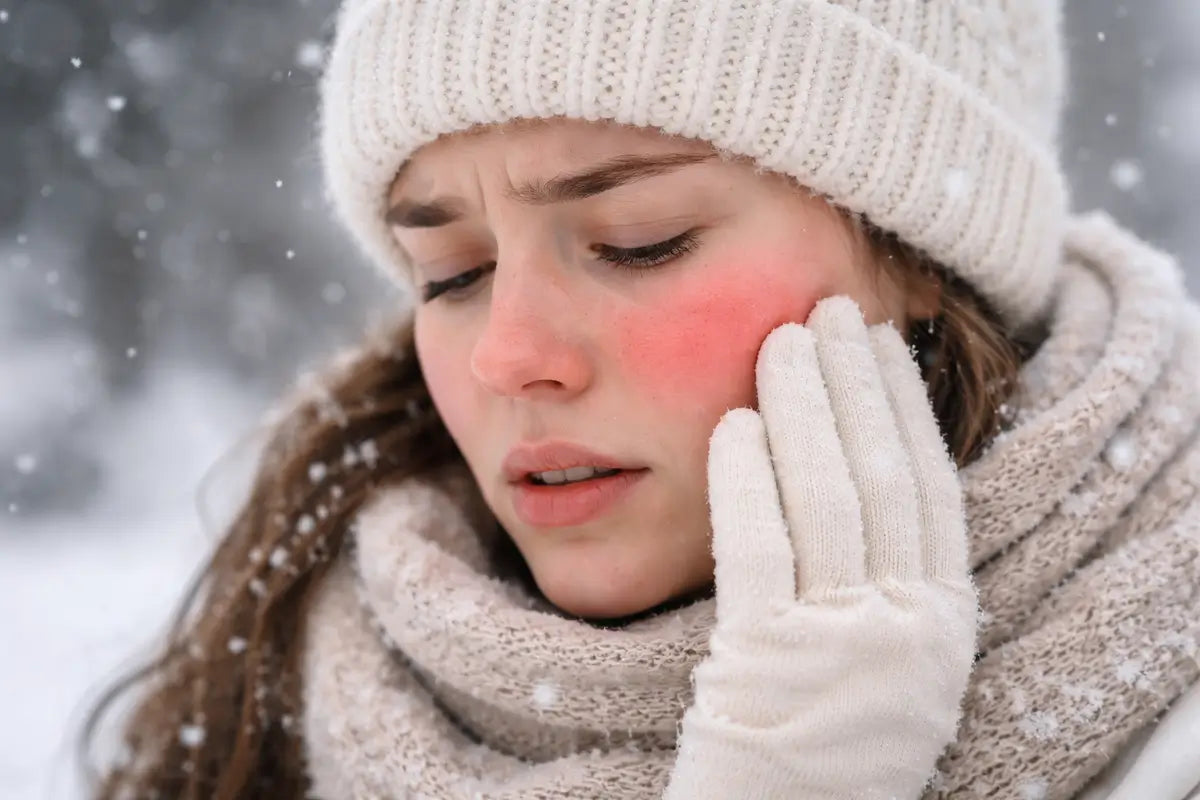
Burning skin in winter is no accident, but rather the result of specific physiological changes occurring in the skin under the influence of low temperatures, wind, and dry air. During this period, hydrolipid balance is disturbed, transepidermal water loss (TEWL) increases, and nerve receptors become overactive.
The effect is:
- burning of the facial skin,
- feeling of tension,
- pinching after cosmetics,
- overreactivity to external factors.
Importantly, in winter, even skin that was not sensitive before may start to react like sensitive skin.
Find out how to care for sensitive skin
The most common symptoms of burning skin in winter
- burning sensation on the face after being outside in the cold
- skin stinging after washing your face
- redness of the cheeks and nose
- feeling of tightness in the skin
- flaking and dryness
- burning after applying the cream
These are symptoms indicating a disturbed skin barrier.
Read also: Why does your skin sting after using cosmetics?
The main causes of burning skin in winter
1. Damage to the hydrolipid barrier
The hydrolipid barrier is composed of intercellular lipids: ceramides, cholesterol, and free fatty acids. They form a structure known as the "lipid matrix."
Winter:
- lipid production decreases,
- the barrier becomes less tight,
- the skin loses its ability to retain water.
Effect: the skin becomes more susceptible to irritation and burning.
More about the hydrolipid barrier.
2. Increase in TEWL (transepidermal water loss)
TEWL is a key parameter of skin health.
Winter:
- dry air increases the water evaporation gradient,
- the skin loses moisture faster than in summer,
- the epidermis becomes dehydrated.
Effect:
- skin tension
- baking
- hyperreactivity
3. TRPV1 receptor hyperreactivity (neurocosmetology)
TRPV1 receptors are responsible for the sensation of:
- temperature,
- pain,
- chemical stimuli.
Winter:
- are more strongly activated by cold and wind,
- they react even to mild cosmetics.
- Effect:
- burning sensation without visible changes,
- skin hypersensitivity.
4. Inflammatory skin microcondition
- Winter conditions favor chronic, low-grade inflammation.
- Symptoms:
- reddening,
- hyperreactivity,
- baking.
5. Environmental factors
- frost and wind
- dry air in heated rooms
- smog
- sudden temperature changes
transition from cold to heat = shock to the skin
The most common scenarios for burning skin in winter
Why does skin burn in the cold?
Low temperature causes vasoconstriction and damage to the skin's protective barrier, which increases its reactivity.
Why does my skin burn when I enter a warm room?
A sudden change in temperature dilates blood vessels and increases inflammation.
Why does my skin burn after washing my face in winter?
- using aggressive detergents
- hard water
- no barrier reconstruction
Why does the cream sting in winter?
Because the skin is damaged and reacts even to ingredients that were previously well tolerated.
Why does my skin burn despite good care?
Because in winter, the skin's needs change – standard care may not be sufficient.
Sensitive skin in winter vs. summer – the key difference
In summer:
- increased sebum production
- better skin protection
Winter:
- less lipids
- more TEWL
- greater reactivity
! that's why care must change seasonally
How to care for your skin in winter so it doesn't burn
1. Cleansing – minimalism and gentleness
The most common mistake: cleansing too hard.
! choose:
- delicate SLS-free gels
- mild foams
!! Orientana:
- gentle facial cleansing gel with gluconolactone
- foam with panthenol
Effect:
- no breach of the barrier
- less baking
2. Toning – restoring balance
tonic-essence with gluconolactone

Action:
- restores pH
- increases hydration
- soothes irritations
3. Serum – protection and regeneration
👉 recommendations:
- serum with plant mucin (soothing)
- booster regeneration
serum with plant mucin

Effect:
- protective film
- reducing skin stress
- less reactivity
booster regeneration

4. Cream – barrier reconstruction
Key ingredients:
- ceramides
- emollients
- panthenol
Effect:
- TEWL reduction
- greater comfort

5. SPF in winter
UV radiation:
- increases inflammation
- weakens the barrier
Also check out Why does my skin feel tight after cleansing my face?
How to quickly soothe burning skin in winter
- put aside the active ingredients
- use only gentle cleansing
- introduce panthenol and niacinamide
- avoid hot water
- use a restorative cream
The most common mistakes in winter
- washing your face too often
- use of mechanical peels
- no protective cream
- ignoring toning
- using summer care in winter
FAQ - Why does my skin burn in winter?
Why does my skin burn in the cold?
Because low temperatures and wind damage the hydrolipid barrier, which increases the skin's sensitivity.
Why does my face sting after applying cream in winter?
Because the skin barrier is weakened and reacts even to mild ingredients.
Can oily skin burn in winter?
Yes. Excess sebum does not protect against dehydration.
Do you need to change your skincare routine in winter?
Yes. The skin needs more regenerative cosmetics.
Is hot water harmful?
Yes. It increases TEWL and irritation.
Do oils help in winter?
Yes. They support the skin's lipid barrier.
Is peeling recommended in winter?
Only very delicate and rare.
Is SPF necessary in winter?
Yes. UV radiation works all year round.
Does stress cause burning skin?
Yes. It increases inflammation and reactivity.
Can you use retinol in winter?
Yes, but carefully and with good skin regeneration.
Summary - What Really Works
Burning skin in winter is a signal that:
👉 the hydrolipid barrier is damaged
👉 the skin is dehydrated
👉 the skin's nervous system is overactive
Best strategy:
- gentle cleansing
- reconstruction of the barrier
- minimalism
- soothing ingredients
Also check out our natural cosmetics section , where we combine a scientific approach to skin with the power of botany.