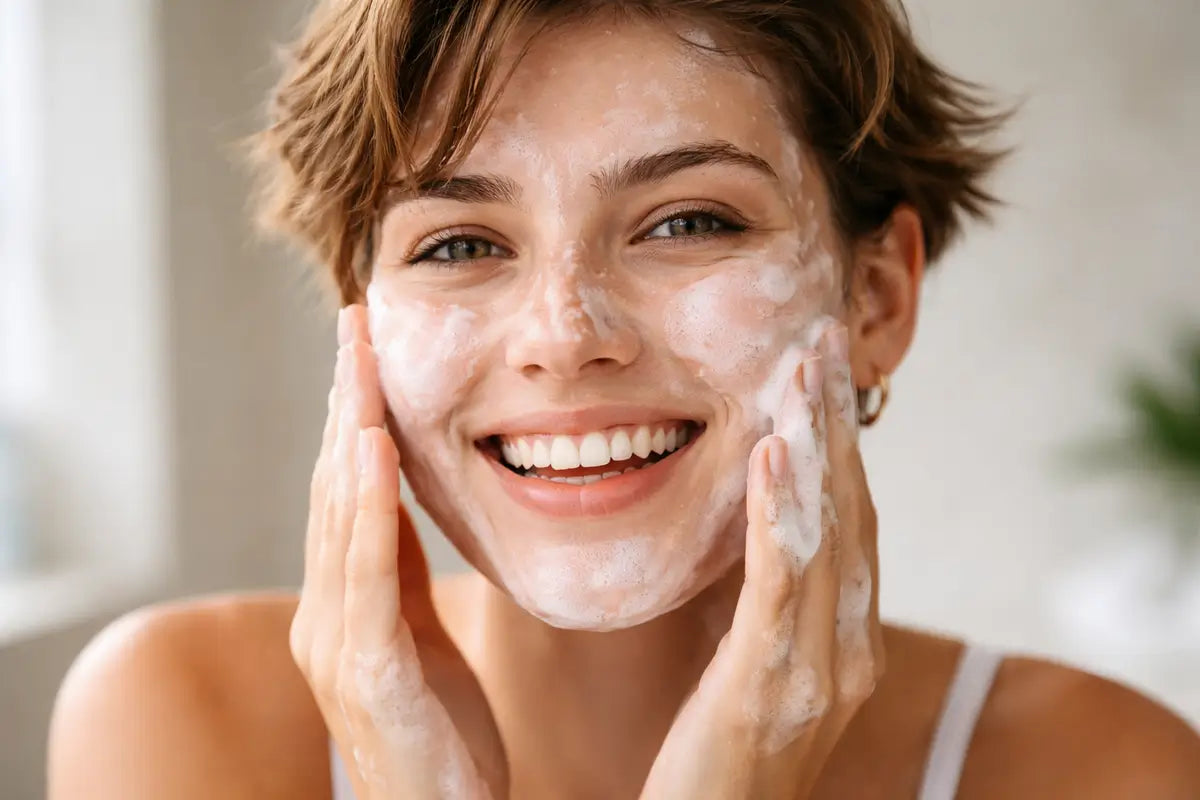
Facial cleansing is the foundation of skincare. It determines whether subsequent cosmetics will work effectively, whether the hydrolipid barrier remains intact, and whether the skin will respond calmly or begin to "defend itself" with overproduction of sebum, burning, or dryness.
One of the most common questions that arise when choosing a cleanser is: foam or gel – which is better? Does the formula matter? Is foam more gentle? Does gel cleanse more deeply?
The answer isn't a one-size-fits-all. It all depends on the ingredients, skin type, and the goal you're trying to achieve.
What is facial cleansing foam?
Facial cleansing foam is a cosmetic product that already has a foamy consistency in the packaging. Its light, fluffy texture makes application quick and pleasant, and the product spreads easily on the skin.

Contrary to popular belief, it is not the "foam" itself that determines the cleansing power, but the type of surfactants (cleansing substances) used .
The analyzed foam formula includes, among others:
- Caprylyl/Capryl Glucoside – a gentle, non-ionic glucoside
- Coco-Betaine – a soothing amphoteric surfactant
- Disodium Cocoyl Glutamate and Sodium Cocoyl Glutamate – amino acid cleansers
This is a very modern, gentle cleansing system. It contains no SLS, SLES, or aggressive anionic detergents.
Additionally, the composition includes:
- Panthenol – soothing and regenerative properties
- Biosaccharide Gum-1 – a soothing and moisturizing ingredient
- humectants: glycerin, propanediol
This means that the foam is not a “bare detergent”, but a cleansing and care cosmetic.
Why does my skin feel tight after cleansing my face?
What is facial cleanser?
The gel comes in a semi-liquid, thickened form (in this formula, thickened with xanthan gum, among other things). It often gives the impression of a more thorough, "deeper" cleanse, although this also depends on the composition.

The analyzed gel contains:
- Sodium Cocoamphoacetate – one of the mildest amphoteric surfactants
- Caprylyl/Capryl Glucoside
- Coco-Betaine
- Cocoyl Glutamate
The washing system is therefore equally gentle, and even more "dermatological".
What makes the gel special?
Presence of active ingredients:
- Gluconolactone (PHA) - gentle exfoliation, antioxidant effect
- Betaine - an osmoprotector that protects cells
- Inulin - a prebiotic that supports the microbiome
- extracts: date (Phoenix Dactylifera), Eclipta Prostrata, green tea leaf water
The gel not only cleanses, but also actively supports the skin.
Foam or gel - the most important differences
Consistency and feel
The foam is lightweight and ready to use immediately. The gel requires lathering in your hands, but it allows for greater control over the amount of product dispensed.
The power of cleansing
In these particular formulas, the cleansing power is comparable because both products rely on mild amino acid and amphoteric surfactants.
It's a myth that gel always cleanses more effectively.
Care
Here the gel has an advantage due to the presence of:
- PHA
- prebiotics
- antioxidant ingredients
The foam has a more comfortable and soothing effect.
Does facial cleansing foam dry out the skin?
It is not the form itself that dries, but the composition.
The presence of humectants, panthenol, and mild detergents in the foam analyzed reduces the risk of dryness. However, it contains a fragrance composition with potential allergens (including limonene and hexyl cinnamal), which may be significant for very sensitive skin.
Is facial wash gel better for sensitive skin?
In this particular formula, the gel has a slightly higher safety potential because:
- contains prebiotic (Inulin),
- contains PHA with a mild effect,
- does not contain fragrance allergens listed in the INCI (as in the foam).
For reactive skin with a compromised hydrolipid barrier, gel may be a safer choice.
Foam or gel and skin type
Dry skin
Avoiding harsh detergents and supporting the barrier are key. Both products are gentle, but the gel can further improve hydration thanks to PHA and betaine.
Oily skin
A stronger cleanse doesn't necessarily mean better results. Overly aggressive cleansing leads to sebum rebound. Both formulas are safe – the choice depends on your sensory preferences.
Sensitive skin
Here, the advantage is the gel with prebiotic and PHA.
Mature skin
Mature skin needs antioxidant support and gentle exfoliation – a gel will be more functional.
Is the form of a product more important than the composition?
NO.
This is the most important conclusion.
It is not the “foam” or “gel” that determines the effect, but:
- type of surfactants,
- presence of soothing ingredients,
- the presence of ingredients that support the microbiome,
- pH range (which with such surfactants is usually within the physiological range of 5–6).
Modern formulas based on amino acid detergents are designed so as not to disturb the skin's balance.
Can cleansing accelerate skin aging?
Yes – if it is too aggressive.
Disturbance of the hydrolipid barrier leads to:
- increase in TEWL (transepidermal water loss),
- microinflammation,
- activation of MMP enzymes responsible for collagen degradation.
Therefore, choosing a gentle cleansing product is not a matter of comfort, but of anti-aging prevention.
Can foam and gel work the same?
Yes – if they have a similar surfactant system.
In this case, both products are gentle. The difference lies in their degree of "caring" properties.
Foam = everyday comfort.
Gel = cleansing + microbiome support + gentle exfoliation.
How to choose the perfect facial cleanser?
- Check your surfactants – avoid strong SLS/SLES.
- Look for amino acid or amphoteric cleansing systems.
- Pay attention to the presence of soothing ingredients.
- Assess skin reaction after 7–10 days.
- Don't rely solely on form.
FAQ – Foam or gel facial cleanser?
Is foam better than gel?
There's no single answer. Foam is sensorially lighter, while gel may offer more active ingredients.
Does the gel cleanse more effectively?
Not always. It depends on the surfactants, not the consistency.
Does the foam clog pores?
No, if it contains light, watery ingredients and is well balanced.
Can the gel be used on sensitive skin?
Yes, especially if it contains mild surfactants and prebiotics.
Can I use the foam in the morning and the gel in the evening?
Yes – this is a good solution for combination skin.
Does cleansing affect the microbiome?
Yes. Too aggressive detergents can disrupt it.
Summary
The choice between facial cleansing foam and gel should not be based on fashion or trends, but on the analysis of the composition and needs of the skin.
If you are looking for:
- light, daily cleansing → foam will be perfect.
- more advanced skin support, microbiome and gentle exfoliation → gel will be a better choice.
However, the most important thing is that the product:
- does not disturb the hydrolipid barrier,
- worked in the physiological pH range,
- contained mild surfactants.
It is the quality of the formula, not the form of packaging, that determines the health of the skin.
We encourage you to visit the natural cosmetics section, where we comprehensively discuss the philosophy of modern care based on plant ingredients.