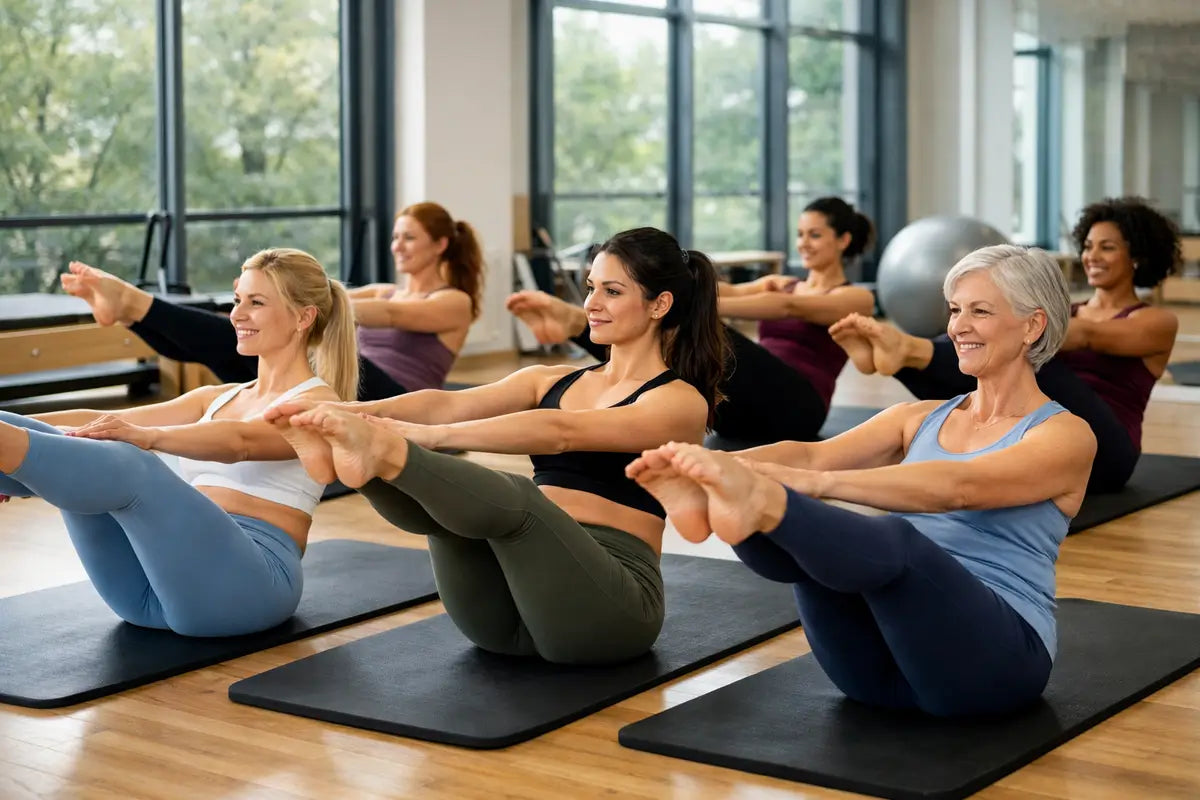
Pilates is one of those training methods that has experienced a true renaissance in recent years. Although it originated over a century ago, it's now reemerging as one of the most valued body and mind exercises. Models, actresses, and those seeking to take care of their bodies in a conscious, calm, and highly effective way practice Pilates in studios.
Unlike many intense fitness workouts, Pilates isn't about rapid calorie burning or dynamic movements. Its essence lies in precise work with the core muscles , controlled breathing, and complete awareness of movement. As a result, Pilates exercises strengthen the body from the inside out, improve posture, and help shape the body in a natural and harmonious way.
Regular Pilates practice also brings surprising benefits to the skin. Improved circulation, improved muscle tone, and stimulation of cellular metabolism make the skin firmer, more elastic, and better oxygenated . This is why Pilates is increasingly being included in body care and skincare therapies.
It's worth remembering that the best body benefits come from a combination of exercise and proper skincare . After a Pilates workout, the skin is warmed up, microcirculation is stimulated, and pores are more open. This is the perfect time to use cosmetics that support skin firmness and improve its tone.
Light, firming formulas are ideal for post-workout care. They absorb quickly and contain active ingredients that support skin regeneration. An example of such a product is the Orientana Japanese Sakura Firming Body Serum , which contains phytoretinol, caffeine, and niacinamide. The combination of these ingredients helps improve skin firmness and smooth its texture.
Firming the body skin - causes, methods, ingredients and effective care

In this article you will learn:
- what exactly is pilates
- what are the effects of regular exercise?
- does pilates help firm the body
- what pilates exercises are best for abs
- how to combine pilates with skin care
This is a complete guide for people who want to take care of their body holistically – through movement, regeneration and conscious care.
What is Pilates and where does this training method come from?
Pilates is an exercise system developed in the early 20th century by Joseph Pilates , a German trainer and anatomy enthusiast. Initially used primarily for rehabilitation, the method has since gained immense popularity in the worlds of sports, dance, and fitness.
Joseph Pilates created his method with the goal of strengthening the body and improving its function. He believed that a healthy body should be strong, flexible, and well-coordinated. He called his method Contrology because movement control plays a key role in it.
Today, Pilates is used both as a form of fitness training and as a method supporting rehabilitation and the prevention of back pain.
What is Pilates?
The basis of Pilates is working with the so-called deep muscles , which stabilize the spine and are responsible for correct body posture.
The most important principles of Pilates include:
concentration
Each movement should be performed consciously. Pilates requires focused muscle work and body control.
control
Movements are performed slowly and precisely, allowing muscles to work more effectively.
breath
Breathing plays a crucial role in Pilates. It helps stabilize the body and increases the effectiveness of the exercises.
fluidity of movement
Pilates exercises are calm and fluid, which reduces the risk of overexertion.
activation of deep muscles
The most important goal of Pilates is to activate the core muscles – i.e. the abdominal, back and pelvic muscles.
Why is Pilates so effective?
Pilates differs from many popular fitness workouts. It doesn't rely on intense movements or rapid calorie burning. Its strength lies in its precision and activation of core muscles , which are often overlooked in other forms of exercise.
Thanks to this, Pilates:
- strengthens muscles without excessively bulking up the figure
- improves spine stabilization
- increases muscle flexibility
- helps shape the figure
This is why Pilates is so popular among dancers, physiotherapists and people who want to take care of their spine health.
Pilates - what are the effects of regular exercise?
Regular Pilates practice brings many benefits to your body and health.
The most commonly noticed effects are:
improved posture
Pilates strengthens the back and abdominal muscles, making the figure more upright.
slimming the silhouette
Pilates exercises help shape the body and give it a slimmer appearance.
strengthening the abdominal muscles
Pilates is one of the best workouts for the core muscles.
greater body flexibility
Exercises improve mobility and range of motion in joints.
reduction of muscle tension
Pilates helps relax tense muscles, especially around the neck and back.
Pilates and skin condition
Although Pilates is mainly associated with muscle training, its effect on the skin is also very important.
During exercise:
- blood flow increases
- skin oxygenation improves
- accelerates cellular metabolism
Better circulation means that skin cells receive more nutrients, which supports regenerative processes.
Regular physical activity can also support the production of collagen and elastin , the proteins responsible for skin firmness.
Pilates and skin firmness
One of the most common reasons for starting Pilates training is to improve skin tone.
When muscles are stronger and more toned, skin also looks firmer. This is why people who practice Pilates regularly often notice improvements in the appearance of their abs, thighs, and buttocks.
But exercise alone isn't everything. Skin also needs proper care.
After training, it is worth using cosmetics that contain active ingredients that support skin regeneration and improve its firmness.
Cosmetics containing the following are great for body care after Pilates training:
- caffeine
- niacinamide
- phytoretinol
- moisturizing ingredients
Such ingredients are found, among others, in the Orientana Japanese Sakura firming body serum , which helps improve skin firmness and smooth its structure.
The light formula of the serum absorbs quickly, making it perfect for use after a workout or shower.
Pilates on reformers - why this workout is conquering the fitness and body shaping world
Pilates for Abs - Does It Really Work?
The abdominal muscles are one of the most important body parts in Pilates.
Unlike classic crunches, Pilates primarily activates the deep muscles that stabilize the spine and are responsible for correct posture.
Regular Pilates exercises can help:
- strengthen your abdominal muscles
- flatten your belly
- improve skin tone
The best pilates exercises for abs
The most popular Pilates abdominal exercises include:
hundred
One of the most popular Pilates exercises, it strengthens the abdominal muscles and improves core stability.
roll-up
An exercise that engages the abdominal muscles and improves spine flexibility.
leg circles
Helps strengthen the abdominal and hip muscles.
Plank Pilates
A variation of the plank performed in a Pilates style that engages the core muscles.
Pilates and cellulite
Cellulite is caused by, among other things, circulatory disorders and the accumulation of fat tissue.
Regular physical activity helps:
- improve circulation
- stimulate lymph flow
- increase fat burning
Pilates can therefore support cellulite reduction, especially when combined with proper skin care.
Pilates + body care - how to enhance the effects of exercise
The best effects on the skin are achieved by combining exercise, massage and cosmetic care .
After Pilates training, it is worth:
- take a warm shower
- perform a skin massage
- apply a firming cosmetic
Regular skin massage supports microcirculation and improves the absorption of active ingredients.
Firming cosmetics, such as Orientana Japanese Sakura body serum , can additionally support the improvement of skin firmness and smoothness.
Remember
Pilates is one of the most comprehensive bodywork methods. Regular exercise helps strengthen core muscles, improve posture, and slim the figure.
Pilates can also support improved skin firmness because it increases circulation and tissue oxygenation.
The best body benefits come from combining exercise with proper skincare. Applying firming products after exercise can further improve skin condition and elasticity.
Pilates for beginners - how to start practicing
Pilates is one of the safest forms of physical activity, which is why it's often recommended for those just beginning their journey with regular exercise. Unlike many dynamic fitness workouts, Pilates exercises are performed in a calm and controlled manner, reducing the risk of injury.
The most important thing in Pilates isn't the pace of the exercises, but the precision and control of the movements . Each exercise should be performed slowly, with full awareness of the muscles working. This is precisely why Pilates activates the core muscles responsible for body stabilization and correct posture.
People who begin practicing Pilates often notice the first results after just a few weeks. The most common changes include:
- improving body posture
- reducing tension in the back and neck
- slimming the silhouette
- greater muscle flexibility
Regular Pilates exercises also help strengthen the abdominal muscles and improve spine stabilization, which is especially important for people who lead a sedentary lifestyle.
How often to practice Pilates
To see the first results of Pilates, it's best to practice 3-4 times a week . After just a month of regular training, you'll notice improved muscle tone and greater body control.
If you're new to Pilates, it's a good idea to start with shorter sessions of around 20–30 minutes. Over time, you can increase your workouts to 45 minutes or an hour.
Regularity is also important. It's better to exercise regularly for shorter periods of time than to engage in high-intensity workouts only occasionally.
Pilates at home or in the studio
Pilates can be practiced both at home and in a professional Pilates studio.
Studio exercises have the advantage that the instructor can improve your technique. In Pilates, proper technique is crucial because it influences the effectiveness of the exercises.
Pilates at home, on the other hand, offers great flexibility and allows you to exercise whenever you have time. Many basic Pilates exercises require no equipment and can be performed on a mat at home.
The most common mistakes in Pilates
Although Pilates is a safe form of exercise, many people make mistakes that reduce the effectiveness of the exercises.
The most common of them are:
doing exercises too quickly
Pilates should be performed slowly and with control.
lack of concentration
In Pilates, it is very important to focus on muscle work.
neck and shoulder tension
During Pilates exercises, the body should be relaxed.
abnormal breathing
Breathing helps stabilize the body and increases the effectiveness of training.
Pilates at home - a simple workout plan
If you want to start practicing Pilates at home, you can start with a short set of exercises.
An example Pilates session might look like this:
- Hundred – Activation of the abdominal muscles
- Roll up – strengthening the abdomen and mobilizing the spine
- Leg circles – hip stabilization
- Plank pilates – core muscle activation
- Bridge – strengthening the buttocks and lower back
This set of exercises can be performed in about 20–30 minutes.
Pilates after weight loss – how to firm your body
After losing a significant amount of weight, skin often needs time to regain its elasticity. Pilates can be very helpful in these situations.
Pilates exercises strengthen the muscles beneath the skin, leaving the body feeling tighter and skin looking firmer.
Regular exercise can help:
- improve abdominal skin tension
- slim your waist
- strengthen the muscles of the buttocks and thighs
It's important to remember that skin regeneration after weight loss is a process that takes time. Exercise should be combined with proper skin care.
Pilates after pregnancy
Pilates is also very popular among postpartum women. The exercises help strengthen the abdominal and pelvic floor muscles.
Of course, before starting training after giving birth, it is worth consulting a doctor or physiotherapist.
Pilates can help:
- strengthen your abdominal muscles
- improve spine stabilization
- reduce back pain
Pilates and body firming after the age of 40
After the age of 40, many women notice their bodies begin to change. Skin may gradually lose firmness, metabolism slows, and muscles become weaker. These are natural age-related processes, but proper physical activity and skin care can significantly slow these changes.
Pilates is one of the best forms of exercise for women over 40. These exercises strengthen core muscles, improve posture, and help shape the body in a way that's gentle and safe for joints.
Pilates doesn't overload the body, so it can be performed by people of all ages. At the same time, it's extremely effective in improving muscle tone, which has a direct impact on the appearance of the skin.
Why does skin lose firmness after the age of 40?
Changes in the appearance of the skin are primarily related to biological processes occurring in the body. With age, the production of collagen and elastin—proteins responsible for skin elasticity and firmness—decreases.
Additionally, factors such as:
- slower regeneration of skin cells
- reducing estrogen levels
- loss of muscle mass
- deterioration of microcirculation
All this means that the skin may become less taut and the silhouette may lose its former elasticity.
Regular physical activity is one of the most important elements in counteracting these changes.
How Pilates affects body firmness
Pilates works the body in several key areas that are especially important after the age of 40.
First, it strengthens the core muscles. Strong muscles provide natural support for the skin, making the body appear firmer and more elastic.
Secondly, Pilates improves blood and lymph circulation. Better circulation means better tissue oxygenation and more effective delivery of nutrients to skin cells.
Third, Pilates exercises help improve posture. An upright posture makes the abdomen firmer and the body appear slimmer.
Pilates as a body shaping workout
Many women over 40 are looking for physical activity that will improve their appearance without being too intense. Pilates is an ideal solution because it strengthens muscles without overly bulking up the figure.
Regular Pilates exercises can help:
- improve abdominal skin tension
- strengthen the buttock muscles
- slim your waist
- improve the appearance of thighs
As a result, the body becomes more harmonious and the skin looks firmer.
Why skincare is important after training
After the age of 40, skin also needs proper care. Exercise itself improves body condition, but cosmetics can also support skin regeneration.
After a Pilates workout, the skin is warmed up and better absorbs the active ingredients in cosmetics. Therefore, it's worth reaching for products that support skin firmness.
Cosmetics containing the following are good for body care after exercise:
- caffeine
- niacinamide
- phytoretinol
- moisturizing ingredients
These ingredients are found in Orientana's Sakura Japońska body serum , which helps improve skin firmness and smooth its texture. Its light consistency makes it quickly absorbed and convenient for post-workout use.
A holistic approach to a firm body after 40
The best effects on the body are achieved by combining several elements:
- regular physical activity
- skin massage
- cosmetic care
- healthy diet
- proper regeneration
Pilates fits perfectly into this holistic approach to body care.
Pilates + anti-cellulite massage – an effective combination for a firm body
Cellulite is one of the most common aesthetic skin problems. It affects most women and can appear even in slim individuals.
The formation of cellulite is related to several factors, including:
- circulatory disorders
- accumulation of fatty tissue
- water retention in the body
- weakening of connective tissue
One of the best ways to improve the appearance of your skin is to combine physical activity with massage.
Why Pilates Helps Fight Cellulite
Pilates improves muscle function and blood and lymph circulation. During exercise, muscles work rhythmically, which promotes fluid flow throughout the body.
Better circulation helps remove waste products from tissues and may reduce the appearance of cellulite.
Regular Pilates exercises can help:
- improve skin tone
- increase tissue elasticity
- stimulate microcirculation
- improve cellular metabolism
Anti-cellulite massage – why is it so effective?
Anti-cellulite massage works primarily by stimulating circulation and lymph flow.
During massage, the skin and subcutaneous tissues are intensively stimulated, which may contribute to:
- reducing swelling
- improving skin tension
- smoothing its structure
Regular skin massage also helps improve the absorption of active ingredients contained in cosmetics.
How to combine pilates with anti-cellulite massage
The best results can be achieved when Pilates and massage are used regularly.
An example care ritual might look like this:
- 30–40-minute Pilates workout
- a warm shower to stimulate circulation
- massage of the skin of the thighs, buttocks and abdomen
- application of a firming cosmetic
After training, muscles are warmed up and circulation is stimulated, so skin massage can be particularly effective.
Cosmetics supporting anti-cellulite massage
During the massage, it is worth using cosmetics containing active ingredients that support the improvement of skin firmness.
The most commonly used ingredients include:
- caffeine
- niacinamide
- moisturizing ingredients
- plant extracts
A cosmetic that works well in this type of skincare ritual is Orientana's Sakura Japońska Body Serum . Its light consistency makes it suitable for use both after a workout and during a skin massage.
Regular use of firming cosmetics combined with physical activity and massage can significantly improve the appearance of the skin and its elasticity.
Why regularity is key
When it comes to fighting cellulite, consistency is key. A one-time massage or workout won't yield dramatic results.
The best results will be seen when:
- Pilates is performed several times a week
- skin massage is performed regularly
- firming cosmetics are used daily
This combination has a multifaceted effect – it strengthens muscles, improves circulation and supports skin regeneration.
Post-pilates care ritual
After a Pilates workout, the body is warmed up and blood circulation is stimulated. It's the perfect time to take care of your skin.
A simple post-exercise skincare ritual might look like this:
- warm shower – helps relax muscles and cleanse the skin
- short skin massage – stimulates circulation
- use of a firming cosmetic
Light cosmetics with a gel consistency are great for post-workout care as they absorb quickly and don't leave a sticky feeling.
One such product is the Orientana Japanese Sakura body serum , which contains ingredients that support the improvement of skin firmness, such as phytoretinol, caffeine and niacinamide.
Regular use of firming cosmetics combined with physical activity can help improve the appearance of the skin and its elasticity.
Pilates as an element of holistic body care
More and more people treat Pilates not only as a workout, but as a lifestyle element.
The combination of exercise, skin care, and regeneration makes the body function better and the skin look healthier.
Holistic body care includes:
- regular physical activity
- proper skin care
- massage
- a healthy diet
- regeneration and sleep
Pilates fits perfectly into this style of body care.
Summary
Pilates is a training method that combines bodywork and conscious movement. Regular exercise helps strengthen core muscles, improve posture, and slim the figure.
Pilates can also help improve skin firmness by increasing circulation and tissue oxygenation. However, the best results come from combining physical activity with proper skin care.
Firming cosmetics, such as Orientana Japanese Sakura body serum , can support skin regeneration and improve its firmness, especially when used regularly after training.
FAQ - Pilates
1. What is Pilates?
Pilates is an exercise method that strengthens deep muscles, improves posture and body stabilization.
2. Does Pilates help you lose weight?
Pilates supports the weight loss process by strengthening muscles and improving metabolism.
3. Does Pilates firm the body?
Yes, Pilates strengthens muscles and improves skin tone.
4. How often to practice Pilates
Ideally 3-4 times a week.
5. Is Pilates good for beginners?
Yes, Pilates is a safe form of activity.
6. Does pilates help with abdominal pain?
Pilates strengthens the abdominal muscles and helps slim the waist.
7. Can Pilates be practiced at home?
Yes, many Pilates exercises can be performed on a mat.
8. Does Pilates help with cellulite?
Regular exercise improves circulation and can help reduce cellulite.
9. How long does a Pilates training last?
Typically 30–60 minutes.
10. Is Pilates good for the spine?
Yes, Pilates strengthens the muscles that stabilize the spine.
11. Does Pilates Build Muscle?
Pilates strengthens muscles, but does not cause them to become excessively large.
12. Does Pilates improve posture?
Yes, it strengthens the back and abdominal muscles.
13. Is Pilates good after pregnancy?
Yes, provided you consult your doctor.
14. Does Pilates help with back pain?
Regular exercise can reduce muscle tension and improve spinal stabilization.
15. Can Pilates be practiced every day?
Yes, if the training is moderate.
16. Does Pilates burn calories?
Yes, although it is a moderate workout in terms of calorie burning.
17. Does Pilates improve flexibility?
Yes, exercise increases your range of motion.
18. Is Pilates good for women?
Yes, Pilates is very popular among women.
19. Does Pilates strengthen the buttocks?
Yes, many Pilates exercises engage the gluteal muscles.
20. Can Pilates be practiced without equipment?
Yes, most exercises are performed on a mat.
21. Does Pilates help with stress?
Yes, Pilates combines movement with breath control.
22. Does Pilates improve circulation?
Physical activity supports blood and lymph flow.
23. Does pilates help with a flat stomach?
Regular exercise can flatten your stomach.
24. Is Pilates difficult?
Basic exercises are relatively easy.
25. Does Pilates improve balance?
Yes, it strengthens the muscles that stabilize the body.
26. Can Pilates be practiced in the morning?
Yes, many people practice Pilates in the morning.
27. Can Pilates be practiced in the evening?
Yes, evening Pilates helps relax the body.
28. Does Pilates help with tight muscles?
Yes, exercise helps loosen them up.
29. Does Pilates improve mobility?
Yes, it increases the range of motion in the joints.
30. Does pilates help with firm skin?
Better circulation can improve skin condition.
31. Does pilates help after weight loss?
Yes, it can help improve skin firmness.
32. Does Pilates improve your figure?
Regular exercise shapes the body.
33. Is Pilates safe?
Yes, if the exercises are performed correctly.
34. Does pilates help with neck pain?
It can reduce tension in the neck muscles.
35. Does Pilates strengthen the spine?
Yes, by activating stabilizing muscles.
36. Is Pilates good for older people?
Yes, it is a gentle form of activity.
37. Does Pilates help with back tension?
Yes, it helps relax muscles.
38. Does Pilates improve your well-being?
Yes, movement and breathing improve your mood.
39. Can Pilates be combined with other training?
Yes, it complements other activities well.
40. Does Pilates improve body condition?
Yes, it strengthens muscles and improves stability.