
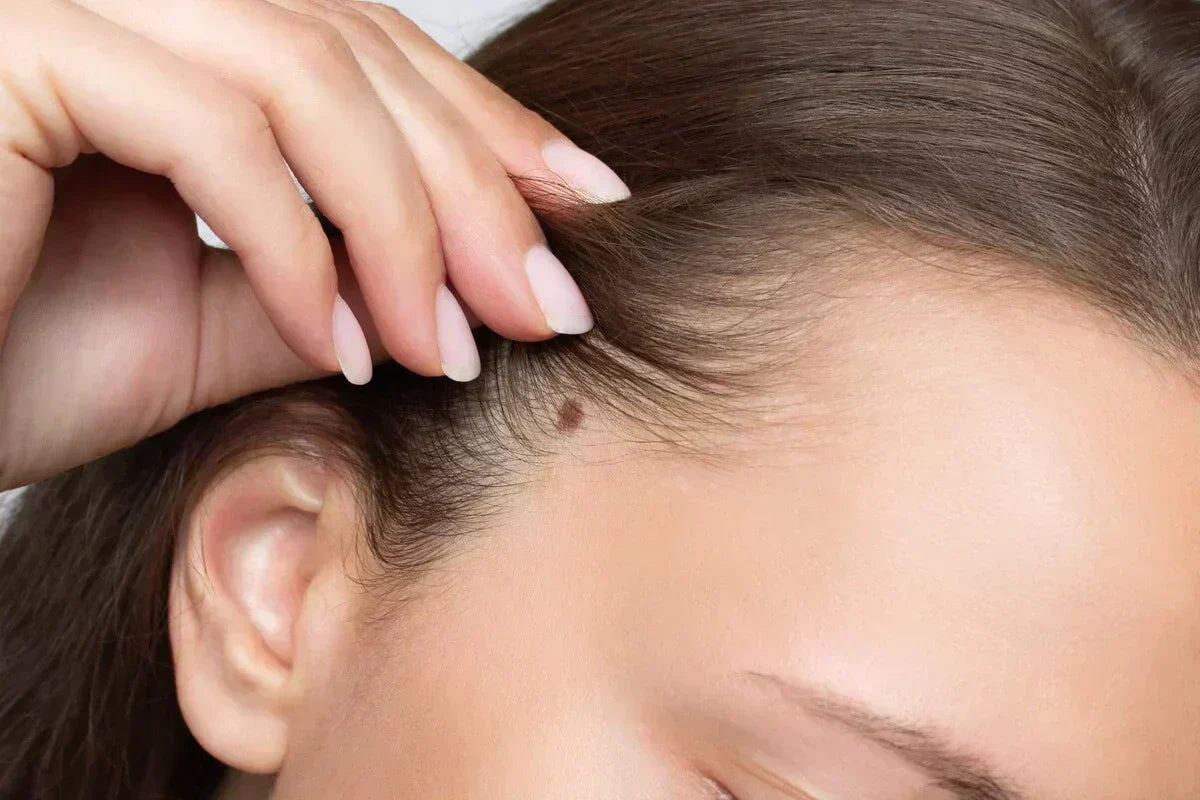
Moles are one of the most common skin lesions. Most of us have a dozen, dozens, or even over a hundred. They are usually completely harmless, consisting merely of clusters of melanocytes—pigment cells. They can be flat, raised, lighter or darker, and their appearance can change throughout our lives.
At the same time, moles are an element that shouldn't be ignored . Some moles can develop into melanoma—one of the most aggressive skin cancers, which, when detected early, is almost 100% curable . Therefore, education about moles, their monitoring, and prevention are key elements of skin health care.
In this comprehensive guide, I present complete knowledge about moles:
- what they are and where they come from,
- what are their types,
- how to distinguish a benign mole from a disturbing one,
- how the ABCDE rule works,
- when a mole requires a quick dermatological examination,
- what does diagnostics look like in the office,
- what removal methods are safe,
- how to care for skin with moles,
- how to protect yourself from UV to reduce the number of new lesions.
This is an educational article intended for people who want to better understand their skin and take care of their health in a wise, conscious way.
Contents
- What is a mole?
- Types of moles and pigmented birthmarks
- Are moles normal?
- When is a mole harmless?
- Symptoms that require attention: the ABCDE rule
- How to start observing moles at home?
- Mole and melanoma - what should worry you?
- What increases the risk of skin cancer?
- Moles in children - what is normal and what needs checking?
- How does a dermatologist examine moles?
- Dermatoscopy and videodermatoscopy - the gold standard
- Can moles be removed?
- Mole removal: surgical, laser, electrocoagulation
- Mole and irritation - hair removal, friction, injuries
- Can a mole hurt?
- Mole on the face - how to care for it?
- Natural care for skin with moles
- Photoprotection - the key to prevention
- Frequently asked questions about moles
What is a mole?
A mole, or melanocytic nevus, is a cluster of melanocytes—cells that produce melanin, the skin pigment. It forms when melanocytes accumulate in one area instead of being evenly distributed.
Moles can appear:
- congenital - present from birth or appearing in the first months of life,
- acquired - appear with age, usually under the influence of hormones or UV radiation.
It's completely natural: most people develop new moles throughout their lives, especially during puberty, pregnancy, and intense sun exposure.

Types of moles and skin tags
Flat moles
They are usually uniform in color and non-protruding. They may be so delicate that they are difficult to detect by touch.
Raised moles
These lumpy lesions are usually benign. However, they can become irritated at the points of friction.
Atypical (dysplastic) nevi
The color is uneven and the shape irregular. Such moles require monitoring, as they are more likely to develop into melanoma than typical moles.
Pigmented moles
They contain no melanin; they are light and flesh-colored. They can easily be confused with a wart.
Vascular birthmarks (colloquially "red moles")
They are not moles in the classic sense (they do not involve melanocytes). They arise from blood vessels and are called ruby hemangiomas.

Are moles normal?
Yes, having moles is absolutely natural. Statistically:
- most adults have about 10-40 moles ,
- people with fair skin usually have more of them,
- the number of moles increases after exposure to the sun.
However, it is important to monitor moles because a lesion that was previously benign may start to behave differently.
When is a mole harmless?
A mole is usually benign if:
- has a regular shape ,
- the color is uniform,
- does not change over time,
- it doesn't hurt, it doesn't itch, it doesn't bleed,
- does not grow at a rapid pace,
- is symmetrical.
This change can remain on the skin for life without any health consequences.
Symptoms that require attention: the ABCDE rule
The ABCDE rule is the most effective method for home mole assessment:
A - Asymmetry
If a mole is not symmetrical – for example, one half is different from the other – this may be an alarm signal.
B - Border
A disturbing mole has ragged, irregular, or blurred edges .
C - Color
Variable, mixed colors: black, brown, red, white in one mole is a signal to check.
D - Diameter
A lesion larger than 6 mm may require observation, although many melanomas are smaller.
E - Evolution
The most important point.
If a mole changes , grows, darkens, brightens, bulges or causes discomfort - react.

How to start observing moles at home?
- Take pictures of your moles every few months - with a ruler next to them.
- Pay particular attention to moles: new, unusual, and in hard-to-see places.
- If you have a lot of moles, consider videodermatoscopy every 6–12 months.
It's not about obsessive control, but about consciously monitoring your skin.
Mole and melanoma - what should worry you?
Melanoma is a cancer that develops from melanocytes. It can develop from a mole , but it can also develop on healthy skin .
Symptoms that may indicate the development of melanoma:
- rapid growth of a mole,
- change of color, appearance of new colors,
- itching or pain,
- cracking, bleeding, oozing,
- lifting the central part of the mole,
- formation of a "crown" of pigmentation around the mole.
Early diagnosis makes a huge difference: melanoma detected at an early stage is almost completely curable.
What increases the risk of skin cancer?
- fair skin, phototype I–II,
- frequent sunburns, especially in childhood,
- sunbathing, using a solarium,
- a large number of atypical moles,
- melanoma in the family,
- weakened immunity,
- intense tanning in countries with strong UV.
Moles in children - what is normal?
Children often have many moles, most appearing between the ages of 2 and 10.
Monitor moles if:
- they grow fast,
- they have an unusual shape,
- the child scratches or reports pain,
- the mole often rubs against clothing.
In newborns, congenital moles require evaluation by a dermatologist, especially if they are large.
How does a dermatologist examine moles?
Inspection of the skin
The dermatologist assesses the location, color, shape and number of moles.
Dermatoscopy
A special magnifying device (10-20×) allows you to assess the structure of the mole.
It is a painless and quick procedure.
Videodermatoscopy
Creates a digital map of the body.
It allows you to compare moles year over year, detecting the slightest changes.
Biopsy/surgical removal
When a lesion is suspicious, the dermatologist orders surgical removal and histopathological examination.
Can moles be removed?
Yes, moles can be removed, but not all of them can be removed using "aesthetic" methods. The most important rule:
Any mole that looks suspicious is removed surgically, not with a laser.
Surgical removal
The safest, it allows for histopathological examination.
Laser mole removal
Only lesions that are benign, non-pigmented and confirmed to be non-life-threatening.
Electrocoagulation or cryotherapy
For the removal of warts, fibromas, and non-pigmented moles.
Mole and irritation - hair removal, friction, injuries
Raised moles may become damaged.
Particularly vulnerable places:
- bra line,
- groin,
- armpits,
- beard while shaving,
- scalp when combing.
If the mole is frequently rubbed or hair removal causes bleeding, a dermatologist may recommend its preventive removal.
Can a mole hurt?
The mole itself usually does not hurt .
Pain can mean:
- inflammation,
- trauma,
- infection,
- or - less frequently - a neoplastic process.
Any painful, suddenly tender mole requires evaluation by a dermatologist.
Mole on the face - how to care for it?
The face is an area particularly exposed to UV radiation.
Rules:
- daily SPF 50,
- gentle care without strong acids for moles,
- avoiding mechanical peeling in the area,
- regular check-ups, especially for moles around the nose, cheeks and temples.
Natural care for skin with moles
Skin with moles requires caution, but does not limit care.
Recommended ingredients:
- aloe – soothes and moisturizes,
- panthenol – accelerates regeneration,
- niacinamide – supports the proper barrier,
- Asian pennywort (CICA) – has a calming effect.
Avoid direct application of strong AHA/BHA acids to moles and abrasive peels in the area.
Photoprotection - the key to prevention
UV radiation is one of the main factors in the development of melanoma and the appearance of new moles.
Protection rules:
- SPF 50 every day, regardless of the weather,
- reapplication every 2–3 hours in summer,
- hat, glasses, UV clothing,
- avoiding the sun between 11:00 a.m. and 4:00 p.m.,
- total ban on solariums.
Regular photoprotection reduces the risk of skin cancer and slows the appearance of new moles.
Frequently asked questions about moles
Can any mole turn into melanoma?
No. However, any mole can , so observation is key.
Can a mole disappear?
Yes, some moles fade and disappear with age.
Can a mole be scratched?
No, irritation increases the risk of infection and lesions.
Can a mole be covered with makeup?
Yes, if it is not irritated.
Can moles be removed in summer?
You can, but UV protection must be doubly careful.
Is tanning dangerous for moles?
Yes, UV increases the risk of cancer.
Can a mole hurt?
If it hurts, contact a dermatologist.
Is a growing mole always dangerous?
Not always, but it always requires evaluation .
A mole is a normal skin feature; most are completely benign. However, careful observation can save your health and even your life. The key is:
- remembering the ABCDE rule,
- regular self-examination and comparison photos,
- UV protection,
- dermatological examinations once a year,
- responding to any change in the appearance of a mole.
Awareness is the best prevention. By taking care of your skin, you take care of your safety—wisely, consistently, and with the utmost care for your health.