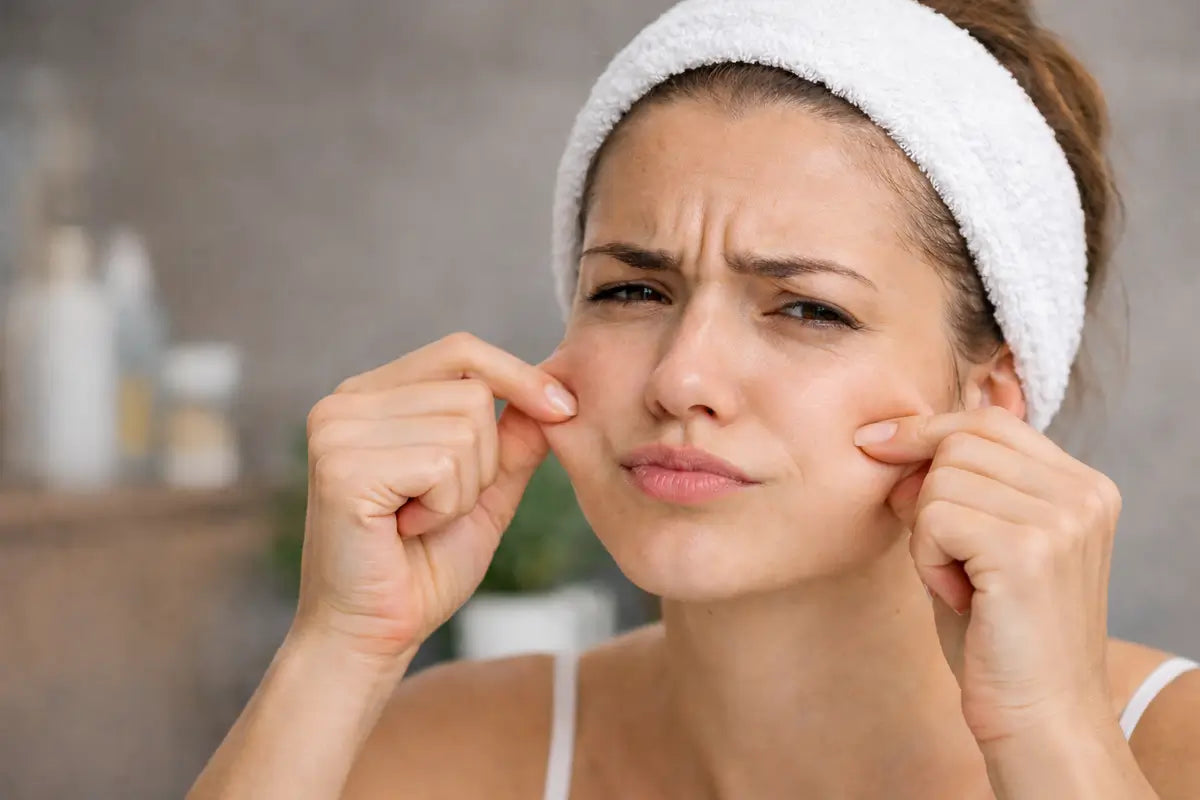
A feeling of tightness after washing your face is one of the most common signs that something in your skincare routine isn't working properly. Many people consider tight, "squeaky" skin to be evidence of effective cleansing. However, in cosmetology, it's a symptom of a compromised hydrolipid barrier and increased transepidermal water loss (TEWL).
If after washing your skin:
- bakes,
- is tense,
- reacts with redness,
- quickly becomes greasy,
- looks gray and tired,
it is very possible that the cleansing is too aggressive.
This article will show you why this happens and how to fix it.
Check out natural and effective facial cleansing cosmetics .
What is the hydrolipid barrier and why does cleansing disrupt it?
The hydrolipid barrier is a protective layer composed of:
- lipids (ceramides, cholesterol, fatty acids),
- natural moisturizing factor (NMF),
- skin microbiome.
Her tasks:
✔ preventing water loss
✔ protection against microorganisms
✔ neutralization of environmental factors
✔ regulation of skin reactivity
Every cleansing process interferes with this structure. The question is: do we do it gently or destructively?
Should skin feel tight after washing?
NO.
Properly cleansed skin is:
- clean,
- comfortable,
- flexible,
- without the feeling of "tightness".
Feeling tense means:
- removing too much lipid,
- increase in TEWL,
- pH disturbance,
- temporary destabilization of the microbiome.
If the tension persists for more than a few minutes, the cleansing is too strong.
How to care for the hydrolipid barrier.
TEWL - What Does Science Say About Overly Aggressive Face Washing?
TEWL (Transepidermal Water Loss) is a parameter that determines the amount of water that escapes through the epidermis.
Dermatological studies show that anionic detergents (e.g. SLS):
- increase TEWL,
- reduce the integrity of the stratum corneum,
- cause microdamage to lipids.
Chronic elevation of TEWL leads to:
- dryness,
- hyperreactivity,
- activation of inflammatory processes,
- accelerated aging.
7 Cleansing Mistakes That Damage Your Skin's Barrier
Too strong cleansing gel
If your skin “squeaks” after washing, it is a sign that the formula removes not only impurities but also natural lipids.

For sensitive skin, a safer option is a mild product, e.g.
Orientana Gentle Date + Inulin facial cleansing gel , which combines cleansing with prebiotic action.
Inulin supports the microbiome, and date extract has a moisturizing and smoothing effect.
You can also choose a delicate moisturizing foam with panthenol.

Washing your face with hot water
Hot water:
- dissolves lipids,
- dilates vessels,
- intensifies dryness.
The optimal temperature is lukewarm water.
No two-step purification
UV filters and makeup are lipophilic.
Without the first stage (oil):
- SPF residues remain in the pores,
- inflammation occurs,
- the risk of blackheads increases.
The first step could be, for example:
Orientana Makeup Removal Oil .

Washing too often
More than 2-3 times a day:
- destabilizes the microbiome,
- increases reactivity,
- increases oiliness.
Skipping toning
After washing, the skin's pH may temporarily increase.
No tonic:
- delays the reconstruction of the barrier,
- promotes irritation.
This step checks
Orientana Revitalizing toning lotion that combines toning with hydration (gluconolactone + rice proteins).

Excessive exfoliation
Daily exfoliation:
- damage the stratum corneum,
- enhance MMP,
- accelerate aging.
Expecting "squeaky clean"
It's a myth.
Healthy skin has a thin lipid layer.
Its complete removal = discomfort and accelerated aging.
Can cleansing cause acne?
Yes, if it's too aggressive.
The skin defends itself by overproducing sebum.
Excess sebum + microdamage to the barrier = inflammation.
Can cleansing accelerate aging?
Yes.
Chronic barrier disruption:
- activates metalloproteinases (MMPs),
- degrades collagen,
- increases oxidative stress.
Gentle cleansing is an element of anti-aging prevention.
Is tonic really necessary?
Yes, especially for sensitive skin.
Restores pH and supports regeneration.
Tonic-essence additionally:
- gently exfoliates (gluconolactone),
- supports NMF,
- strengthens the barrier.
Does the oil clog pores?
No, if it is washed off properly in the second step.
OCM does not increase the risk of blackheads if you use the gel after it.
Is washing your face in the morning necessary?
Yes, but mild.
At night, the skin produces sebum and cellular metabolites.
In the morning, a gentle gel is enough.
Cleansing and the skin microbiome
Too strong detergents:
- reduce beneficial bacteria,
- increase the colonization of pathogens,
- aggravate acne and sensitivity.
Prebiotic ingredients (e.g. inulin) support the balance of microflora.
What should a proper routine look like?
Evening:
- Oil
- Gentle gel
- Tonic / tonic-essence
- Serum
- Cream
In the morning:
- Light gel
- Tonic
- Serum
- Cream
Signs that your cleansing is harming your skin
- baking
- download
- peeling
- rapid greasing
- new imperfections
If they occur - change your routine.
Summary
Cleansing is the foundation of healthy skin.
It's not about "power," it's about balance.
Gentle, two-step cleansing + toning + microbiome support = less irritation, less acne, slower aging.
For more information on how natural care works and how to choose cosmetics according to your skin's needs, please visit our dedicated natural cosmetics section.