
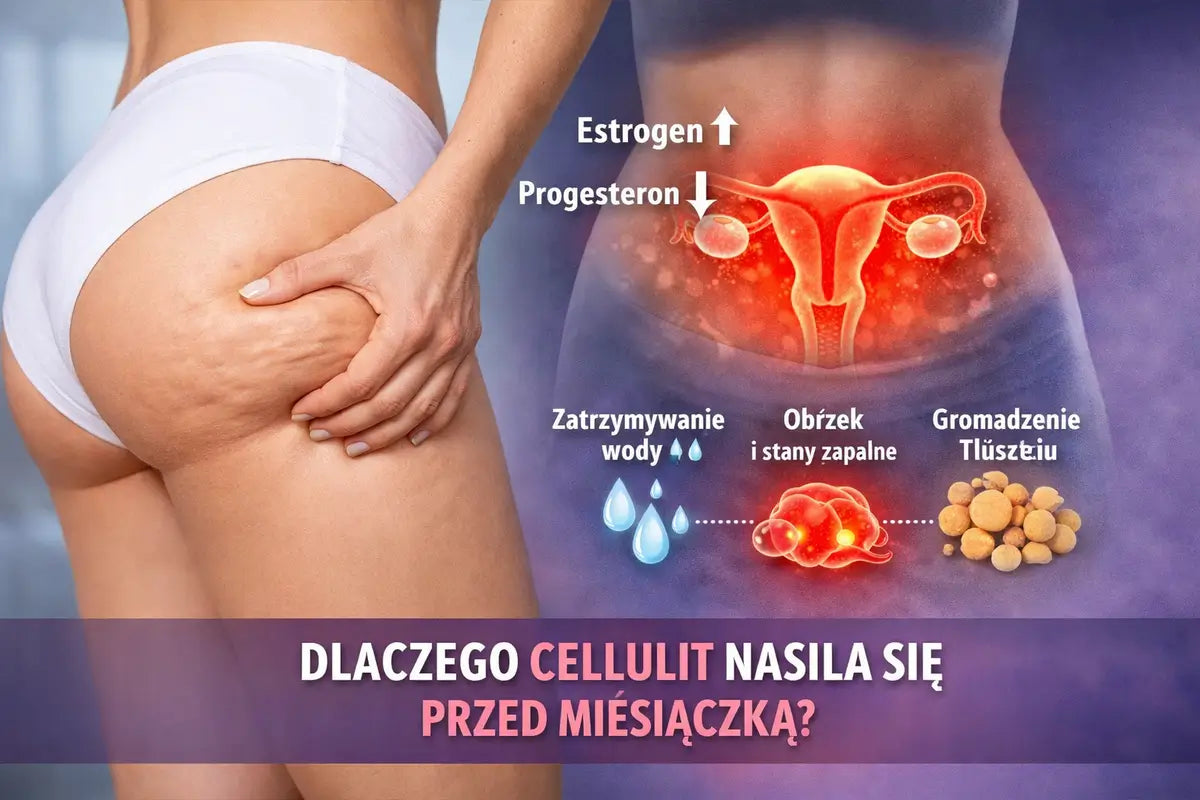
Cellulite is not just an aesthetic problem; it's a complex phenomenon involving adipose tissue, fibrous septa, microcirculation, and hormonal balance. Many women notice that cellulite becomes more visible before menstruation – the skin appears swollen, less firm, and the "orange peel" texture is more pronounced.
Is this an illusion?
No. It's physiology.
In the second half of the menstrual cycle, hormonal changes occur that affect:
- water retention,
- vessel permeability,
- connective tissue tension,
- fibroblast activity,
- lymphatic drainage.
This article is a complete, expert guide – explaining biological mechanisms, referencing collagen, MMPs, microcirculation, and estrogens, and providing a practical skincare strategy.
What exactly is cellulite?
Cellulite (female lipodystrophy) is a structural change within the subcutaneous tissue, consisting of:
- adipocyte hypertrophy,
- fibrosis of collagen septa,
- microcirculation disorders,
- lymphatic stagnation,
- chronic micro-inflammation.
It affects 80-90% of women after puberty and is strongly dependent on estrogen activity.
Cycle phase and cellulite – what happens in the body?
The menstrual cycle is divided into:
- Follicular phase (after menstruation)
- Ovulation
- Luteal phase (7-10 days before menstruation)
It is the luteal phase that is responsible for the intensification of cellulite.
Progesterone - the water-retaining hormone
In the second half of the cycle, progesterone levels rise.
Progesterone:
- increases sodium retention,
- increases vessel permeability,
- promotes swelling,
- slows down lymphatic drainage.
The effect?
Tissues "swell," and fat cells increase in volume. Fibrous septa become more visible on the skin's surface.
Decreased estrogen and connective tissue
Estrogen:
- supports collagen synthesis,
- improves vessel elasticity,
- protects against extracellular matrix degradation.
During the luteal phase, there is a relative decrease in estrogen, which affects:
- reduced skin tension,
- increased susceptibility to edema,
- increased activity of metalloproteinases (MMPs).
MMPs - enzymes accelerating collagen degradation
Matrix metalloproteinases (MMPs) are responsible for the breakdown of collagen and elastin.
Hormonal fluctuations can:
- intensify their activity,
- worsen the quality of the collagen septum,
- increase skin laxity.
This does not mean that cellulite "forms" in a week, but its structure becomes more visible.
Microcirculation and lymph stagnation
Cellulite is largely a circulatory-lymphatic problem.
Before menstruation:
- vessels are more permeable,
- intercellular fluid accumulates in tissues,
- lymph drains more slowly.
This causes:
- a feeling of heavy legs,
- swelling of the thighs and buttocks,
- deepening of the "dimpling."
Water retention - even +2 kg
In the luteal phase, a woman can retain 1-2 kg of water.
Increased volume:
- compresses fibrous septa,
- potentiates irregularities,
- intensifies edematous cellulite.
After menstruation begins, excess water is removed – which is why cellulite often "magically" diminishes.

Does cellulite actually worsen before menstruation?
Most often, there is no permanent worsening of the structure.
This is a temporary intensification of symptoms related to:
- swelling,
- changes in skin tension,
- lymph stagnation.
Does cellulite before menstruation mean hormonal disorders?
No.
It's a physiological response to progesterone and a drop in estrogen.
Can this phenomenon be completely eliminated?
Natural hormonal fluctuations cannot be turned off.
However, you can:
- reduce water retention,
- improve microcirculation,
- support collagen synthesis,
- reduce low-grade inflammation.
Skincare strategy 7 days before menstruation
Massage and lymphatic drainage
Regular massage provides the strongest effect.
Massage:
- improves lymph flow,
- reduces swelling,
- oxygenates tissues,
- increases penetration of active ingredients.
Cosmetics supporting microcirculation
Ingredients worth noting:
- caffeine
- bladderwrack
- butcher's broom
- Sichuan pepper

Sodium restriction
Less salt = less retention.
More water
Paradoxically – dehydration intensifies fluid retention.
Movement
30 minutes of walking:
- improves lymph flow,
- reduces stagnation,
- supports fat burning.
Does diet affect cellulite before menstruation?
Yes.
High glycemic index:
- increases inflammation,
- intensifies swelling,
- promotes collagen glycation.
Does stress worsen cellulite?
Yes.
Cortisol:
- increases sodium retention,
- intensifies fat deposition,
- affects collagen degradation.
Does supplementation help?
It won't replace massage and exercise, but it can support:
- vitamin C - collagen synthesis
- magnesium - reduction of swelling
- omega-3 - anti-inflammatory action
Scientific summary
Cellulite intensifies before menstruation because:
- Progesterone increases water retention.
- Estrogen levels, which support collagen, decrease.
- Microcirculation slows down.
- Vessel permeability increases.
- Subcutaneous tissue swelling occurs.
This is a reversible and physiological process.