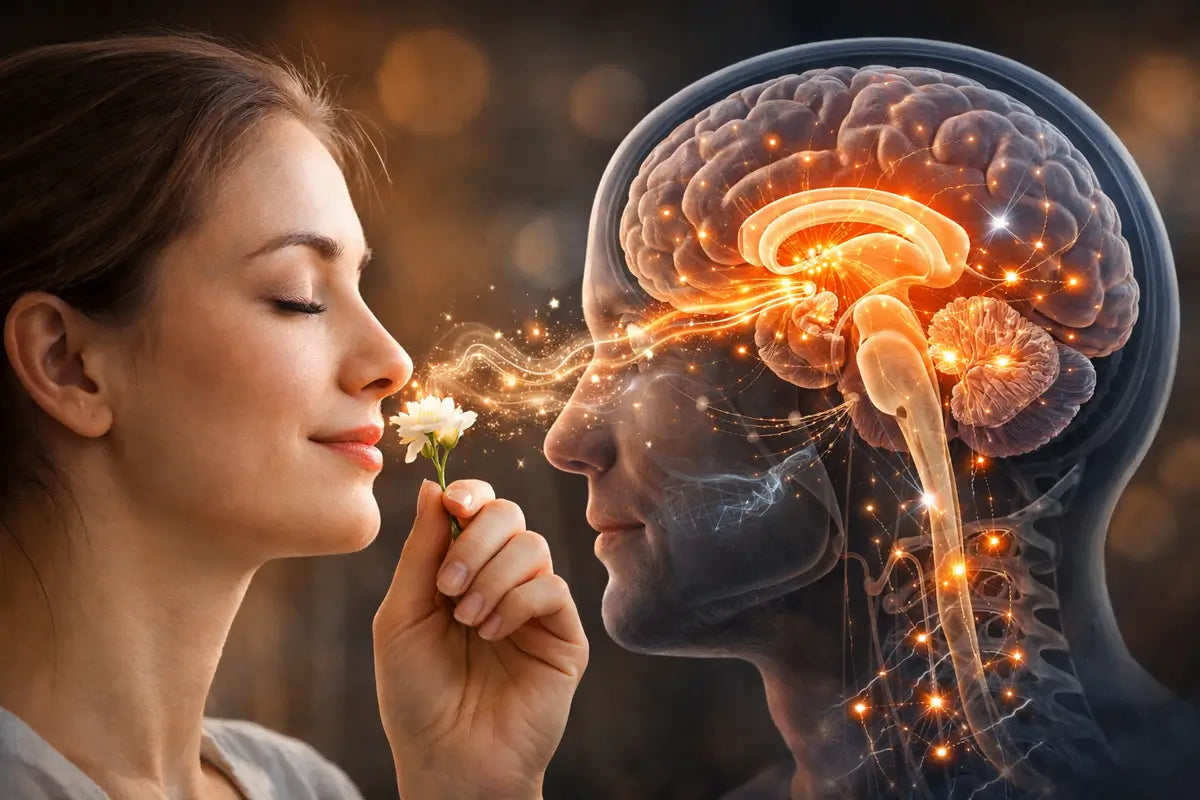
Smell and the limbic system constitute one of the most direct connections between the external world and our emotions. Unlike sight or hearing, olfactory stimuli reach almost directly the structures responsible for memory and emotional responses. Therefore, an aroma can instantly evoke a long-ago memory, evoke a sense of security, or evoke a sense of tension.
This article explains how the sense of smell works, what the limbic system is, and why smell so strongly influences our decisions – including purchasing ones.
What is the limbic system?
The limbic system is a set of brain structures responsible for emotions, memory, motivation, and stress responses. It includes:
- amygdala
- hippocampus
- hypothalamus
- cingulate gyrus
It is these areas that respond when we feel threat, pleasure, nostalgia or stress.
Is the limbic system responsible for emotions?
Yes. The amygdala processes emotional stimuli—especially those related to fear and safety. The hippocampus stores situational context and memories. Therefore, emotions and memory are closely linked.

How does the sense of smell work?
The process of smell perception is faster than most other sensory stimuli.
- Odor molecules reach the olfactory epithelium in the nose.
- Olfactory receptors convert them into nerve impulses.
- The signal goes to the olfactory bulb.
- Then directly to the limbic system.
Unlike vision and hearing, the olfactory signal does not pass through the thalamus as the main sensory "filter" .
Does smell go directly to the brain?
Yes. This is why the emotional response to a scent can be immediate and intense.
Why does scent trigger memories?
This phenomenon is known as the "Proust effect" after the description in literature where the taste and smell of cookies triggered a flood of memories.
Marcel Proust described this phenomenon in his novel "In Search of Lost Time".
Can a scent evoke memories from years ago?
Yes. Because the olfactory signal goes directly to the hippocampus, which is responsible for autobiographical memory. Scent memories are often more emotional and vivid than visual ones. And yes, the scent of Sandalwood cosmetics reminds me of my travels to India.
Read A scent that relaxes the body and mind - the properties of sandalwood in cosmetics
Smell and emotions - the role of the amygdala
The amygdala is responsible for:
- threat assessment
- stress reaction
- activation of the HPA axis
- cortisol secretion
Smell can both activate and calm this structure.
Can scent reduce stress levels?
Yes. Aromatherapy research shows that some essential oils (e.g., lavender) reduce sympathetic nervous system activity and cortisol levels.
Smell and the limbic system in the context of chronic stress
Chronic stress activates the amygdala and increases cortisol levels. Long-term activation:
- increases oxidative stress
- accelerates aging
- increases neuroinflammation
This is where the connection with care comes in - because mental stress and oxidative stress of the skin are interconnected.
Does emotional stress affect the skin?
Yes. Chronic stress increases cortisol levels, which weakens the hydrolipid barrier, increases TEWL, and can exacerbate hypersensitivity.

Check out Indian Jasmine - the floral scent of the Orient
Smell and Purchasing Decisions - The Neurobiology of Marketing
Sensory marketing takes advantage of the fact that scent influences emotions faster than conscious analysis.
Does scent influence purchasing decisions?
Yes. Pleasant scent:
- increases the time spent in space
- increases the subjective assessment of product quality
- builds trust
Smell works on an emotional level, before rational analysis kicks in.
Fragrance in cosmetics - why does it matter?
Fragrance in skincare isn't just an aesthetic addition. It can:
- build a ritual
- strengthen the reward system
- increase the regularity of product use
- improve the subjective assessment of effectiveness
Does fragrance increase the effectiveness of a cosmetic?
Not directly biologically, but indirectly – yes. If a scent evokes positive emotions, it increases regular use, which in turn influences the skincare results.
Read Arabic Perfumes and Ayurvedic Aromas - the magic of the Orient enclosed in scent
Does every fragrance work the same?
No. The reaction depends on:
- personal experiences
- culture
- context
- mental state
The smell of childhood may have a calming effect, but for another person it will be neutral.
Smell and neuroplasticity
The limbic system is plastic. This means that olfactory associations can change.
Can you “learn” to like a scent?
Yes. Repeated positive experiences in the presence of a given aroma can change its emotional perception.
Smell and hormones
The hypothalamus controls the endocrine system. Smell can:
- affect cortisol levels
- modulate serotonin levels
- influence dopamine
Can scent improve your mood?
Yes, by activating the reward system and reducing the activity of the stress axis.
How to beat the autumn blues with scents?
Smell and the limbic system - importance in therapy
Aromatherapy is used:
- in anxiety therapy
- in tension reduction
- in sleep disorders
It does not replace treatment, but can support emotional regulation.

FAQ
Does smell work faster than sight?
Yes, because the olfactory signal goes directly to the limbic system, bypassing the thalamus.
Can smell cause stress?
Yes, if it is associated with a negative experience.
Does smell affect memory?
Yes, especially for autobiographical memory.
Does aromatherapy have a scientific basis?
There are studies showing the impact of scents on stress levels and the activity of the autonomic nervous system.
Does scent influence the perception of cosmetic quality?
Yes. A pleasant scent increases positive product evaluation.
Summary
Smell and the limbic system are a direct link between aroma molecules and emotions. Smell is not just an aesthetic sense—it's a tool for regulating mood, memory, and decision-making.
Therefore, the smell:
- builds memories
- affects stress levels
- shapes brand perception
- can support the care ritual
Understanding the neurobiology of scent allows us to better design products, spaces, and experiences – so that they affect not only the skin, but also the emotions.
Also check out our natural cosmetics section, where we combine a scientific approach to skin with the power of botany.
Bibliography
- Herz RS, Engen T. Odor memory: review and analysis. Psychon Bull Rev. 1996;3(3):300–313.
- Herz RS. The emotional, cognitive, and biological basics of olfaction: implications and considerations for scent marketing. Psycho Mark. 2009;26(9): 1–18.
- Gottfried JA. Central mechanisms of odor object perception. Nat Rev Neurosci. 2010;11(9):628–641.
- Phelps EA, LeDoux JE. Contributions of the amygdala to emotion processing: from animal models to human behavior. Neuron. 2005;48(2):175–187.
- McEwen B.S. Protective and harmful effects of stress mediators. N Engl J Med. 1998;338:171–179.
- Kiecolt-Glaser JK, et al. Stress, inflammation, and skin barrier function. Brain Behav Immun. 2018; (works on the stress-skin axis).
- Field T, et al. Lavender fragrance cleansing gel effects on relaxation. Int J Neurosci. 2005;115(2):207–222.
- Diego M.A., et al. Aromatherapy affects mood positively, EEG patterns of alertness and math computations. Int J Neurosci. 1998;96(3-4):217–224.
- Yeshurun Y, Sobel N. An odor is not worth a thousand words: from multidimensional odors to unidimensional odor objects. Annu Rev Psychol. 2010;61:219–241.
- Small DM, Prescott J. Odor/taste integration and the perception of flavor. Exp Brain Res. 2005;166(3-4):345–357.
- Croy I, et al. Olfaction as a marker for depression. J Neurol. 2014;261(4): 1–9.
- Seo HS, Roidl E, Müller F, Negoias S. Odors enhance visual attention to congruent objects. Appetite. 2010;54(3):544–549.