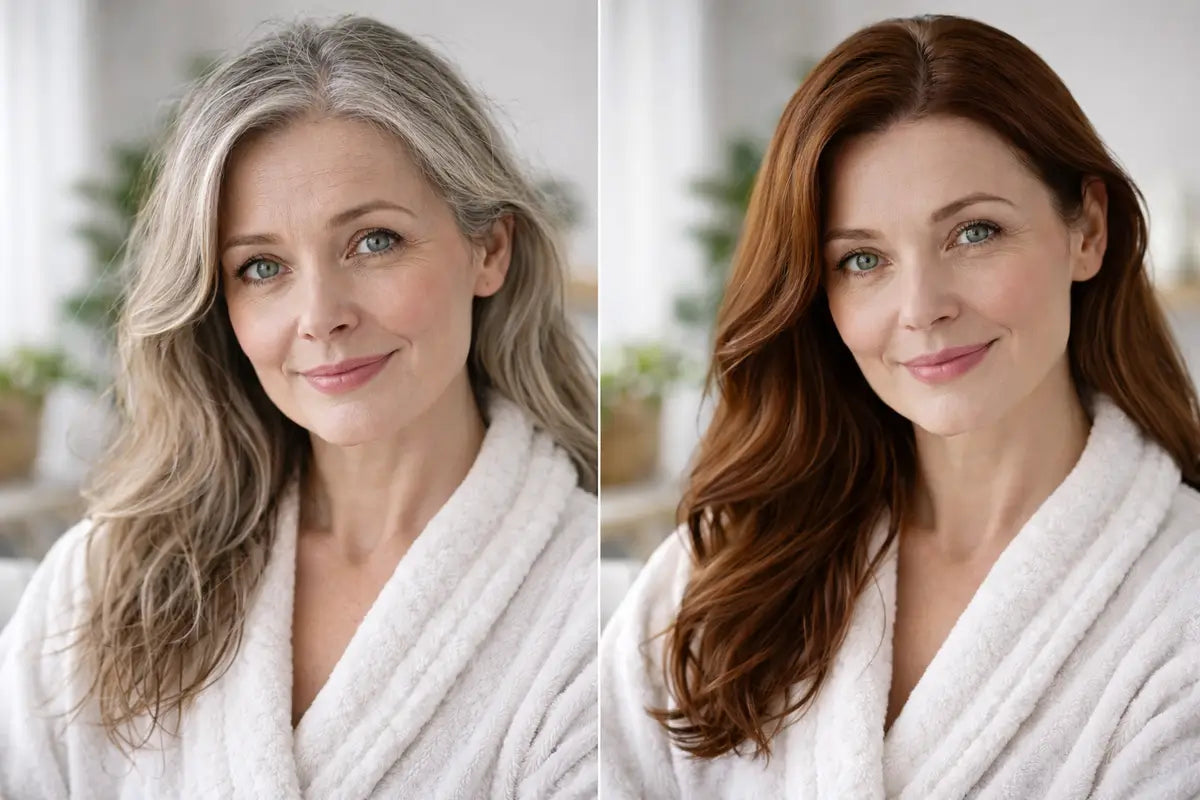
Henna for gray hair works - but only if you understand how it works.
This isn't just any ordinary hair dye. It's a process that combines coloring with care, and the results depend on the hair's biology, application technique, and patience.
Dyeing gray hair with henna is one of the most sought-after natural hair coloring methods. More and more people are consciously abandoning chemical dyes in favor of plant-based alternatives. The reasons? safety, healthy hair, and a more natural color result.
Henna, or powdered Lawsonia inermis leaves, contains a natural dye called lawsone , which binds to hair keratin. This mechanism allows henna to:
- does not damage hair
- doesn't make them clear
- does not interfere with the internal structure
But at the same time…
works differently on gray hair than on pigmented hair.
And this is the key to understanding the whole process.
Does henna cover gray hair?
Yes - henna covers gray hair, but not in the same way as chemical dye.
To achieve full coverage and deep color, it is necessary to dye in two stages: first pure henna, then a mixture with indigo.
Why is henna for gray hair a growing trend?
Just a few years ago, henna was a niche trend. Today, it's one of the fastest-growing hair care trends.
Why?
1. Awareness of the composition of cosmetics
More and more people avoid:
- ammonia
- PPD
- oxidants
Henna does not contain these ingredients, so it is seen as a safe alternative to chemical dyes .
2. The need for care, not just color
Gray hair is:
- drier
- rougher
- more difficult to style
Henna works as:
- natural conditioner
- structure enhancer
- "plant lamination"
3. Natural coloring effect
Chemical paint gives a uniform effect.
Henna gives the following effect:
- multidimensional
- bright
- more "alive"
This is a huge visual difference.
What is gray hair and why is it harder to dye?
To understand henna, you have to understand gray hair.
Lack of melanin - the key problem
Gray hair does not contain melanin, a natural pigment.
This means:
- no "color base"
- greater transparency of the hair
- different dye reception
➡️ that's why henna on gray hair gives a brighter effect
Changed hair structure
Gray hair can be:
- more resistant (so-called "glassy")
- more porous (absorb unevenly)
Effect:
- uneven coverage
- more difficult application
- greater need for technology
The Graying Process – What Really Happens?
With age:
- the number of melanocytes decreases
- oxidative stress increases
- hair loses pigment
Statistically:
- approximately 50% of people have 50% gray hair by the age of 50
- the process begins around 30–40 years of age.
Accelerating factors:
- genetics
- stress
- deficiencies (B12, iron)
- smoking

How does henna work on gray hair? (biological mechanism)
Henna contains the molecule lawsone , which:
- combines with hair keratin
- creates a permanent bond
- deposits color on the hair surface
➡️ this is NOT dyeing "from the inside"
What does this mean in practice?
On natural hair:
- color = henna + hair pigment
On grey:
- color = henna only
➡️ therefore the effect is:
- brighter
- more copper
- less deep
Why does henna give an orange color to gray hair?
Because the natural color of henna is:
➡️ red-orange
On dark hair:
- mixes with pigment → gives brown
On grey:
there is nothing to mix with → a pure shade comes out
Why doesn't henna cover gray hair "like paint"?
This is one of the most important questions users ask.
Henna:
- it is semi-transparent
- does not contain oxidizer
- does not "open" the hair
Chemical paint:
- brightens + introduces pigment
- provides full, uniform coverage
Solution: Two-step henna (key to success)
This is the most important element of the entire article.
STEP 1 - base (red henna)
Objective:
- creating a base pigment
- hair preparation
Effect:
- orange/copper hair
This is not a mistake - it is the foundation of color.
STEP 2 - actual color (henna + indigo)
Objective:
- color darkening
- obtaining a natural shade
Effect:
- brown
- dark brown
- black
Why does it work?
Because:
- henna creates a base
- indigo reacts with this base
➡️ without the first stage:
- the color may be greenish
- weaker coverage

Will henna cover 100% of gray hair?
Yes - but only with the right technique.
Conditions:
- 2-step method
- appropriate holding time
- precise application
Effect:
- it won't be "plastic" like paint
- it will be natural and multidimensional
How to prepare your hair for hennaing gray hair?
Step 1: Thorough cleansing
- use a mild shampoo
- remove sebum and styling
Step 2: no conditioner
Conditioner:
- makes a movie
- blocks lawsone binding
Step 3: Combing
- no tangles = even application
How to prepare henna for gray hair?
Temperature matters
- 50–60°C → optimal
- too hot → destroys the pigment
- too cold → poor release
Acidic environment
For better effect you can add:
- lemon juice
- apple cider vinegar
Why?
➡️ increases dye release
Consistency
Perfect:
- thick paste
- like Greek yogurt
How to increase the effectiveness of henna on gray hair?
- longer holding time (2 hours)
- warmth (hat + foil)
- precise section-by-section application
- regularity (every 4–6 weeks)
What does henna color look like on gray hair?
Day 1
- lighter color
- more orange
Day 2–3
- oxidation
- the color deepens
After a week
- stable, natural effect
Henna works for gray hair, but requires two-step dyeing and the right technique.
This allows you to achieve a long-lasting, natural color and at the same time improve the condition of your hair.
Henna for Gray Hair - Common Mistakes, Color Effects, and Advanced Techniques
1. No two-step dyeing
This is the most common mistake.
Effect:
- poor coverage
- uneven color
- greenish tones using indigo
Why?
➡️ gray hair has no pigment, so it needs a "base"
2. Henna left on for too short a time
Henna needs time to:
- release the dye
- bind to keratin
Effect of holding too short:
- weak color
- quick rinse
- no coverage
➡️ minimum: 2–3 hours
➡️ optimal: 3–6 hours (for grey hair)
3. Applying conditioner before henna
This is a mistake that sabotages the entire process.
Conditioner:
- creates a layer on the hair
- blocks lawsone binding
Effect:
- henna "slides" on the hair
- lack of color fastness
4. Wrong water temperature
Water too hot:
- destroys the dye
Too cold:
- does not activate henna
➡️ ideal: 50–60°C
5. Inaccurate application
Henna requires precision:
- section by section
- precise coverage of roots
Otherwise:
- gaps appear
- gray hair "shines"
6. Washing too quickly after henna
After henna:
- do not wash your hair for 24–48 hours
Why?
➡️ the color oxidizes and stabilizes
What colors come out on gray hair after henna?
After the first stage:
- intense orange / copper
After the second stage:
- natural brown
- warm brown
- dark brown / black
The two stages can be separated by a single day. I do the red henna on Friday, and the chocolate brown on Saturday. Sunday through Monday is the oxidation period. Since Tuesday, I've had beautiful, shiny brown hair. No trace of gray!
Can henna give a green color to gray hair?
Yes - but only in case of a technical error.
When?
- using indigo without a henna base
- missing stage 1
➡️ solution:
- always clean henna first
What does the effect of henna vs chemical dye look like?
Color effect
Henna:
- natural
- multidimensional
- bright
Paint:
- uniform
- "flat"
- predictable
Hair condition
Henna:
- strengthens
- thickens optically
- smoothes
Paint:
- may weaken
- dry up
Durability
Henna:
- It doesn't wash out like paint
- visible roots
Paint:
- washes out
- requires more frequent corrections
What does henna color look like over time?
Immediately after rinsing
- brighter
- more red
After 24–48 hours
- oxidation
- color deepening
After 7 days
- stabilization
- natural effect
Does henna damage hair?
No, and that is one of its greatest advantages.
Henna:
- does not open the hair cuticle aggressively
- does not contain oxidants
- strengthens the structure
Effect:
- the hair is thicker
- more shiny
- less brittle
Does henna dry out hair?
Maybe if:
- is used without a balance of humectants/emollients
- the hair is already very dry
➡️ solution:
- oiling after henna
- henna based on linseed slime
Read: Flaxseed - a natural way to healthy skin, hair and body
How often should you use henna on gray hair?
- every 4–6 weeks (growth)
- lengths do not require frequent dyeing
Can henna be done in one day?
Yes.
Options:
- stage 1 + stage 2 on the same day
- or day by day - I recommend this option
Does henna work on chemically bleached hair?
Yes, but:
- the effect is less predictable
- the color may be more intense
➡️ it's always worth doing a band test
Will henna cover gray hair on the first use?
Often:
-
partly
Full effect:
-
after 2–3 applications
Why?
➡️ henna builds up in layers
For whom is henna for gray hair NOT a good choice?
Henna will not be ideal for people:
- wanting cool blondes
- expecting immediate effect
- impatient
- wanting frequent color changes
Advanced techniques for hennaing gray hair
The "regrowth" technique
- application only on gray hair
- product savings
- less load on length
Layering technique
- multiple applications
- deeper color
- better coverage
Heat technology
- Hat
- towel
- heat increases efficiency
How to maintain henna color on gray hair?
- avoid strong detergents
- use gentle shampoos
- oil your hair
- protect against UV
Summary
Henna for gray hair requires technique, but it gives a natural, lasting and healthy effect.
The key is two-step dyeing, appropriate holding time and avoiding the most common mistakes.
FAQ - henna for gray hair
Does henna cover gray hair 100%?
Yes, but you will get the best results with a two-step dyeing – first pure henna, then a mixture with indigo.
Does henna always turn out red on gray hair?
After the first stage, yes, but the second stage neutralizes the redness and gives the target color.
Can you skip the first stage of henna?
Not if you want to avoid green tones and get full coverage.
Why didn't henna cover my gray hair?
The most common reason is the lack of a base stage, too short a holding time or the use of a conditioner before henna.
How long should you keep henna on gray hair?
At least 2-3 hours, and for stubborn hair even 4-6 hours.
Does henna work from the first use?
Yes, but full coverage often occurs after 2-3 applications.
Does henna damage hair?
No, on the contrary – it strengthens them and improves their structure.
Does henna dry out your hair?
It can be slightly drying, so it is worth using oiling or conditioners after coloring.
Can henna be used on chemically dyed hair?
Yes, but the effect may be less predictable – it is worth trying.
Will henna cover gray roots?
Yes, but it requires precise application and often a longer holding time.
Does henna wash off?
It does not wash out like paint, but the color may change slightly over time.
How often should you dye your gray hair with henna?
Every 4–6 weeks, depending on the rate of regrowth.
Can henna give a green color?
Yes, if you use indigo without first applying henna.
Can you do henna in one day?
Yes – both stages can be completed on the same day.
Does henna work on short hair?
Yes, hair length does not matter for the effect.
Does henna work on thin hair?
Yes, it also optically thickens them.
Does henna make hair shiny?
Yes, it gives a natural, healthy glow.
Does henna weigh down the hair?
No, but with multiple layers it can stiffen them up a bit.
Can you mix henna with other herbs?
Yes, it is often combined with indigo and Ayurvedic herbs.
Does henna work on the scalp?
Yes, it can regulate oiliness and have a soothing effect.
Can you dye only the roots?
Yes, this is the most commonly used technique.
Does henna darken hair?
Yes, you can get browns and blacks using indigo.
Does henna lighten hair?
No – it only works by giving color.
Does the color of henna change over time?
Yes, it gets worse over the first 48 hours.
Does henna work on high porosity hair?
Yes, but the effect may be more intense.
Does henna work on low porosity hair?
Yes, but may require longer holding time.
Can you sleep with henna on your head?
Yes, many people apply henna at night for better results.
Does henna stain the skin?
It may stain slightly, so it is worth protecting the hairline.
Does henna cause allergies?
It is rare, but always worth doing an allergy test.
Does henna work on curly hair?
Yes, it can also improve their definition.
Does henna straighten hair?
No, but it can smooth them out.
Does henna work on stubborn gray hair?
Yes, but it requires longer time and several applications.
Can you use henna while pregnant?
Yes, if it is pure henna without chemical additives.
Does henna work on the beard?
Yes, it can also be used on beards.
Does henna have an intense scent?
It has a natural, herbal scent.
Can you add oil to henna?
Not recommended before application - may make color binding more difficult.
Does henna work on damaged hair?
Yes, it often improves their condition.
Will henna cover gray hair without indigo?
Not completely – it will give a rather coppery effect.
Does henna give a natural effect?
Yes, more natural than chemical paints.