Malic acid - an AHA acid naturally derived from apples, is one of the most frequently searched ingredients in the context of skin and hair care. In recent years, its popularity has been growing not only in cosmetology but also in home use. You ask us about: "malic acid for hair", "malic acid for face", "malic acid effects", "how to use malic acid at home".
It is one of the gentlest AHA acids, combining the ability to remove dead skin cells with moisturizing and pH-regulating properties. It works effectively but without the aggressiveness typical of glycolic acid. It is also safe for sensitive and problematic skin.
Below you will find a complete guide to malic acid, based on cosmetic knowledge. The article also includes a homemade recipe for a malic acid hair rinse, indications, contraindications, and combinations with Orientana products.
Table of Contents:
- What is malic acid?
- Properties of malic acid
- Malic acid and skin - mechanism of action
- Homemade method of using malic acid for hair
- Why Orientana serum is a sensible alternative to malic acid
- Effects of using malic acid on hair
- How malic acid works on hair
- What to choose? Comparison: malic acid vs. citric vs. acetic
- Contraindications and safety
- Common mistakes when using malic acid on hair
- Questions
What is malic acid?
Malic acid is an alpha-hydroxy acid belonging to the AHA group. It occurs naturally in apples, cherries, grapes, and a range of fruits, but in cosmetology, its stable, purified synthetic forms are used. This ensures a constant pH and predictable action.
It is distinguished by its great mildness because it has a larger molecule than, for example, glycolic acid and penetrates the epidermis more slowly. It is an ideal acid for sensitive, dry skin, with a disturbed barrier, and for people starting their adventure with acids.
Properties of malic acid
Malic acid:
- gently exfoliates dead skin cells,
- smoothes the skin,
- improves its hydration due to humectant properties,
- evens out skin tone and brightens discolorations,
- supports cell renewal,
- regulates skin pH,
- improves the absorption of other active ingredients,
- has antioxidant properties.
Compared to other AHA acids, it is extremely gentle - making it an ideal choice for sensitive and dehydrated skin.
Malic acid and skin - mechanism of action
The mechanism of action of malic acid, according to dermatological literature, is based on three processes:
Exfoliation
Removes dead skin cells, making the skin brighter, smoother, and regenerating faster.
Hydration
Malic acid is a humectant – it binds water in the epidermis and prevents its loss.
pH regulation
Restores the skin's acidic pH (around 5.5), which promotes a healthy microbiome.
This combination makes the skin regain its radiance, firmness, and balance.
Homemade method of using malic acid for hair
This is one of the most frequently searched methods. Below is the safest, cosmetologically approved recipe.
Homemade malic acid rinse (1-2%)
Ingredients:
- 1 liter of cool water,
- 4–5 g of powdered malic acid (a level teaspoon).
Preparation:
Dissolve the powder in water, stirring until fully combined.
Application:
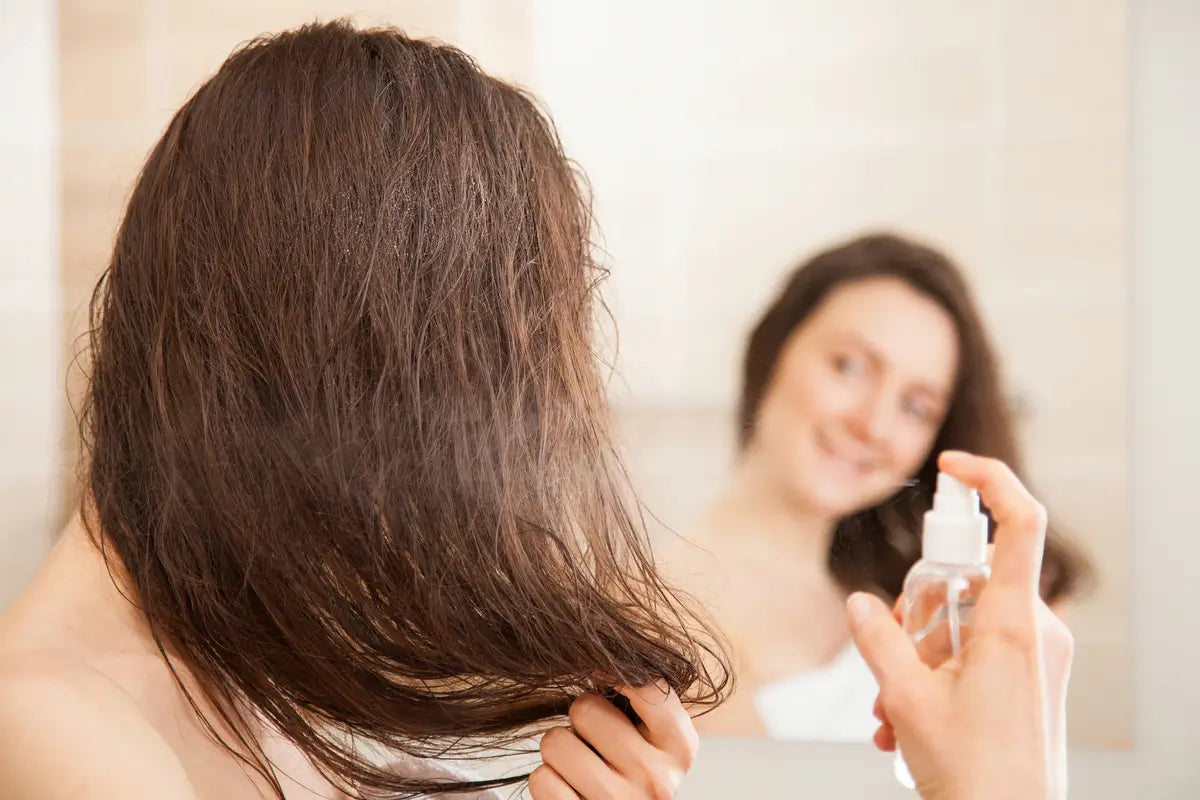
- Wash your hair as usual.
- Rinse off excess water.
- Pour the solution over your hair - from the scalp to the ends.
- Do not rinse.
Frequency:
oily hair: once a week,
color-treated hair: every 10–14 days,
high porosity hair: less frequently.

Why Orientana serum is a sensible alternative to malic acid
Rich composition of milder smoothing and moisturizing ingredients
The serum contains gluconolactone - a gentle polyhydroxy acid (PHA), which acts more gently than AHA acids like malic acid. Gluconolactone has moisturizing, antioxidant properties and helps maintain adequate hair hydration, with minimal risk of irritation.
The presence of lactic acid, pectins, as well as lychee extract and other plant substances means that the serum nourishes the hair, gives it softness, shine, and elasticity, without drying out or making the hair stiff.
Gently closes hair cuticles and provides a smoothing effect
According to the manufacturer, the serum "closes the hair cuticles," which helps smooth the strands, increase their elasticity, add shine, and make detangling easier. For those who were concerned about the potential side effects of an acidic rinse - this is a big plus.
Lower risk of care errors
By using a ready-made cosmetic, you don't have to measure the acid concentration yourself, monitor the pH, or worry about excessive action - the manufacturer has done it for you. This means fewer mistakes like "too strong a concentration," "too long contact," or "over-drying."
Multidimensional benefits - not just smoothing
Orientana serum not only smooths but also nourishes, moisturizes, adds shine, makes detangling easier, and can support the overall condition of the hair.
For whom do I particularly recommend the serum instead of a malic acid rinse?
- For people with sensitive scalps or previous irritations - the serum acts more gently than acids.
- For those who want everyday smoothing, softness, and shine without the risk of drying out.
- For delicate, fine, color-treated, or weakened hair - the serum regenerates and does not weigh down the strands.
- For people who are not confident in applying acids themselves (precise measuring, pH control, etc.).
Effects of using malic acid on hair
- smoothing,
- increased shine,
- easier detangling,
- reduced frizz and static,
- cleansing from hard water deposits,
- lift from the roots,
- improved softness.
How malic acid works on hair
Malic acid acts similarly to an apple cider vinegar rinse, but more gently and without an intense odor.
Malic acid smoothes hair for several very specific, chemical-cosmetological reasons, which is why it is so popular in homemade rinses and professional smoothing products.
Lowers hair pH and closes cuticles
Healthy hair has a slightly acidic pH (approx. 4.5–5.5).
When hair is treated with water, shampoos with a higher pH, styling, or coloring, the hair cuticles lift, making the hair:
- rough
- dull
- frizzy
- more susceptible to damage
Malic acid, as a gentle AHA acid, restores a lower pH, causing the hair cuticles to close.
And closed cuticles = a smooth hair surface.
Increases light reflection = "shine" effect
When the cuticles are closed, the hair surface becomes more even and smooth, so light reflects off it uniformly. That's why after using malic acid, hair looks:
- shinier
- healthier
- "slippery" to the touch
Dissolves deposits and product residues
Malic acid gently removes:
- hard water deposits
- excess minerals
- cosmetic residues
- silicone or polymer build-up
Cleaned hair automatically looks smoother and softer, because nothing weighs it down or snags on accumulated impurities.
Moisturizes (AHA = humectant)
Malic acid, like other AHAs, has moisturizing properties and binds water in the hair structure. Better hydrated hair is more elastic and less porous, which further enhances smoothing.
Facilitates detangling
Thanks to closed cuticles and reduced roughness, hair:
- tangles less
- is easier to detangle
- is less prone to matting
Which the user perceives as an immediate smoothing effect.
Stabilizes color after dyeing
Acidic pH closing the cuticles improves the "seal" of pigment in the hair. Dyed hair therefore looks more uniform and smooth.
Malic acid smoothes hair because it lowers its pH, closes cuticles, removes deposits, moisturizes, and evens out the hair surface - giving the effect of a healthy, shiny sheen.

What to choose? Comparison: malic acid vs. citric vs. acetic
Malic acid
- The gentlest of the three
- Strongly smoothing by gently lowering pH
- Very even effect
- Least drying
- Great for high porosity and color-treated hair
Citric acid
- Stronger, more acidic
- Works very quickly, but can dry out with overuse
- The smoothing effect can be "strong," sometimes too intense
- Ideal for closing cuticles after coloring or chelating
Apple cider vinegar (acetic acid in diluted form)
- Works well, but has a less predictable pH
- Additionally has antibacterial properties
- Smoothes and adds shine
- Can be irritating to sensitive scalps
Contraindications and safety
Do not use malic acid if:
- you have active atopic dermatitis, seborrheic dermatitis, or psoriasis,
- the skin is damaged or very irritated,
- you have recently undergone treatments such as mesotherapy, retinoids, laser,
- the scalp has micro-injuries from scratching.
Common mistakes when using malic acid on hair
Too high a concentration
This is the most common and problematic mistake. Malic acid has a smoothing effect at very low concentrations (0.1–0.5%). When someone adds 1–2 teaspoons to a glass of water, the concentration increases to as much as 3–5%, which:
- dries out the hair
- causes stiffness ("wire-like")
- increases brittleness
- irritates the scalp
Correctly: 1 liter of water + 0.5-1 g of malic acid = ideal pH.
Leaving the rinse on for too long
Malic acid acts quickly - 1–2 minutes of contact is enough. Leaving it on the hair for 10–20 minutes does not improve anything, and may:
- visually over-proteinize the hair (effect of dull, stiff strands)
- disrupt the hydrolipid balance
- cause scalp irritation
Applying malic acid to the scalp without dilution
Undiluted malic acid or a very strong rinse can cause:
- itching
- burning
- redness
- skin flaking
Correctly: the rinse should be acidic, but very gentle.
Using too often
Many people use an acidic rinse after every wash. This is a mistake - hair can become:
- rough
- dull
- dry
- lacking volume
Optimally: once a week, for high porosity hair - maximum twice.
Combining malic acid with other acids in one treatment
The mistake is when someone does an acidic chelation with lemon, and then adds malic acid as well.
The effect?
- drying out
- excessive softening of the hair → increased brittleness
- skin irritation
Malic acid should be used alone, as the last smoothing step.
Using after keratin straightening or keratin botox
Acidic rinses close the cuticles, but can also:
- shorten the durability of keratin
- wash out the smoothing effect
- reduce the "sheet" effect after the treatment
It's best to avoid acids for the first 2-3 weeks after smoothing treatments.
Applying to very damaged and severely dry hair
"Broken," brittle hair with extremely open cuticles can:
- react by drying out
- become even rougher
- lose elasticity
In such a case, we first rebuild the hair with emollients and humectants, and only then add acids.
Using malic acid on hair with oil
If the hair is covered with oil, malic acid cannot work because:
- oil blocks the solution from reaching the hair
- cuticles do not close
- the smoothing effect is zero
Acid should be used after washing and after conditioner, before completing the care routine.
Improper rinsing of the rinse
Insufficient rinsing can:
- leave hair dull
- increase friction
- cause static electricity
Always rinse with cold water until all remnants of the rinse are completely removed.
Using malic acid in hard water
Hard water neutralizes the action of acid. The effect? The rinse does not work or works less effectively.
Solution: filtered / boiled / distilled water - then the difference is huge.
Questions
Is malic acid safe?
Yes, it is the gentlest of the AHA acids.
Does it lighten discolorations?
Yes, regularly used, it evens out skin tone.
Can it be used daily?
No, preferably 2–3 times a week.
Does malic acid moisturize?
Yes, it acts as a humectant.
Is it suitable for oily skin?
Yes, it regulates pH and smooths.
Does malic acid irritate?
Rarely, it is very gentle.
Does it close hair cuticles?
Yes, this is its main action.
Can the rinse be used on color-treated hair?
Yes, it helps to set the color.
Does it neutralize hard water?
Yes, it removes minerals and deposits.
Can it cause allergies?
Rarely, but it's always worth doing a test.
Does the rinse require rinsing?
No, we leave it on the hair.
Can it be used during pregnancy?
At typical concentrations - yes, but it is worth consulting a doctor.
Remember
Malic acid is a versatile, gentle, and effective AHA acid. In skincare, it provides exfoliation and hydration, brightens discolorations, and improves skin tone. In hair care, it acts as a natural pH regulator that closes cuticles, smooths, and adds shine. It is a great choice for people who need a balance between effectiveness and mildness.
Check out