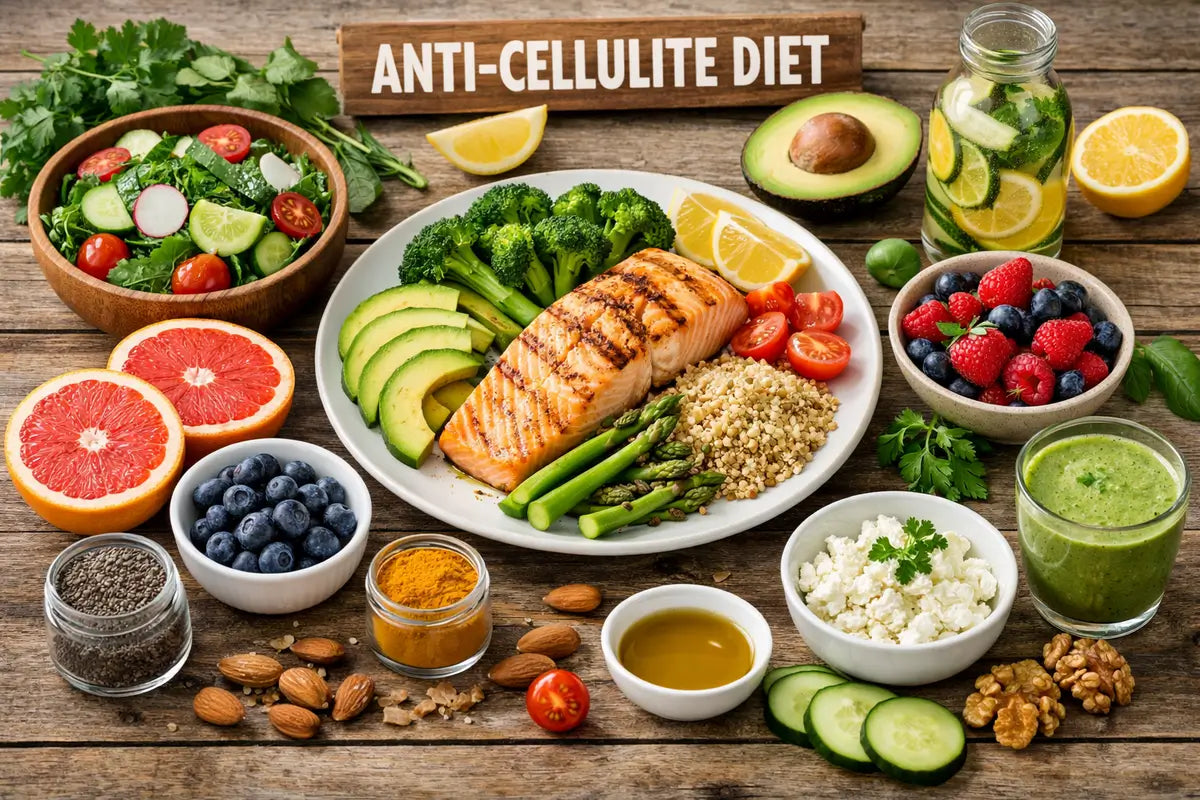
Cellulite is not just an aesthetic problem. It is a complex phenomenon involving connective tissue structure, microcirculation, low-grade inflammation, hormonal balance, and glucose metabolism. That's why the question is increasingly asked: can diet reduce cellulite?
The answer is yes, but only if we understand the biological mechanisms.
An anti-cellulite diet is not a "7-day detox". It's a way of eating that:
- supports collagen synthesis,
- improves microcirculation,
- reduces water retention,
- reduces oxidative stress,
- stabilizes insulin,
- supports estrogen balance.
And only in combination with anti-cellulite massage and physical activity does it yield real results.

What exactly is cellulite?
Cellulite (female type lipodystrophy) is a change in the structure of subcutaneous tissue. Collagen fibers form septa, between which fatty tissue and fluids accumulate. When there is:
- weakening of collagen,
- impaired microcirculation,
- water retention,
- increased activity of MMP enzymes (metalloproteinases),
the characteristic "orange peel" appearance is formed.
Diet affects all these elements.
How does diet affect cellulite?
1. Insulin and fat storage
High intake of simple sugars causes insulin spikes. Insulin promotes:
- fat storage,
- increased inflammation,
- collagen glycation (stiffening and weakening of fibers).
Glycation causes collagen to lose elasticity. The skin becomes less supple, and irregularities become more visible.
2. Low-grade inflammation
A diet rich in sugar, trans fats, and processed foods increases the level of pro-inflammatory cytokines (IL-6, TNF-α).
Chronic micro-inflammatory state promotes:
- collagen degradation,
- impaired microcirculation,
- increased swelling.
3. Water retention
Excessive salt intake increases water retention in tissues.
Lymphatic stasis + fluid retention = greater visibility of cellulite.
Does sugar cause cellulite?
Yes, indirectly.
Sugar:
- worsens insulin resistance,
- increases inflammation,
- leads to collagen glycation,
- promotes fat accumulation.
The higher the intake of simple sugars, the greater the risk of worsening cellulite.

Does drinking water reduce cellulite?
Drinking water does not "remove" cellulite, but it:
- improves lymphatic drainage,
- supports metabolite removal,
- reduces swelling,
- improves skin elasticity.
Dehydration increases the visibility of irregularities.
Diet components that support cellulite reduction
1. Protein - the foundation of collagen
Collagen is formed from amino acids: glycine, proline, and lysine.
Sources:
- legumes,
- tofu,
- tempeh,
- pumpkin seeds,
- quinoa,
- eggs (if the diet includes them).
Protein deficiency = weaker connective tissue structure.
2. Vitamin C – essential for collagen synthesis

Without vitamin C, fibroblasts do not produce healthy collagen.
Sources:
- bell peppers,
- parsley,
- blackcurrant,
- kiwi,
- strawberries.
3. Antioxidants
Oxidative stress activates MMPs – enzymes that degrade collagen.
Strong antioxidants:
- polyphenols (berries),
- catechins (green tea),
- resveratrol (grapes),
- curcumin,
- raw cocoa.

4. Omega-3 fatty acids
They have anti-inflammatory effects and improve cell membrane elasticity.
Sources:
- flaxseed,
- chia,
- walnuts,
- flaxseed oil.
5. Cruciferous vegetables and estrogen metabolism
Broccoli, cauliflower, and cabbage contain sulforaphane and indole-3-carbinol.
They support:
- estrogen detoxification,
- hormonal balance.
Excessive estrogen dominance can promote fat accumulation in the lower body.
Does a ketogenic diet help with cellulite?
It can reduce body fat, but it:
- does not automatically improve collagen quality,
- does not replace physical activity,
- can increase oxidative stress if poorly balanced.
It is not necessary to reduce cellulite.
Does coffee worsen cellulite?
In excess, it can:
- increase cortisol,
- promote water retention.
However, moderate consumption is not a major cause of cellulite.
Does salt cause cellulite?
It doesn't cause it, but it:
- increases water retention,
- worsens swelling,
- can make irregularities more visible.
Products worth limiting
- sugar and sweets
- sugary drinks
- fast food
- trans fats
- excess salt
- highly processed products
Example of a daily anti-cellulite diet plan
Breakfast:
Oatmeal with chia seeds, berries, and nuts.
Lunch:
Buckwheat groats + tofu + broccoli + olive oil.
Dinner:
Salad with arugula, pumpkin seeds, and chickpeas.
Snacks:
A handful of nuts, green tea.
This model supports:
- stable insulin,
- collagen,
- microcirculation,
- anti-inflammatory action.
Is diet alone enough to eliminate cellulite?
No.
Cellulite is a structural phenomenon.
Diet improves the metabolic environment, but it does not mechanically break down fibrous septa.
Therefore, the best results come from a combination of:
- anti-inflammatory diet,
- muscle-strengthening exercises,
- anti-cellulite massage,
- skincare that improves microcirculation.
Why is massage an important complement to diet?
Diet improves metabolism.
Massage:
- stimulates microcirculation,
- improves lymphatic drainage,
- improves tissue oxygenation,
- supports the penetration of active ingredients (e.g., caffeine).
Therefore, a multi-directional strategy works best.
Do supplements help with cellulite?
Some may support:
- collagen (if protein deficient),
- vitamin C,
- omega-3,
- antioxidants.
But they do not replace diet.
The role of collagen and MMP enzymes
Metalloproteinases (MMPs) degrade collagen.
Their activity is increased by:
- oxidative stress,
- inflammation,
- excess sugar.
A diet rich in antioxidants can limit their overactivity.
Does insulin resistance worsen cellulite?
Yes.
Insulin resistance:
- promotes fat accumulation,
- increases inflammation,
- worsens connective tissue quality.
Stabilizing blood sugar levels is a key element of an anti-cellulite diet.
Summary - how does an anti-cellulite diet work?
An anti-cellulite diet:
✔ stabilizes insulin
✔ reduces inflammation
✔ supports collagen synthesis
✔ reduces water retention
✔ improves microcirculation
This is not a miracle diet, but biological support for skin and connective tissue.
The best results are achieved through:
diet + exercise + massage + skincare.
We encourage you to visit our natural cosmetics section, where we comprehensively discuss the philosophy of modern skincare based on plant-derived ingredients.