Contents
- What is a back massage?
- Why is the back the most tense part of the body?
- How does back massage affect the muscles and nervous system?
- Does back massage help with back pain?
- What types of back massage are there?
- Back massage at home - how to do it properly?
- Which cosmetic should I choose for a back massage?
- Contraindications to back massage
- FAQ - frequently asked questions
Read: Hadado Massage - The Japanese Secret of Youth for Your Skin
What is a back massage?
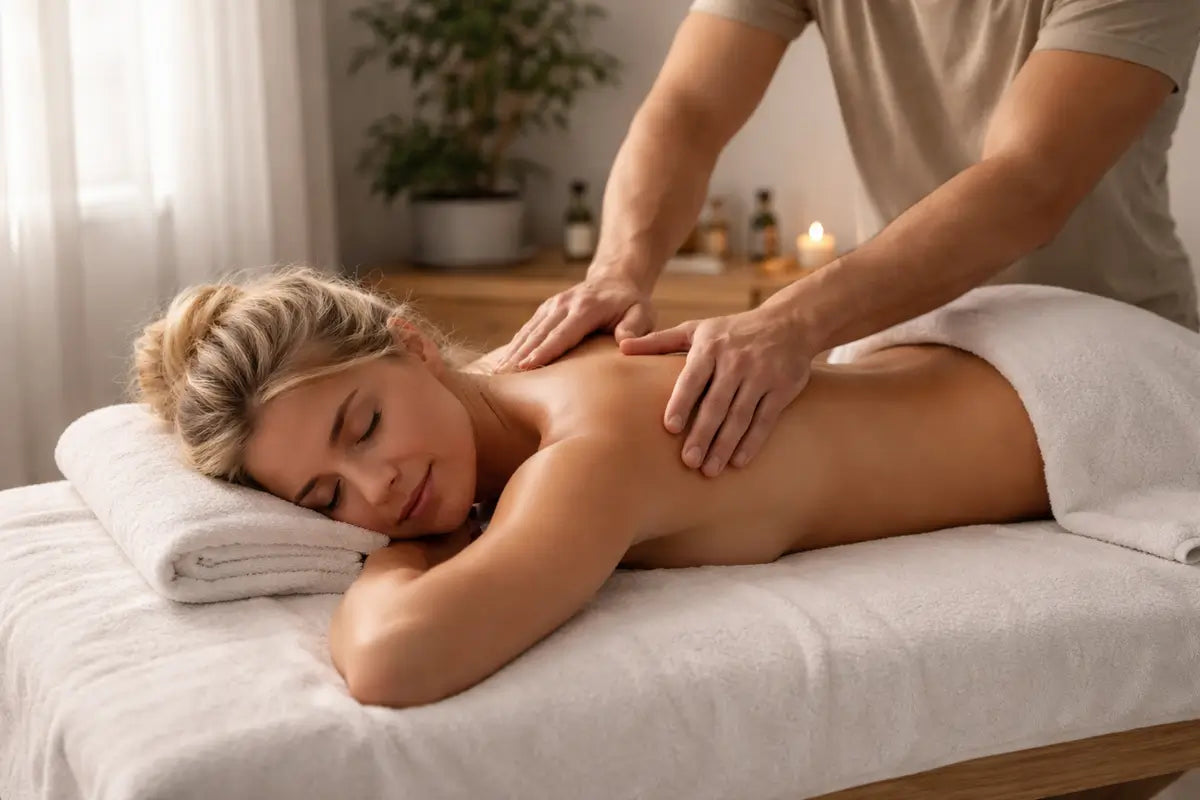
Back massage is a manual technique that affects soft tissues – mainly muscles, fascia and skin – to reduce tension, improve circulation and support the body's regeneration.
It includes:
- cervical spine,
- thoracic section,
- lumbar section,
- the area around the shoulder blades and the paraspinal muscles.
Massage may be of the following nature:
- relaxing,
- therapeutic,
- analgesic,
- regenerative,
- draining.
In the context of modern lifestyle (working at a computer, stress, lack of exercise), back massage has become one of the most frequently performed manual treatments.
Why is the back the most tense part of the body?
The back is the biomechanical center of our body. This is where:
- chronic stress,
- prolonged sitting,
- incorrect posture,
- one-sided overloads,
- lack of physical activity.
The paraspinal muscles are responsible for stabilizing the entire body. When they are constantly tense, they result in:
- reduced blood flow,
- limitation of oxygen supply to tissues,
- accumulation of metabolites (e.g. lactic acid),
- formation of trigger points.
The effect may be:
- back pain,
- feeling of stiffness,
- pain radiating to the neck or shoulders,
- tension headaches.
Back massage works here not only mechanically, but also neurophysiologically.
Read about Thai spa .
How does back massage affect the body?
Mechanical action
Pressure and rubbing:
- improve microcirculation,
- increase muscle flexibility,
- loosen the fascia,
- reduce tissue adhesions.
Neurological effects
During the massage:
- the skin's sensory receptors are activated,
- the activity of the sympathetic nervous system decreases,
- the activity of the parasympathetic nervous system increases.
Effect:
- decrease in cortisol levels,
- a feeling of deep relaxation,
- improving sleep quality.
Impact on stress
Research shows that massage can reduce stress hormones and increase serotonin and dopamine levels. Therefore, a back massage is not only a physical treatment but also an emotional support for the body.
Does back massage help with back pain?
Short answer: yes, but under certain conditions .
Back massage can help with:
- tension muscle pain,
- overload pain,
- stiff neck,
- lumbar complaints resulting from a sedentary lifestyle.
However, it will not replace treatment in the case of:
- discopathy,
- serious degenerative changes,
- acute inflammation,
- injuries.
In case of chronic pain, it is always worth consulting a physiotherapist.
Also check out: Anti-Cellulite Massage - Does It Really Work? Cellulite Reduction Mechanism, Techniques, and Plan
Types of back massage
Classic massage
Most popular. Includes:
- pat,
- grinding,
- kneading,
- patting.
It has a relaxing and pain-relieving effect.
Relaxing massage
More gentle, focused on stress reduction. Often performed with aromatic balms and oils.
Deep tissue massage
More intense. Targets the deep layers of muscles and fascia. Helps with chronic tension.
Chinese cupping massage
Supports microcirculation and drainage.

Learn the principles of Balinese massage.
Back massage at home - does it make sense?
Yes, if done correctly.
A home back massage can:
- reduce tension after work,
- improve circulation,
- strengthen the partnership bond,
- have a preventive analgesic effect.
The key are:
- proper technique,
- correct direction of movements,
- good lubricating medium.
And here comes an extremely important element - choosing the right cosmetic for massage .
Which balm should I choose for a back massage?
When massaging your back, it is worth using a cosmetic that:
- ensures proper slippage,
- does not absorb too quickly,
- supports skin regeneration,
- has an aromatherapeutic effect.
A good choice is Sandalwood Balm 125 ml by Orientana .

Why is it good for back massage?
- contains natural plant extracts,
- has a creamy-balm consistency, ideal for a long massage,
- the scent of sandalwood has a calming effect,
- does not leave a sticky layer.
Sandalwood has been used for centuries in Ayurvedic traditions as an ingredient promoting relaxation and harmony. In back massages, its aroma also helps relieve emotional tension.
Back massage step by step - how to do it properly at home?
A home back massage can be effective if you follow three rules:
- Slow pace.
- Work along the muscles, not directly on the spine.
- Constant, fluid hand-skin contact.
Step 1: Preparation
- Room temperature: approx. 22-24°C
- Lighting: soft, diffused
- Time: minimum 15-20 minutes
- Cosmetic: balm providing good slip
Apply 125 ml of Sandalwood Balm to your hands and warm it between your fingers. The warmth of your hands will enhance the relaxing effect.
Step 2: Stroking (warm-up)
Start with long, slow movements from your lower back towards your shoulders.
Objective:
- stimulation of circulation,
- preparing muscles for deeper work,
- calming the nervous system.
The movements should be calm, rhythmic, without sudden changes in pressure.
Step 3: Blending
Make circular movements with your thumbs or the heel of your hand on both sides of your spine.
This is the moment when:
- microcirculation improves,
- the tissue temperature increases,
- fascial tension is reduced.
Do not apply direct pressure to the spinous processes of the spine.
Step 4: Kneading
Grasp the muscles between your thumb and fingers and knead gently.
This technique:
- improves muscle nutrition,
- supports the removal of metabolites,
- reduces stiffness of the neck and shoulder blades.
Step 5: Slow fade-out
Finally, return to gentle stroking.
Reduce pressure and pace.
This is a key step - it allows the nervous system to enter regeneration mode.
How long should a back massage last?
The optimal time is:
- 15-20 minutes at home
- 30-45 minutes in the office
Too short a massage may not bring any results, too intense a massage may cause muscle tenderness.
What happens in the muscles during a massage?
During a back massage, specific physiological processes occur:
1. Increased blood flow
Mechanical pressure dilates capillaries, which:
- increases oxygen supply,
- supports the regeneration of muscle fibers,
- reduces the feeling of "heavy back".
2. Reducing fascial tension
Fascia is the connective tissue that surrounds muscles.
Chronic stress causes it to stiffen.
Massage:
- increases its elasticity,
- reduces trigger points,
- improves range of motion.
3. Pain modulation
Stimulation of touch receptors activates the “pain gate” mechanism in the spinal cord, which may reduce the perception of pain.
Does back massage help with stress?
Yes.
Touch triggers the release of oxytocin, the hormone of bonding and security.
At the same time, cortisol levels drop.
Effect:
- deeper breathing,
- slower heart rate,
- feeling of relaxation throughout the body.
The scent of sandalwood contained in the Orientana balm additionally supports relaxation through its aromatherapeutic effect.
Can a back massage be harmful?
Yes, if it is made in inappropriate conditions.
❗ Contraindications:
- fever,
- active inflammation,
- fresh injuries,
- thrombosis,
- advanced osteoporosis,
- cancers,
- acute pain of unknown origin.
In case of discopathy or severe back pain, consult a doctor or physiotherapist.
Back massage and insomnia
Regular back massage can:
- shorten the time it takes to fall asleep,
- improve sleep quality,
- reduce nighttime awakenings.
This happens because:
- reduces the activity of the sympathetic nervous system,
- increases parasympathetic activity,
- stabilizes the heart rhythm.
In practice: an evening massage acts as a natural calming ritual.
How often should you do a back massage?
Preventively:
- 1-2 times a week.
At high voltage:
- short, 10-minute sessions even every other day.
Regularity is key.
Back massage and sedentary work - why is it so necessary?
Modern lifestyle means:
- 6-10 hours a day in a sitting position,
- protruding head,
- rounded shoulders,
- limited mobility of the chest.
This leads to what is known as upper crossed syndrome, in which:
- the pectoral muscles are shortened,
- the interscapular muscles are weakened,
- the paraspinal muscles are overloaded.
Back massage in this case:
- improves tissue elasticity,
- reduces neck stiffness,
- supports muscle regeneration after long hours of work at the computer,
- increases the range of motion in the shoulder girdle.
It does not replace exercise, but is an important addition to the prevention of back pain.
Back massage and tension headaches
Can a back massage help with a headache?
Yes, if it is caused by muscle tension.
Tension headaches often result from:
- overload of the neck muscles,
- stiffness of the shoulder girdle,
- chronic stress.
Relaxing the cervical spine and upper back can reduce:
- compression of nervous structures,
- excessive tension of the suboccipital muscles,
- pain radiating to the temples.
Regular back massage works both locally and systemically - by reducing cortisol levels.
Fascia and Trigger Points - Why Massage Works Deeper Than You Think?
What is fascia?
Fascia is a three-dimensional network of connective tissue that:
- surrounds the muscles,
- stabilizes organs,
- transfers tension throughout the body.
When it is overloaded, it loses elasticity and trigger points form.
What are trigger points?
These are overactive areas within the muscle that:
- cause local tenderness,
- may cause radiating pain,
- limit range of motion.
Back massage:
- increases the hydration of the fascia,
- improves its glide,
- reduces over-reactivity of trigger points.
This is why after a massage we feel "lightness" in our back.
Neurobiology of Touch - Why Does Back Massage Soothe the Mind?
Touch activates C-tactile nerve fibers, which are responsible for pleasant sensations.
Their stimulation:
- increases the secretion of oxytocin,
- reduces the activity of the amygdala (stress center),
- reduces emotional tension.
This explains why back massage works not only on the muscles, but also on the psyche.
Combined with the natural aroma of sandalwood - present in the Sandalwood Balsam 125 ml - the relaxing effect can be even deeper.
Back massage in a partner relationship
Massage doesn't have to be solely therapeutic. It can be:
- evening ritual,
- a way to build closeness,
- a form of communication without words.
Regular back massage:
- increases the sense of security,
- reduces emotional tension,
- improves the quality of relationships.
It is worth introducing it as a permanent element of evening relaxation.
Does back massage support post-workout recovery?
Yes.
After intense physical activity, massage can:
- reduce DOMS (delayed onset muscle soreness),
- improve lymph flow,
- accelerate the regeneration of muscle fibers.
It is best to do it 24-48 hours after intense training.
Does back massage improve circulation?
Yes.
Pressure and rubbing:
- increase blood flow in superficial tissues,
- improve muscle oxygenation,
- support the removal of metabolites.
Regular back massage can reduce feelings of heaviness and stiffness.
Does back massage help with chronic stress?
It can be an important element of supportive therapy.
Chronic stress leads to:
- excessive activity of the sympathetic nervous system,
- chronic muscle tension,
- sleep disorders.
Massage:
- activates the parasympathetic nervous system,
- supports relaxation,
- improves sleep quality.
It does not replace psychological therapy, but provides effective support.
FAQ - back massage
Can a back massage be performed every day?
Yes, if it's gentle and relaxing. Intensive deep tissue massage should be performed less frequently— 1-2 times a week.
Does back massage help?
- sciatica?
It can provide relief from muscle tension, but it doesn't treat the underlying cause of the pinched nerve. Medical advice is necessary for sciatica.
Is back massage safe during pregnancy?
It can be performed, but only by a specialist trained in prenatal massage.
Does back massage slim you?
It does not reduce fat tissue, but it can improve microcirculation and skin firmness.
Can you feel pain after a back massage?
Yes, especially after intensive deep tissue massage. Symptoms should subside within 24-48 hours.
Does back massage help with stress?
Yes, by affecting the nervous system and lowering cortisol levels.
Which cosmetic should I choose for a back massage?
It is best to use a balm with a good consistency and natural ingredients that does not absorb too quickly, e.g. a product from Orientan with a creamy formula and a relaxing sandalwood scent.
Summary
Back massage is:
- an effective method of reducing tension,
- support in the prevention of back pain,
- a tool to combat stress,
- relationship building element,
- regenerative ritual.
Regularity, proper technique and selection of the right cosmetic - such as Sandalwood Balm 125 ml - can significantly increase its effectiveness.