There are ingredients that don't need marketing. They have survived hundreds of years, changing trends, and cosmetic revolutions. One of them is amla oil - the essence of Ayurvedic care, used by women in India for generations.
I remember the first time I saw the ritual of oiling hair with amla – calm, repetitive, almost meditative. It wasn't a "trend." It was a part of life.
Today, we return to these rituals, but with cosmetological knowledge and research that confirms what Ayurveda has known for a long time.

What is amla oil?
Amla oil is derived from the fruit of the Indian gooseberry (Phyllanthus emblica), which is one of nature's richest sources of vitamin C and antioxidants.
In cosmetic practice, this means one thing: strong regenerating, protective, and strengthening effects.
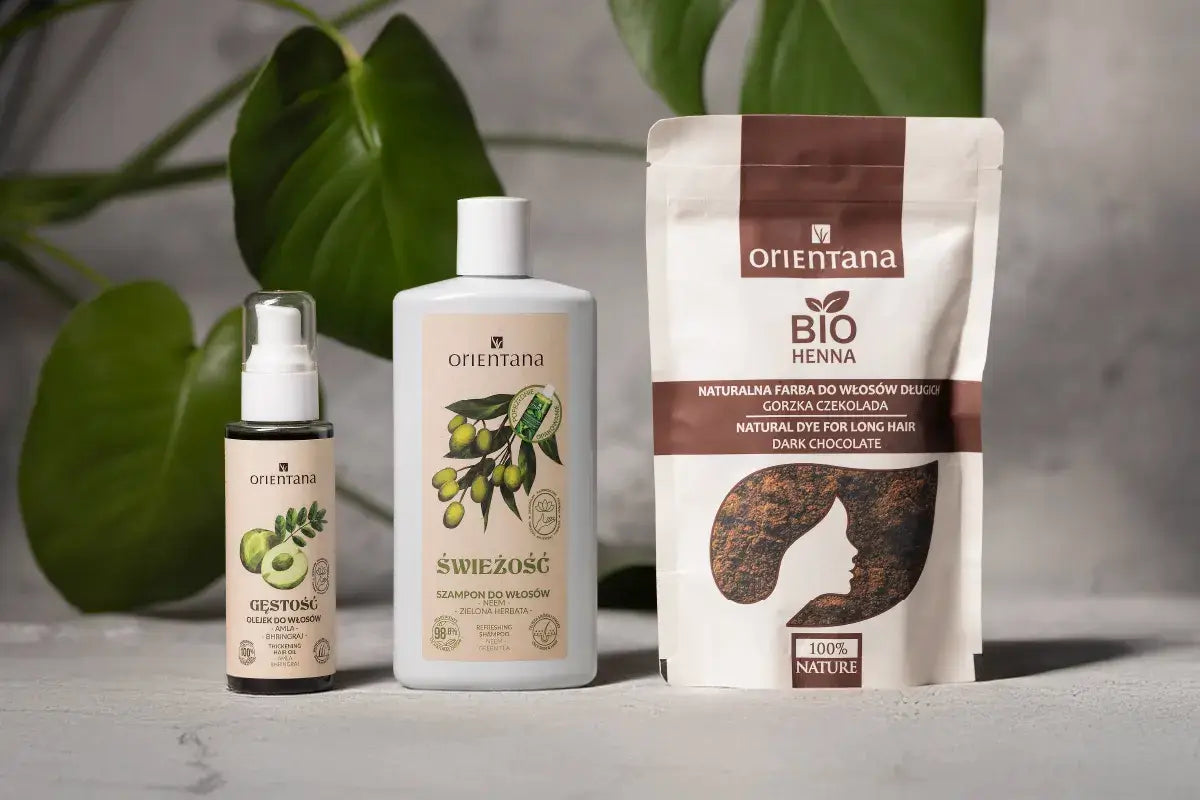
See in which Orientana cosmetics we use amla oil
Amla has been called the "guardian of hair" in India for centuries – and not by chance.
Amla oil - scientifically proven properties
What was once tradition now has its biochemical justification.
Amla oil contains:
- polyphenols and flavonoids
- gallic and ellagic acid
- vitamin C
- tannins
Thanks to this, it exhibits the following effects:
- anti-inflammatory
- antibacterial
- antioxidant
- sebum-regulating
In practice, this means it works on the scalp, hair, and facial skin.
Amla oil for hair - why does it work differently from other oils?
Not every oil acts on the hair follicle. Amla does.
Regular use:
- strengthens hair follicles
- reduces hair loss
- stimulates new hair growth
- improves density and volume
Additionally:
- reduces brittleness
- protects ends
- adds natural shine
- may delay hair graying
This is why amla is one of the most commonly used ingredients in Ayurvedic hair rubs and oils.
Amla oil and scalp - the key to healthy hair
If I had to point out one common hair care mistake, it would be neglecting the scalp.
Amla works on multiple levels:
- regulates sebum secretion
- has anti-dandruff properties
- soothes inflammation
- improves microcirculation
The result?
Healthy scalp = faster hair growth + less hair loss
Amla oil for face - an underrated anti-aging ingredient
Although amla is primarily associated with hair, its effects on the skin are equally impressive.
Thanks to its high antioxidant content, it:
- neutralizes free radicals
- supports collagen production
- lightens discolorations
- evens out skin tone
Additionally:
- has a gentle exfoliating effect
- improves skin texture
- gives a "healthy glow" effect
It is an ideal ingredient for:
- tired skin
- dull skin
- skin with discolorations
- skin showing first signs of aging
How to use amla oil?
1. For hair (strongest effect)
- apply to scalp and hair length
- massage for 5–10 minutes
- leave on for at least 30 minutes (preferably overnight)
- wash off with a gentle shampoo
👉 2–3 times a week

2. As a tonic-rub
- a few drops only on the scalp
- no rinse or before washing
3. For face
- 2–3 drops on damp skin
- in the evening instead of cream or as a booster
Who is amla oil for?
✔ falling hair
✔ thin and weakened hair
✔ scalp with dandruff
✔ dull and voluminous hair
✔ skin with discoloration
✔ tired and dull complexion
Amla oil in modern cosmetology
What is most interesting today is the combination of tradition and technology.
Amla:
- acts as a natural "hair growth booster"
- supports protection against oxidative stress
- fits into the pre-aging and slow aging trend
It's not a trend.
It's a foundation.
Amla oil in Orientana care - tradition that works
When I created Orientana products, I wasn't interested in fleeting trends.
I was interested in ingredients that really work.
Amla was one of the first.
Not because it's trendy.
Only because I saw its effect - live, in India.
👉 Read about scientific studies confirming the effect of amla on hair Preclinical and Clinical Studies Demonstrate That the Proprietary Herbal Extract DA-5512 Effectively Stimulates Hair Growth and Promotes Hair Health
Why does amla in Orientana cosmetics work differently?
Because we don't treat it as an "additive."
It is an active ingredient that:
- supports hair growth
- strengthens the scalp
- has anti-aging effects
- protects against oxidative stress
And importantly, it is embedded in formulations that work in the European climate.
Who are cosmetics with amla for?
For people who:
- are losing hair or see it weakening
- have thin, delicate hair
- want to improve density
- are looking for natural, but effective care
- don't want 10 steps - just 2–3 that work

Effects you will see
With regular use:
- fewer hairs on the brush
- increased volume
- healthier scalp
- natural shine
- stronger, more resilient hair
This is not an effect "after one use."
It is the effect of a process that works biologically.
How to incorporate amla into your routine?
The simplest way:
- rub or oiling 2–3 times a week
- gentle scalp cleansing
- consistency (that's key)
You don't need 10 products.
You need a good ingredient and regularity.
Orientana Philosophy
We don't chase trends.
We create them in the lab.
Amla is not a fad.
It's a foundation of care that returns because it works.
👉 Check out cosmetics with amla and see how your hair reacts
👉 Start with one product and observe the change
FAQ: amla oil
1. What is amla oil?
Amla oil is oil extracted from Indian gooseberry (Phyllanthus emblica), rich in antioxidants and vitamin C, used in Ayurveda for hair and skin care.
2. What does amla oil help with?
It strengthens hair, reduces hair loss, improves scalp condition, and has an anti-aging effect on the skin.
3. Does amla oil accelerate hair growth?
Yes, it supports scalp microcirculation and nourishes hair follicles, which can accelerate hair growth.
4. Does amla oil help with hair loss?
Yes, it strengthens hair follicles and reduces hair weakening at the root.
5. How to use amla oil on hair?
Best used as an oiling treatment: apply to the scalp and hair length, leave on for at least 30 minutes or overnight, then wash your hair.
6. Can amla oil be left overnight?
Yes, this is one of the most effective methods of use.
7. How often should amla oil be used?
2–3 times a week for best results.
8. Is amla oil suitable for all hair types?
Yes, but it is especially recommended for thin, falling out, and weakened hair.
9. Does amla oil weigh down hair?
No, if it is well rinsed and used in the right amount.
10. Does amla oil work on the scalp?
Yes, it regulates sebum, soothes irritations, and supports a healthy skin microbiome.
11. Does amla oil help with dandruff?
Yes, it has anti-inflammatory and antibacterial properties.
12. Can amla oil be used on the face?
Yes, it has antioxidant properties and supports skin regeneration.
13. Does amla oil lighten skin?
It can gently even out skin tone and reduce discolorations.
14. Does amla oil have an anti-wrinkle effect?
Yes, it supports collagen production and protects against oxidative stress.
15. Is amla oil good for acne-prone skin?
It can be helpful due to its anti-inflammatory action, but it's important to use it cautiously.
16. Is amla oil natural?
Yes, it's a plant ingredient used for hundreds of years in Ayurveda.
17. Does amla oil dye hair?
It may slightly darken hair with very regular use.
18. Does amla oil have an intense scent?
It has a characteristic, herbal scent.
19. Can amla oil be used on dry hair?
Yes, it perfectly regenerates and smooths them.
20. Does amla oil add shine to hair?
Yes, hair becomes shinier and healthier.
21. Does amla oil prevent graying?
It may slow down the graying process due to its antioxidant properties.
22. Can amla oil be combined with other oils?
Yes, it works well with coconut or sesame oil, for example.
23. Can amla oil be used daily?
There is no need - better 2-3 times a week.
24. Is amla oil suitable for colored hair?
Yes, it supports their regeneration.
25. Is amla oil good for split ends?
Yes, it smoothes and protects hair.
26. Does amla oil affect hair porosity?
Yes, it helps to seal the hair cuticles.
27. Can amla oil be used on eyebrows and eyelashes?
Yes, it can strengthen them.
28. Does amla oil clog pores?
It can be comedogenic for oily skin - use cautiously.
29. Does amla oil work on discolorations?
Yes, it helps to lighten them.
30. Can amla oil be used in summer?
Yes, but in minimal quantity for daytime.
31. Does amla oil act as a serum?
It can serve as a natural serum.
32. Can amla oil replace hair conditioner?
Not entirely, but it can significantly support it.
33. Is amla oil good for sensitive skin?
Yes, but it's worth doing a patch test.
34. Does amla oil have anti-aging effects?
Yes, thanks to its powerful antioxidants.
35. Can amla oil be used on the neck and décolletage?
Yes, a very good direction for skincare.
36. Does amla oil improve skin elasticity?
Yes, it supports regeneration and hydration.
37. Is amla oil suitable for scalp massage?
Yes, it's one of the best forms of application.
38. Does amla oil work on oxidative stress?
Yes, it neutralizes free radicals.
39. Can amla oil be used during pregnancy?
Usually yes, but it is worth consulting a doctor.
40. Why is amla oil so popular in Ayurveda?
Because it works comprehensively on hair, skin, and aging processes.
Summary - is amla oil worth using?
If you are looking for one ingredient that:
- works on hair and skin
- has proven effects
- is natural yet effective
→ amla oil is one of the strongest choices.
It's not a "pretty ingredient for the label."
It's a real tool for a cosmetologist's work.