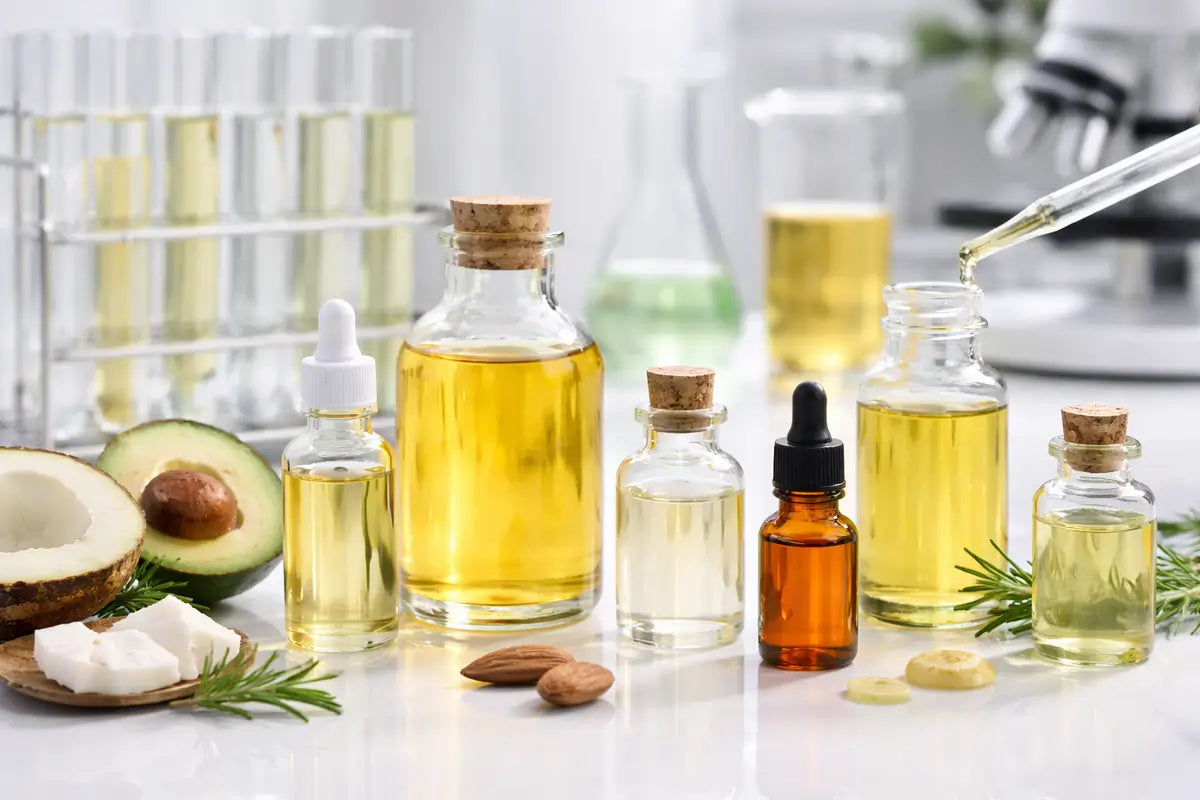
In the world of modern cosmetology, we are increasingly returning to solutions that have been the foundation of skin care for centuries. One such pillar is vegetable oils – natural lipid substances obtained from seeds, pits, fruits, and nuts of plants, which demonstrate high biocompatibility with human skin.
The growing popularity of natural cosmetics has meant that vegetable oils are no longer associated solely with heavy, greasy formulas. Today, they form the basis of modern serums, creams, masks, and oils, where they act not only as emollients but also as carriers of active substances and ingredients that regenerate the skin barrier.
It's worth emphasizing that vegetable oils in cosmetics are not a passing trend. These are ingredients with documented biological effects, whose effectiveness stems from their rich chemical composition and ability to influence key processes occurring in the skin.
Body oil made exclusively from vegetable oils 🔽

In this article we will explain:
- what exactly are vegetable oils,
- why are they so valuable in care,
- what properties do they exhibit,
- and how they are used in modern natural cosmetics.
If you are interested in conscious care based on natural ingredients, you will find practical tips and inspiration tailored to various skin needs in our natural cosmetics section.
What are vegetable oils?
Vegetable oils are mixtures of lipids obtained from various parts of plants, most often through cold pressing or mechanical extraction. They are based on triglycerides of fatty acids, but these are not the only valuable components they contain.
Natural vegetable oils contain, among others:
- unsaturated fatty acids (omega-3, omega-6, omega-9),
- phytosterols,
- tocopherols (vitamin E),
- carotenoids,
- squalene,
- phenolic compounds.
It is this complex that gives vegetable oils a wide spectrum of care properties , from moisturizing and lubricating, through soothing, to antioxidant protection.
It's worth noting that a vegetable oil is not the same as an essential oil. Vegetable oils are fatty, odorless, or have a delicate scent, while essential oils are volatile fragrances used in very low concentrations.
A blend of vegetable oils in Facial Massage Oil 🔽

Vegetable oils and natural skin lipids
Human skin has its own lipid system, which is a key element of the hydrolipid barrier. It includes:
- ceramides,
- cholesterol,
- free fatty acids.
The structure of many plant oils is similar to the lipids present in the epidermis, allowing the skin to easily recognize and utilize them. This is why plant oils are so well-tolerated and effective in skincare.
Regular use of cosmetics with vegetable oils helps:
- replenish lipid deficiencies,
- strengthen the tightness of the protective barrier,
- limit excessive water loss from the epidermis,
- improve skin elasticity and softness.
Why are vegetable oils the foundation of natural care?
Natural cosmetics strive to create formulas that support the skin's physiological processes rather than mask them. Vegetable oils fit perfectly into this philosophy.
Their operation can be described as multidirectional:
- moisturizing – limit water evaporation,
- nourishing – provide the skin with lipids and vitamins,
- regenerating – supporting the reconstruction of the hydrolipid barrier,
- protective – protect against external factors,
- soothing – reduce the feeling of tightness and discomfort.
This makes vegetable oils suitable for the care of dry, sensitive and mature skin, as well as combination or oily skin – provided they are selected appropriately.
Hair oil 🔽

Vegetable oils in cosmetics - not just pure oil
Modern cosmetology is increasingly relying on the use of a single, pure oil as the sole care product. Vegetable oils are now much more frequently incorporated into advanced formulations.
Oils in creams, serums and emulsions:
- cooperate with humectants (e.g. glycerin, hyaluronic acid),
- are stabilized in appropriate proportions,
- have a lighter consistency and better bioavailability.
This makes cosmetics with vegetable oils comfortable to use, does not burden the skin, and allows for more predictable results than applying oil alone.
Sandalwood Facial Oil 🔽

Also read the article about cosmetic oils.
What active ingredients are hidden in vegetable oils?
Although oils are mainly associated with lubrication, their potential is much greater.
Unsaturated fatty acids
- omega-3 – soothing and anti-inflammatory effect
- omega-6 – support for the hydrolipid barrier
- omega-9 – improving skin elasticity and softness
Phytosterols
- support the regeneration of the epidermis
- have a soothing effect
- improve skin immunity
Tocopherols (vitamin E)
- strong antioxidant properties
- protection against oxidative stress
- support for repair processes
It is thanks to this composition that vegetable oils owe their care properties not only to their fatness, but also to their biological activity .
How to choose vegetable oil for your skin type?
One of the most common myths about oil-based skincare is that vegetable oils are only suitable for dry skin. In reality , all skin types can benefit from oils , provided they are selected correctly and formulated appropriately.
The fatty acid profile of a given oil, its lightness and the way it is incorporated into the cosmetic are of key importance.
Vegetable oils for dry and dehydrated skin
Dry skin is characterized by lipid deficiency and a weakened hydrolipid barrier. In this case, oils rich in omega-6 and omega-9 fatty acids are most effective, effectively replenishing epidermal lipids.
Oils recommended for this type of skin include:
- fruit seed oils,
- seed oils,
- oils rich in phytosterols.
In cosmetics for dry skin, vegetable oils support:
- long-lasting hydration,
- reduction of roughness,
- improving flexibility.
Vegetable oils for combination and oily skin
Contrary to popular belief, oily skin also needs lipids. Their deficiency can lead to increased sebum production as a defense mechanism.
For combination and oily skin, choose light, quick-drying oils with a higher content of linoleic acid.
Their action:
- normalization of the functioning of the sebaceous glands,
- strengthening the protective barrier,
- improved skin comfort without feeling heavy.
In modern natural cosmetics, such oils are combined with plant extracts and regulating ingredients, which allows for the creation of balanced formulas.
Vegetable oils for sensitive and reactive skin
Sensitive skin needs ingredients that not only nourish, but above all soothe and strengthen its immunity.
Vegetable oils used in cosmetics for such skin:
- support the regeneration of microdamages,
- reduce the feeling of burning and tightness,
- help rebuild the hydrolipid barrier.
Regular use of cosmetics with properly selected oils can gradually increase the skin's tolerance to external factors.
Vegetable oils for mature skin
As we age, the skin's natural lipid production decreases, leading to dryness, loss of elasticity and the appearance of wrinkles.
Vegetable oils in the care of mature skin play the following roles:
- nutritional,
- smoothing,
- antioxidant.
Oil-based cosmetics are often combined with peptides, ceramides and plant antioxidants to enhance the anti-aging effect.
Refined and unrefined oils – what is the difference?
In the context of natural cosmetics, the question often arises as to whether refined or unrefined oils are better.
Unrefined oils
- cold pressed,
- retain the full spectrum of active ingredients,
- have a natural scent and color.
They are particularly valued in natural cosmetics due to their high phytonutrient content.
Refined oils
- subjected to purification processes,
- odorless and colorless,
- more stable.
Modern formulations often use a combination of both types of oils to achieve a compromise between stability and the richness of active ingredients.
Can vegetable oils clog the skin?
The concept of comedogenicity refers to an ingredient's ability to promote the formation of blackheads. However, it's worth emphasizing that:
- comedogenicity depends on the type of oil,
- the concentration in the cosmetic is important,
- The key is the entire formula, not a single ingredient.
Well-designed cosmetics with vegetable oils are created to minimize the risk of burdening the skin, even problematic skin.
How to use vegetable oils in daily care?
Vegetable oils can be used in several ways:
- as an ingredient in a cream or serum,
- as an occlusive layer at the end of care,
- in body and hair care.
The best results are achieved when oils are used as part of a complete skincare routine, where they work together with humectants and active ingredients.
Vegetable oils and the philosophy of natural cosmetics
Natural cosmetics are based on the premise that skin functions best when supplied with ingredients that are compatible with its physiology. Vegetable oils fit this concept perfectly, as they are naturally derived raw materials rich in biologically active lipids that the skin can recognize and utilize.
Unlike synthetic emollients, vegetable oils:
- they do not create only a surface protective layer,
- actively participate in the reconstruction of the hydrolipid barrier,
- support regenerative processes.
That's why oils rarely appear alone in modern natural cosmetics . They're most often combined with:
- plant extracts,
- humectants,
- adaptogens,
- biotechnological ingredients.
Such combinations allow for formulas that not only nourish but also respond to specific skin needs: moisturizing, soothing, smoothing, or strengthening.
Vegetable oils in face, body and hair care
Although the topic of vegetable oils is most often associated with facial care, their use is much broader.
Oils in facial care:
- improve skin elasticity,
- reduce the feeling of tightness,
- support natural glow.
In body care:
- protect the skin from drying out,
- smooth and soften the epidermis,
- increase comfort after bathing.
In hair care:
- protect the ends,
- improve shine,
- reduce frizz.
This makes vegetable oils one of the most versatile cosmetic ingredients .
Frequently asked questions about vegetable oils
Are vegetable oils suitable for all skin types?
Yes, vegetable oils can be used on all skin types, as long as they are properly selected and incorporated into the appropriate cosmetic formula.
Which vegetable oil is best for moisturizing the skin?
Oils rich in omega-6 and omega-9 acids effectively support the hydrolipid barrier and limit water loss from the epidermis.
Can vegetable oils be used in summer?
Yes. Light oils and cosmetics with fast-absorbing oils also work well in the warmer months.
Can vegetable oil replace cream?
In practice, the best results are achieved by combining oils with creams and serums, because the cream also provides humectants and active ingredients.
How often should you use cosmetics with vegetable oils?
Every day, as part of morning and evening care, tailored to the needs of the skin.
Summary
Vegetable oils are the foundation of natural skin care. Rich in lipids, vitamins, and phytonutrients, they support the hydrolipid barrier, improve elasticity, and protect the skin from dryness and oxidative stress. Properly selected and used in modern formulations, they are safe, effective, and versatile.
Discover natural cosmetics with plant oils for hair , face and body - choose care tailored to the needs of your skin.