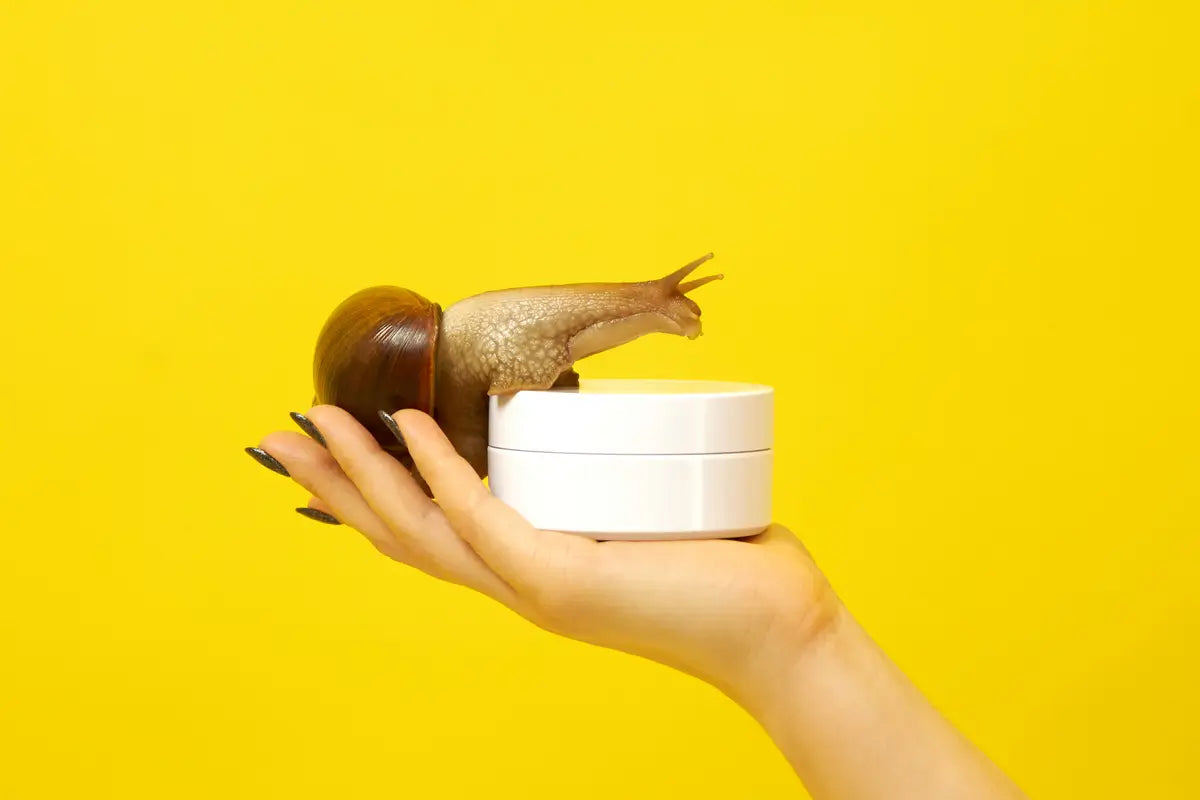
In this article, I will describe the most frequently asked questions about snail mucus cosmetics and about snail mucus itself.
Table of Contents
- Snail mucus in cosmetics
- Where does the snail mucus used in cosmetics come from?
- How is snail mucus filtrate produced?
- What active ingredients does snail mucus contain?
- How does snail mucus work on the skin?
- What are the skincare properties of snail mucus?
- Why is snail mucus so popular in Korean cosmetics?
- What is the difference between pure snail mucus and snail mucus filtrate?
- Can a cosmetic contain 90% snail mucus?
- Is snail mucus a safe ingredient for the skin?
- Is snail mucus suitable for sensitive skin?
- Can snail mucus cause irritation?
- How to identify snail mucus in INCI ingredients?
- Is snail mucus a vegan ingredient?
- Is snail mucus harvesting ethical?

What is snail mucus?
Snail mucus in cosmetics is usually not "pure mucus," but rather a raw material called Snail Secretion Filtrate - a product obtained from filtered snail secretion.
Where does the snail mucus used in cosmetics come from?
The raw material comes from snail secretion which is collected and then filtered/purified, and the finished ingredient appears in the INCI as Snail Secretion Filtrate.
How is snail mucus filtrate produced?
Snail mucus filtrate is produced by collecting the secretion, and then filtering and purifying it, so that the ingredient is safe and stable in the cosmetic product.
What active ingredients does snail mucus contain?
Publications most frequently mention, among others, allantoin, glycoproteins/mucins, glycosaminoglycans (GAGs), AHAs (e.g., glycolic, lactic), proteins/peptides, and ingredients supporting skin regeneration processes.
How does snail mucus work on the skin?
Preclinical study data suggest that SSF may support skin repair processes (including inflammation modulation and matrix remodeling), and clinical studies indicate an improvement in selected skin parameters, such as signs of aging or hydration.
What are the strongest types of evidence?
- Cell culture studies (mechanisms: healing, collagen, inflammatory markers).
- Human studies (usually smaller, cosmetic; effects include skin appearance and signs of aging).

What are the skincare properties of snail mucus?
Snail mucus (SSF) is most commonly described as an ingredient that supports hydration, smoothing of skin texture, comfort, and regeneration, and in some studies also an improvement in parameters related to signs of aging.
Why is snail mucus so popular in Korean cosmetics?
The popularity of snail mucus in K-beauty is due to the emphasis on hydration, soothing, and improving skin texture, as well as marketing based on "skin barrier" and regeneration.

What is the difference between pure snail mucus and snail mucus filtrate?
"Pure mucus" is raw secretion, whereas filtrate (SSF) is an ingredient that is filtered and purified, listed in INCI, and used as a cosmetic raw material.
Can a cosmetic contain 90% snail mucus?
The phrase "90%" usually refers to a high proportion of filtrate solution in the aqueous phase of the product, not 90% "pure mucus" in the literal sense.
Is snail mucus a safe ingredient for the skin?
In reviews and clinical studies, SSF is often described as a generally well-tolerated ingredient, although like any cosmetic ingredient, it can cause reactions in some individuals.
Is snail mucus suitable for sensitive skin?
It can be suitable, but sensitive skin is unpredictable — therefore, a patch test / trial is recommended before full incorporation into a routine.
Can snail mucus cause irritation?
Yes, rarely, and most often due to individual hypersensitivity or the co-existence of other irritating factors in the routine.
What increases the risk of irritation?
- weakened barrier after intensive exfoliation/treatments,
- combining many strong actives at once,
- hypersensitivity to composition ingredients (e.g. fragrance).
How to identify snail mucus in INCI ingredients?
Look for the name SNAIL SECRETION FILTRATE (sometimes also fermented variants, depending on the product).
Is snail mucus a vegan ingredient?
No, because it is of animal origin, SSF does not meet the standard "vegan" definition in cosmetics.
Is snail mucus harvesting ethical?
This is a debated topic; some brands declare "humane" harvesting methods, but ethical assessment depends on breeding standards and the manufacturer's practices, so it's worth asking manufacturers. Orientana harvests snail mucus ethically.
Bibliography
- CosIng (European Commission) - INCI entry "Snail Secretion Filtrate" (ingredient definition).
- Lim VZ et al., 2020 - clinical study on a cosmetic regimen with snail secretion filtrate and assessment of aging signs.
- Gugliandolo E et al., 2021 - SSF in a wound healing model (inflammatory markers, collagen, tissue remodeling).
- Singh N et al., 2024 - review "Snail extract for skin" (composition, applications, cosmetic context).
- Aflatooni et al., 2024 - systematic review on the effects of snail-derived ingredients on skin (including clinical studies).
- Wojnarowicz J et al., 2021 - review article on the composition and applications of snail mucus in cosmetics.
- Wargala/Kot et al., 2023 (PDF) - review article on snail mucus as an ingredient, with reference to CosIng nomenclature and typical raw material forms.
- Journal of Cosmetic Dermatology, 2022 - study on the efficacy and safety of serum with SSF (and other extracts) – (Wiley publishing source).
Discover the full line of Orientana cosmetics with snail mucus