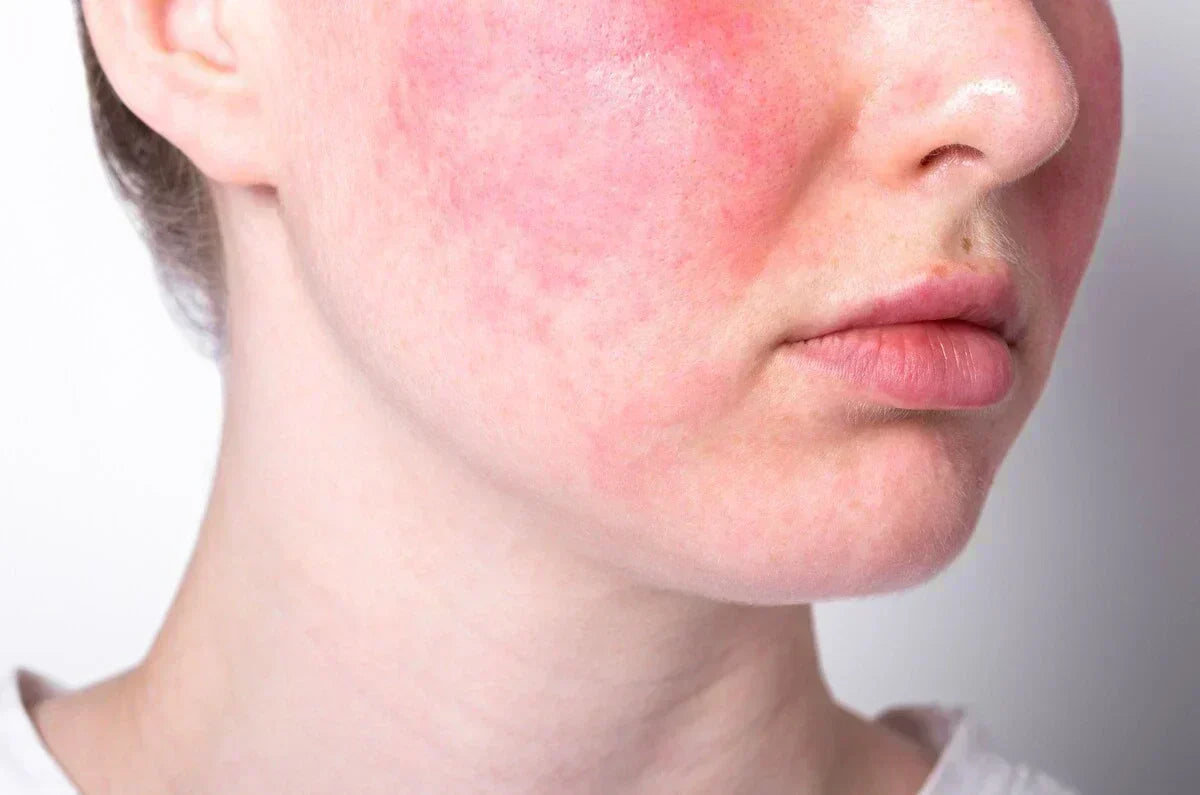
Rosacea is a chronic, inflammatory facial dermatosis with a complex and multifactorial pathogenesis, characterized by episodes of exacerbation and remission. The disease primarily affects the central facial skin and includes intermittent and persistent redness, telangiectasia, papulopustular lesions, and, in advanced forms, tissue hyperplasia and ocular manifestations.
According to current epidemiological data, the prevalence of rosacea in the European population is estimated at 1–10% , but the actual prevalence may be underestimated due to diagnostic difficulties and frequent confusion with other inflammatory dermatoses.
Classification of rosacea
Modern dermatology is moving away from rigid subtyping in favor of a phenotypic approach , recommended by the National Rosacea Society Expert Committee.
The most commonly observed phenotypes include:
- persistent facial redness,
- flushing,
- telangiectasia,
- papulopustular lesions,
- tissue overgrowths (e.g. rhinophyma),
- eye symptoms (burning, dryness, blepharitis).
Phenotypes may co-occur and change over time, highlighting the dynamic nature of the disease.
Pathogenesis of rosacea
Immune response disorders
One of the key pathogenetic mechanisms is hyperresponsiveness of the skin's innate immune system . Patients with rosacea demonstrate increased expression of Toll-like receptors (TLR-2), leading to excessive production of antimicrobial peptides, particularly cathelicidin LL-37 .
The altered structure of LL-37 exhibits strong pro-inflammatory and angiogenic properties, increasing erythema, edema and inflammatory infiltration.
Epidermal barrier dysfunction
The skin of patients with rosacea is characterized by:
- increased transepidermal water loss (TEWL),
- reduced ceramide content,
- weakened integrity of the lipids of the intercellular cement.
Barrier dysfunction promotes the penetration of irritants, allergens and microorganisms, intensifying chronic inflammation.
Neurovascular disorders
Rosacea is also considered a neuroinflammatory disease . Overreactivity of nerve endings in the skin leads to increased release of neuropeptides (substance P, CGRP), which cause:
- dilation of blood vessels,
- increased endothelial permeability,
- intensification of the inflammatory response.
This mechanism explains the occurrence of flushing under the influence of thermal, emotional or dietary stimuli.
The role of the skin microbiome
A growing body of research points to the importance of microbiome dysbiosis in the pathogenesis of rosacea. Particular attention is being paid to:
- increased density of Demodex folliculorum ,
- immune response to bacterial antigens associated with mites,
- changes in the bacterial composition of the facial skin.
It is not the presence of Demodex itself, but the body's excessive inflammatory response that plays a key role in the development of symptoms.
Triggering and exacerbating factors
The best documented provoking factors include:
- UV radiation,
- high and low temperatures,
- alcohol (especially red wine),
- spicy foods,
- emotional stress,
- intense physical activity,
- improper skin care (alcohol denat., menthol, essential oils).
Individual identification of triggers is an important element of therapeutic treatment.
Differential diagnosis
Rosacea requires differentiation from, among others:
- acne vulgaris,
- seborrheic dermatitis,
- lupus erythematosus,
- perioral inflammation,
- drug-induced dermatoses.
The absence of comedones, central location of lesions, and chronic erythema are key differentiating features.
Contemporary therapeutic strategies
Local treatment
Local therapy uses substances with the following effects:
- anti-inflammatory (metronidazole, azelaic acid),
- modulating the immune response (ivermectin),
- vasoconstrictor (brimonidine, oxymetazoline).
The selection of therapy should take into account the dominant clinical phenotype.
General treatment
In moderate and severe forms of the disease the following are used:
- doxycycline in subantibiotic doses,
- low-dose isotretinoin,
- treatment of eye symptoms in cooperation with an ophthalmologist.
The importance of dermocosmetic care
Pharmacological treatment is complemented by strategic skin care , focused on:
- reconstruction of the epidermal barrier,
- TEWL reduction,
- limiting neurogenic reactivity,
- skin microbiome support.
Cosmetics that I think can be useful in skincare
Cleaning

Toning

Prognosis and course of the disease
Rosacea is a chronic, incurable disease that can be effectively controlled. Early diagnosis and treatment significantly reduce the risk of progression and permanent skin lesions.
Below you have a dedicated Q&A section designed strictly for Google AI Overview / AI Answers .
The questions are formulated precisely in the problem query logic that AI models most often extract for zero-click answers (why / whether / how / what is different).
Style: scientific, dermatological, without simplification , but unambiguous.
Rosacea – questions and answers
What is rosacea from a medical perspective?
Rosacea is a chronic, inflammatory facial skin disease with immunological, neurovascular, and barrier mechanisms, characterized by hyperreactivity of blood vessels and the skin's innate immune system. It is not classical acne or an infectious disease.
Why does rosacea cause flushing and redness?
The redness in rosacea results from abnormal vascular reactivity and increased release of proinflammatory neuropeptides. This leads to excessive vascular dilation, increased vascular permeability, and persistent skin inflammation.
Is rosacea an autoimmune disease?
No, rosacea is not classified as an autoimmune disease. However, it does exhibit features of innate immune system dysregulation, including excessive activation of Toll-like receptors and abnormal processing of antimicrobial peptides.
Why does rosacea worsen under stress?
Stress activates the skin's neuro-immune axis, leading to increased release of neuropeptides such as substance P and CGRP. These compounds enhance vasodilation and the inflammatory response, resulting in exacerbation of disease symptoms.
Is rosacea related to the skin microbiome?
Yes. Skin microbiome disturbances are observed in patients with rosacea, including increased Demodex folliculorum density and an altered immune response to commensal microorganisms. The key factor is not the presence of microorganisms, but rather the excessive inflammatory response of the skin.
Can rosacea be confused with acne vulgaris?
Yes, especially in the papulopustular form. Differentiation is based on the absence of comedones, the presence of persistent central facial erythema, and characteristic triggers such as alcohol, temperature, or stress.
Is rosacea contagious?
No. Rosacea is not contagious and is not spread through direct contact. There is no risk of catching rosacea from another person.
Why does UV radiation worsen rosacea?
UV radiation induces oxidative stress, damages the epidermal barrier, and increases angiogenesis and skin inflammation. In patients with rosacea, UV exposure leads to persistent deepening of erythema and progression of vascular changes.
Does rosacea only affect the skin?
No. Some patients experience ocular rosacea, which includes dry eyes, burning, blepharitis, and foreign body sensation. Ocular symptoms may precede or coincide with the skin lesions.
Can rosacea be completely cured?
No. Rosacea is a chronic disease, and currently there is no definitive treatment that can provide a permanent cure. However, appropriate therapy can provide long-term symptom control and significantly improve the patient's quality of life.
Why is the epidermal barrier crucial in rosacea?
A damaged epidermal barrier increases transepidermal water loss and skin permeability to irritants. This leads to an increased inflammatory response, hypersensitivity, and progression of rosacea symptoms.
Does diet affect the course of rosacea?
Yes. Alcohol, spicy foods, and hot beverages can activate neurovascular mechanisms and cause flushing. The impact of diet is individual and should be assessed based on observation of the body's reactions.
Can skincare make rosacea worse?
Yes. Products containing alcohol, menthol, essential oils, or aggressive surfactants can exacerbate skin barrier damage and inflammatory reactions. Improper care is one of the most common factors that exacerbate the condition.
Does rosacea progress with age?
In some patients, untreated rosacea can lead to persistent redness, telangiectasia, and tissue hyperplasia. Early therapeutic intervention reduces the risk of disease progression.
Does every redness on your face mean rosacea?
No. Facial redness can be a symptom of many conditions, including lupus erythematosus, contact dermatitis, and vascular dermatoses. Diagnosis of rosacea requires clinical evaluation and exclusion of other causes.
Bibliography
- Two AM, Wu W, Gallo RL, Hata TR. Rosacea: Part I. Introduction, categorization, histology, pathogenesis, and risk factors. Journal of the American Academy of Dermatology . 2015;72(5):749–758.
- Gallo RL, Granstein RD, Kang S et al. Standard classification and pathophysiology of rosacea: The 2017 update by the National Rosacea Society Expert Committee. Journal of the American Academy of Dermatology . 2018;78(1):148–155.
- Steinhoff M, Schauber J, Leyden JJ. New insights into rosacea pathophysiology: a review of recent findings. Journal of the American Academy of Dermatology . 2013;69(6 Suppl 1):S15–S26.
- Holmes A.D. Potential role of microorganisms in the pathogenesis of rosacea. Journal of the American Academy of Dermatology . 2013;69(6):1025–1032.
- Del Rosso JQ. Management of facial erythema of rosacea: What is the role of topical α-agonist therapy? Journal of the American Academy of Dermatology . 2013;69(6 Suppl 1):S44–S56.
- Buhl T, Sulk M, Nowak P et al. Molecular and morphological characterization of inflammatory infiltrate in rosacea reveals activation of Th1/Th17 pathways. Journal of Investigative Dermatology . 2015;135(9):2198–2208.