
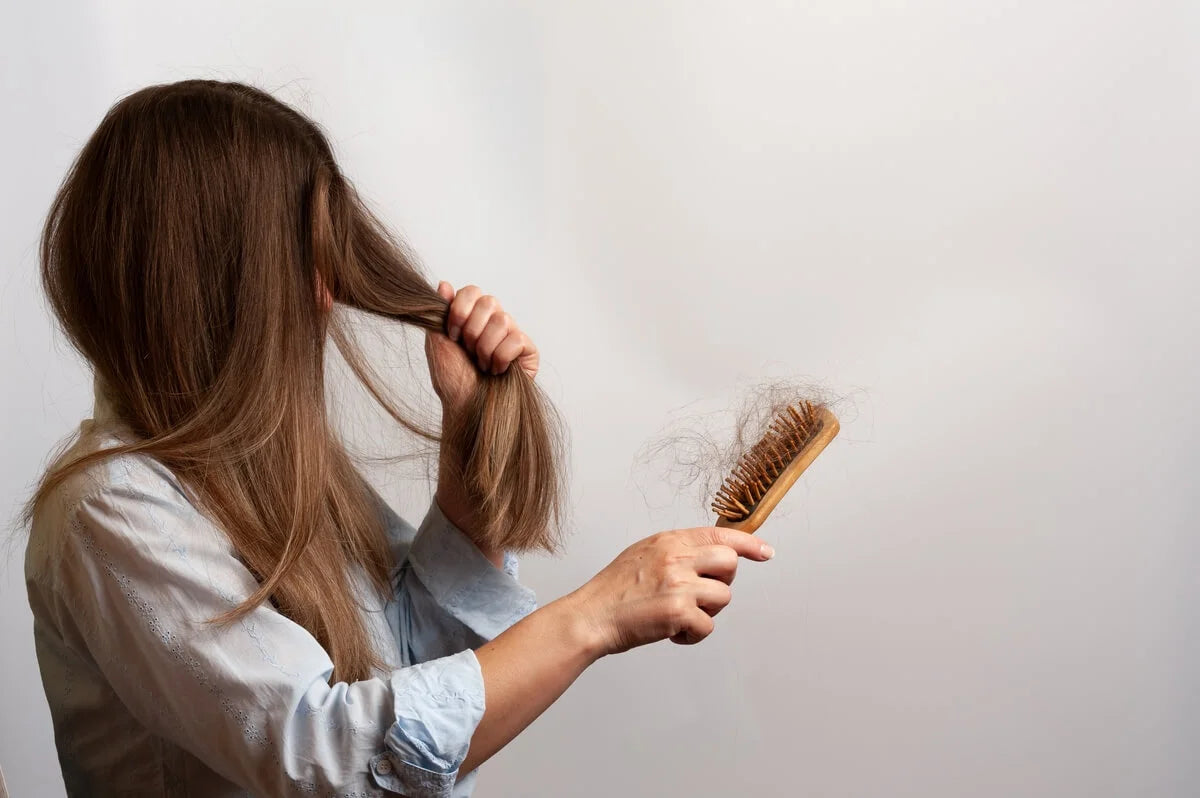
When you run a brand whose mission is natural beauty, sometimes you learn the most not from laboratories, but from people. For many years, many of my acquaintances – young mothers – have been coming to me with the same problem.
"Ania, my hair is falling out in handfuls after pregnancy. I'm afraid to wash my hair, because after each brushing I see less and less of it..." These are not isolated stories. This is the everyday reality for thousands of women who, after childbirth, feel as if they are losing a part of themselves along with their hair – confidence, peace, femininity.
Today, I will tell you why this happens, what happens to the scalp after childbirth, and how – step by step – you can help your hair regain its balance. And also, how our Trycho Liczi Orientana series was created with the needs of women in the perimenopausal period in mind, but it also turns out to be effective during the post-pregnancy period.
Why does hair fall out after pregnancy?
It's due to hormones that change everything. During pregnancy, high estrogen levels keep hair in the growth phase (anagen). They are thick, shiny, beautiful. But after childbirth, estrogen levels drop sharply – hair enters the resting phase (telogen) and starts to fall out after a few weeks.
This is a natural, physiological process called postpartum telogen effluvium.
Additional factors that can worsen the problem:
- postpartum stress and lack of sleep,
- iron, zinc, vitamin D, and biotin deficiencies,
- breastfeeding without dietary support,
- mechanical damage to hair and overly strong cosmetics.
I often heard: "I always had thick hair, and after childbirth, it started to thin out at the forehead, at the temples..." In fact, I remember having problems with hair loss after giving birth to my sons. This is a classic symptom of postpartum effluvium – but also a moment when the scalp needs gentle but consistent support.
How long does postpartum hair loss last?
Most often between 3 and 6 months after childbirth, but sometimes the process can last up to a year. However, this does not mean that you have to wait passively. Many women see their first "baby hair" after just a few weeks of regular care – especially when they start to take care of scalp microcirculation and the hydrolipid barrier.

How to care for hair after pregnancy? Trycho Liczi Ritual
From conversations with women and consultations with a trichologist, a line was created that combines gentleness, effectiveness, and phytotechnology – Trycho Liczi. Its task is to support the scalp, hair follicles, and hair length in a biocompatible and friendly way.
Step 1: Gentle cleansing – Trycho Liczi Shampoo
Many women choose overly strong shampoos after childbirth – SLS, alcohol, excessive perfume.
Meanwhile, the scalp during this period is very sensitive.
Our Gentle Moisturizing Trycho Liczi Shampoo contains:
- sugar betaine and gentle coconut surfactants,
- lychee extract, which has antioxidant and toning properties,
- panthenol and gluconolactone, which soothe and rebuild the microbiome.
After 3–4 weeks of use, scalp comfort is noticeable – this means the hydrolipid barrier has been restored.
Step 2: Hair nourishment – Trycho Liczi Conditioner-Mask
Here's an important caveat that I often repeat. We apply Trycho Liczi Conditioner Mask only to the lengths and ends, never to the scalp.
The formula contains:
- Fiberhance™ BM solution - rebuilds hair structure from within, improves its strength, and smooths it.
- rice proteins and amino acids – rebuild the hair fiber,
- squalane - gives shine and softness.
As a result, hair becomes elastic and less brittle – which is extremely important in the postpartum period.
Step 3: Growth Activation – Trycho Liczi Scalp Treatment
The most emotional messages start with the sentence: "Ania, after a month of using the scalp treatment, I see baby hair!"
This is precisely the effect of natural stimulants:
- Baicapil™ - a clinically proven complex that activates hair follicles,
- Arginine - an amino acid that stimulates microcirculation and hair growth, and also strengthens hair follicles,
- Quinine - stimulates microcirculation and hair growth.
Regular use (daily or every other day) really brings results – but it requires patience. Just like motherhood.
Step 4: Caring for the structure
Trycho Liczi Hair Serum acts as a "liquid shield" – its light formula envelops the hair shaft and strengthens it. Active ingredients penetrate micro-damages, improving hair elasticity and preventing brittleness. Regular use helps smooth the hair structure, close the cuticles, and reduce frizz, which translates into a shiny, disciplined effect.
How to support hair from within?
Women often ask, "Are cosmetics alone enough?" No – but they are the foundation.
It's worth combining them with:
- a diet rich in iron, zinc, protein, and vitamin D,
- supplementation after consulting a doctor,
- scalp massage with oil or a rub,
- regular sleep and stress reduction.
Ayurveda says that "beautiful hair begins with a calm mind." That's why hair care is also a calming ritual – a moment for yourself, even with a baby sleeping nearby.
Most common questions from women after pregnancy
Does postpartum hair loss always resolve on its own?
Yes, it's a temporary process, but it's worth supporting with care to shorten the regeneration time.
Does breastfeeding worsen hair loss?
Not directly, but micronutrient deficiencies can exacerbate the problem.
Is Trycho Liczi scalp treatment safe during breastfeeding?
Yes, the formula is natural, without alcohol and irritating ingredients.
How long does it take to see the effects of the treatment?
Most often after 3–4 weeks – less hair on the brush, after 8–10 weeks baby hair appears.
Can the entire Trycho Liczi line be used together?
Yes – the series was designed as a comprehensive trichological ritual that can be used daily.
Below is an expert explanation of what happens to hair after childbirth, prepared by our trichologist.
What happens to hair after childbirth? - a trichologist's perspective
During pregnancy, high levels of estrogen and progesterone keep most hair in the anagen phase. Women then observe a significant thickening and increased density of their hair. After childbirth, when hormone levels drop sharply, up to 30–40% of hair enters the telogen phase. After 2–3 months, noticeable hair loss appears – usually referred to as postpartum telogen effluvium (Telogen Effluvium Postpartum).
What can be observed under a trichoscopic camera?
- Hair follicles in the telogen phase – smaller, with visible keratinization.
- Increased hair breakage along the length – caused by dryness and keratin deficiency.
- Inflammation of follicular orifices – a common result of stress and disturbance of the scalp's hydrolipid barrier.
- Regenerating hair (baby hair) – thin, light, with normal growth – a sign of regeneration.
Trichologist's advice for women after childbirth
Scalp massage – an invisible ally
I recommend daily scalp massage for women after childbirth, using a bristle brush or fingertips. Such a massage:
• stimulates circulation,
• facilitates the absorption of scalp treatments,
• has an anti-stress effect – which is just as important after childbirth as cosmetics.
Additional trichologist tips:
• Dry hair with cool air, avoid straighteners for the first few months.
• Do not sleep with wet hair – this promotes the growth of microorganisms on the scalp.
• Choose soft elastic bands and natural brushes that do not pull out hair.
• Regularly clean brushes and combs (at least once a week).
Postpartum hair loss is not a disease – it's a signal that the body is returning to balance. The key is patience, consistency, and wisely chosen scalp care. That is why the Trycho Liczi line was created – out of concern for women who want to feel that their hair is their strength again.