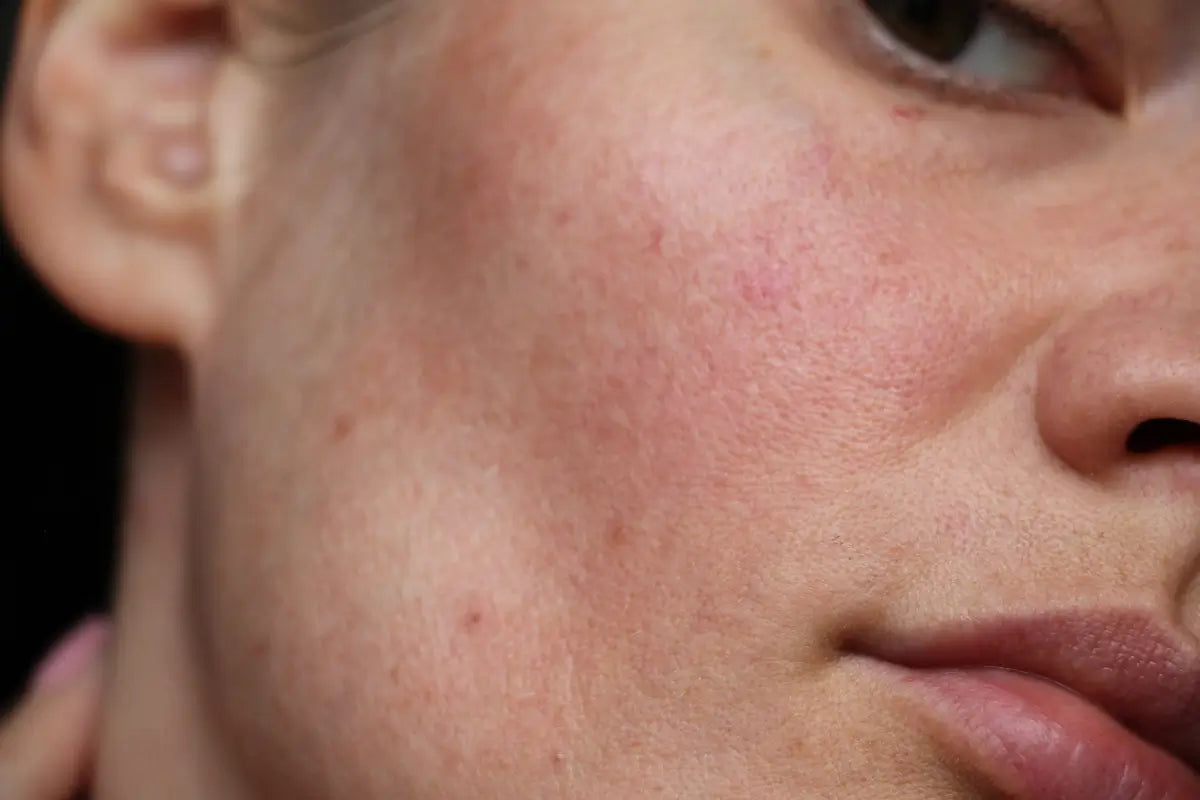
Couperose skin - characteristics and occurrence
Couperose skin is a particularly sensitive skin type, where capillaries are located very superficially beneath the epidermis. As a result, they easily become dilated, and their weakened walls break, causing permanent redness and so-called telangiectasias.
According to research by the Journal of the European Academy of Dermatology and Venereology (2019), symptoms of couperose skin occur in 37% of women in Europe, with most cases affecting individuals with fair skin and thin skin.
This skin type often co-occurs with neurovascular hyperreactivity, meaning it reacts with erythema even to minor stimuli such as emotions, temperature changes, stress, or inappropriate cosmetics.
Causes of broken capillaries
Genetic factors
Couperose skin is largely genetically determined. We inherit thin skin, a reduced number of collagen and elastic fibers, and increased fragility of capillaries.
Hormonal factors
Estrogens affect the elasticity of blood vessel walls. During periods of hormonal fluctuations – such as pregnancy, menopause, or hormonal contraception – an exacerbation of erythema and capillary fragility is often observed by as much as 30%.
Environmental factors
UV radiation, strong wind, frost, temperature changes, and smog are the main external factors damaging skin microcirculation. Prolonged UV exposure leads to pathological angiogenesis, i.e., the formation of new, fragile capillaries.
Oxidative stress
Reactive oxygen species (ROS) damage the vascular endothelium, increasing its permeability. Research from Dermatologic Therapy (2020) showed that in people with couperose skin, the level of the MMP-9 enzyme, responsible for the degradation of type IV collagen, is 45-60% higher than in people with normal skin.
Biological mechanisms in couperose skin
Couperose skin is characterized by a disturbance in vascular homeostasis. There is excessive vasodilation, followed by its persistence.
As a result, erythema appears, which over time can turn into permanent changes.
Also important is the degradation of type IV collagen and elastin within the capillaries, as well as an increased presence of inflammatory factors (IL-6, TNF-α).
This is why the care of couperose skin should focus not only on alleviating symptoms but also on antioxidant, anti-inflammatory, and vessel-sealing actions.
Couperose skin and genes, hormones, and environment
The relationship between genes, hormones, and environment is scientifically documented.
Individuals with mutations in genes encoding type IV collagen (COL4A1 and COL4A2) show up to 2.5 times higher susceptibility to the formation of telangiectasias.
In turn, exposure to UVB radiation increases the level of metalloproteinases MMP-1 and MMP-9, which degrade structural skin proteins.
During menopause, a decrease in estrogen levels by about 60% causes weakening of microcirculation and greater vascular reactivity - which is why many women notice persistent redness at that time.
How to care for couperose skin – step-by-step care
Cleansing
Cleansing should be extremely gentle to avoid disrupting the hydrolipid barrier.
Avoid harsh detergents and sonic brushes.
Recommended product:
Toning
Toner should restore proper pH and soothe the skin. Toners with gluconolactone, aloe vera, and date extract are ideal.
Recommended product:
Serum
Serum is a key step in skincare – it contains concentrated active ingredients that strengthen capillary walls.
Recommended product:
🌿 Ashwagandha + CICA + Niacinamide Serum – combines the action of an adaptogen (ashwagandha) and Gotu Kola (Centella Asiatica), reducing redness and improving skin's resistance to oxidative stress.
🌿 Ashwagandha + Vitamin C + Tranexamic Acid Serum - seals blood vessels.
Moisturizing and regenerating
Creams should be light, non-comedogenic, with ceramides, biomimetic peptides, and adaptogenic extracts. They should not contain irritating, strong active ingredients.
Recommended product:
🌸 Lifting Cream with microalgae collagen + biomimetic peptides – strengthens skin structure, supports microcirculation, and rebuilds the lipid barrier.
UV Protection
UV radiation is the enemy of capillaries. Use mineral SPF 30–50 filters all year round, even in winter.
Active ingredients with proven effectiveness
Strengthening capillaries requires ingredients with scientifically proven effectiveness.
Soothing and anti-inflammatory ingredients:
- Azelaic acid derivative (Azeloglicyna) - reduces redness, regulates vascular tone
- Niacinamide (vitamin B3) - reduces redness, strengthens skin barrier
- Allantoin - soothes irritation
- Panthenol - regenerates and calms
Antioxidants:
- Vitamin C - strengthens vessels, brightens post-inflammatory discolorations
- Vitamin E - protects against oxidative stress
- Green tea extract - antioxidant, soothing
Other helpful ingredients:
- Hyaluronic acid - moisturizes, does not irritate
- Ceramides - rebuild the skin's protective barrier
- Azelaic acid - anti-inflammatory, reduces redness
It is important to avoid irritating ingredients (alcohol, menthol, harsh exfoliants) that can further irritate couperose skin.
Natural cosmetics for couperose skin
Natural cosmetics are a gentle alternative to classic dermo-cosmetics.
Their advantage is biocompatibility with the skin, the presence of antioxidants, and the absence of strong, irritating active substances. Check out:
Lifting Cream with collagen, microalgae, biomimetic peptides, and caffeine
Advanced anti-aging cream combining plant collagen from microalgae with biomimetic peptides for a lifting effect and wrinkle smoothing. Caffeine additionally stimulates microcirculation and improves skin tension, providing comprehensive firming action.
Anti-wrinkle serum with phytoendorphins
Innovative serum using phytoendorphins - plant compounds that stimulate the production of endorphins in the skin for a "feel-good" effect on cells. It intensely reduces wrinkles and improves skin elasticity thanks to a combination of advanced active ingredients of plant origin.
Anti-wrinkle eye cream with bioretinol, caffeine, and moringa
Gentle eye cream with bioretinol – a plant-based alternative to retinol that works against wrinkles without the risk of irritation. Caffeine reduces puffiness and dark circles, and moringa nourishes and protects the delicate skin around the eyes.
Restoring mask with yuzu ceramides, sativa, and trehalose
Intensely regenerating mask rebuilding the skin's hydrolipid barrier with ceramides and trehalose. Yuzu (Japanese citrus) and sativa oil provide antioxidants and fatty acids, restoring a healthy, radiant look to the skin.
Smoothing and soothing serum with plant mucin
Multifunctional serum with vegan mucin from fermented aloe, which naturally regenerates, smooths wrinkles, and accelerates skin healing. It soothes irritation, evens out skin tone, and improves skin texture, providing comprehensive renewal.
Cosmetics with vitamin C - acting to seal the skin
What to avoid in couperose skin care
- Avoid mechanical exfoliants
- Abrasive particles can micro-damage capillaries and worsen redness.
- Do not use cosmetics with alcohol
- Ethyl alcohol and menthol cause vasodilation.
- Avoid hot water and saunas
- Sudden temperature changes cause rapid dilation and constriction of vessels, increasing their fragility.
- Limit the use of AHA acids. Concentrations above 10% can lead to irritation and burning.
Home remedies for couperose skin
Compress of linden or chamomile infusion
The flavonoids contained in them seal vessel walls and reduce redness.
Aloe vera and honey mask
The combination of a humectant and an anti-inflammatory ingredient soothes irritation and strengthens microcirculation.
Massage with a cool roller
A chilled jade roller constricts capillaries, improves lymphatic circulation, and reduces swelling.
Cosmetological and dermatological treatments
- Laser capillary removal - modern lasers (Nd:YAG, KTP) reduce telangiectasias with an efficiency of up to 90%.
- Mesotherapy with CICA and vitamin C - introducing substances that strengthen capillaries improves skin elasticity and reduces redness.
- Sonophoresis with vitamin C - increases the penetration of active ingredients by over 40% compared to topical application.
Diet supporting capillaries
Some studies from Nutrients (2020) confirm that a diet rich in plant polyphenols (berries, chokeberry, blackcurrant, broccoli) can reduce the visibility of telangiectasias.
What to include in your diet:
- vitamin C and rutin – strengthen vessels,
- zinc, silicon, and copper – support collagen production,
- omega-3 acids – have anti-inflammatory effects.
What to avoid:
- alcohol,
- spicy foods,
- excessive coffee and tea.
Most common skincare mistakes
- Washing face with hot water - increases skin congestion.
- Lack of UV protection - UVB radiation is one of the main causes of permanent redness.
-
Changing cosmetics too often - couperose skin needs stable care – sudden changes can disrupt it.
FAQ - cosmetology questions
Is couperose skin the same as rosacea?
No, but couperose skin can be a pre-rosacea condition.
Can retinol be used on couperose skin?
Yes, if they are plant-derived or gentle substitutes, e.g., NovoRetin™.
Does laser remove capillaries permanently?
No, but it can significantly reduce them. New ones can form under the influence of UV or hormones.
Are adaptogens effective in skincare?
Yes. Ashwagandha and Reishi show anti-inflammatory and antioxidant effects, as confirmed in Phytotherapy Research (2019) studies.
Couperose skin requires care that strengthens microcirculation, protects against oxidative stress, and rebuilds the epidermal barrier.