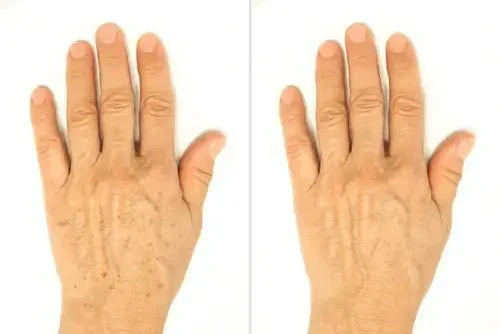
How do age spots form?
- Age – the older the skin, the greater the likelihood of discoloration.
- Light phototype – people with light skin are more susceptible.
- Frequent exposure to the sun and solarium – UVA and UVB radiation accelerates the process of discoloration.
- Lack of sun protection – especially on the hands, which we often skip when applying sunscreen.
How to recognize age spots?
- grows quickly,
- has irregular edges,
- bleeds or itches,
Cosmetics for age spots
Snail slime

- With daily, regular use of a snail slime product (e.g. at least once, preferably twice a day) for 8-12 weeks, you can achieve a visible improvement in skin tone - reduced discoloration , even skin tone, better hydration and smoothing.
- Higher concentrations of the active ingredient typically work faster and more intensely, but can be more irritating – so a good formula (with soothing ingredients like allantoin) is important to avoid irritation. This formula is provided by the Snail Slime Hand Cream.
- The skin of the hands, often dry, thin and exposed to external factors, also responds well to regenerating and moisturizing ingredients – snail slime + compounds such as allantoin/glycolic AHA acid can work synergistically.
Azelaic acid and AHA (e.g. lactic acid)
Vitamin C

For whom is the Ashwagandha Brightening Ampoule Serum particularly recommended?
- For those with more visible sun/age spots who want to act faster.
- For those who have already used regenerating cosmetics (e.g. creams with snail slime) and want to enhance the depigmentation effect.
- For mature, gray skin with uneven tone.
- For people who are ready to systematically use active ingredients and take care of UV protection, because without SPF even the best serum will not bring lasting results.
Dermatological treatments
- Chemical peels – controlled exfoliation of the epidermis.
- Laser therapy and IPL – precise removal of discolorations.
- Cryotherapy – freezing lesions with liquid nitrogen.
- Microdermabrasion – mechanical exfoliation of dead skin.
How to prevent age spots?
- Daily SPF 30–50 protection – also in autumn and winter.
- Protective gloves and a hat – an additional barrier against the sun.
- A diet rich in antioxidants – vitamin C, E, beta-carotene.
- Hydration – at least 1.5–2 liters of water per day.
- Limit smoking and alcohol – these substances accelerate skin aging and promote discoloration.
Frequently Asked Questions about Age Spots (FAQ)
Are age spots the same as discoloration?
Age spots are a type of discoloration. They are primarily caused by long-term sun exposure and the aging process. Unlike melasma or post-inflammatory hyperpigmentation, they are usually oval, well-defined, and appear primarily on the face, hands, arms, and décolleté.
At what age do age spots most often appear?
Statistically, most people notice their first age spots after the age of 50 , but they can appear after 30–40 years in people who expose their skin to the sun intensively.
Are age spots dangerous?
No, these are benign lesions that pose no health risk. However, any new skin lesion that grows, itches, bleeds, or has an irregular shape should be consulted with a dermatologist.
Why do age spots appear more often on the hands than on other parts of the body?
Because hands are constantly exposed to the sun, most people forget to apply SPF. The skin on the backs of the hands is also thinner, making it more susceptible to photoaging.
Can age spots be completely removed?
Yes, dermatological treatments (laser, IPL, chemical peels, cryotherapy) can significantly reduce their appearance and sometimes eliminate them completely. However, for long-lasting results, daily sun protection is essential.
What cosmetics help with age spots?
The most commonly used active ingredients are:
vitamin C – has a brightening and antioxidant effect,
tranexamic acid – inhibits the overproduction of melanin,
retinoids – accelerate cell renewal,
AHA and azelaic acids – exfoliate and brighten,
snail slime – supports regeneration and evens out skin tone.
Do whitening creams work on age spots?
Yes, but they require regular use for at least several weeks. For best results, combine home care with professional treatments.
Does diet affect age spots?
Yes. A diet rich in antioxidants (vitamin C, E, beta-carotene, polyphenols) helps protect the skin against free radicals and may reduce the risk of new discolorations developing.
Do age spots only appear in people with fair skin?
No, they can occur in any skin type, but people with fair skin are more susceptible because they have less natural protection against UV radiation.
Will age spots disappear on their own?
No, once discoloration occurs, it usually doesn't disappear on its own. However, it can be significantly lightened with cosmetics and dermatological treatments.
How long does it take to treat age spots?
The effects of skincare are visible after 6–12 weeks of regular use . Laser treatments or peels can produce faster results but often require a series.
Can age spots be removed with home remedies?
Home remedies (e.g., lemon masks, apple cider vinegar) can gently brighten the skin, but they aren't as effective as modern cosmetics and treatments. Furthermore, they can irritate the skin and worsen the problem.
Can age spots recur after removal?
Yes. Even after effective treatment, they can reappear if the skin isn't protected with a UV filter. Therefore, daily sun protection is key.
Does using SPF really prevent age spots?
Yes. Studies show that regular use of SPF 30–50 sunscreens reduces the risk of photoaging and discoloration by up to 40–50% compared to people who don't use sunscreen.
Can you use serum for age spots on your hands?
Yes. Although serums (e.g., vitamin C or tranexamic acid) are most often used on the face, they can also be applied to the hands. Combined with a moisturizing cream (e.g., snail slime), this provides a more effective result.