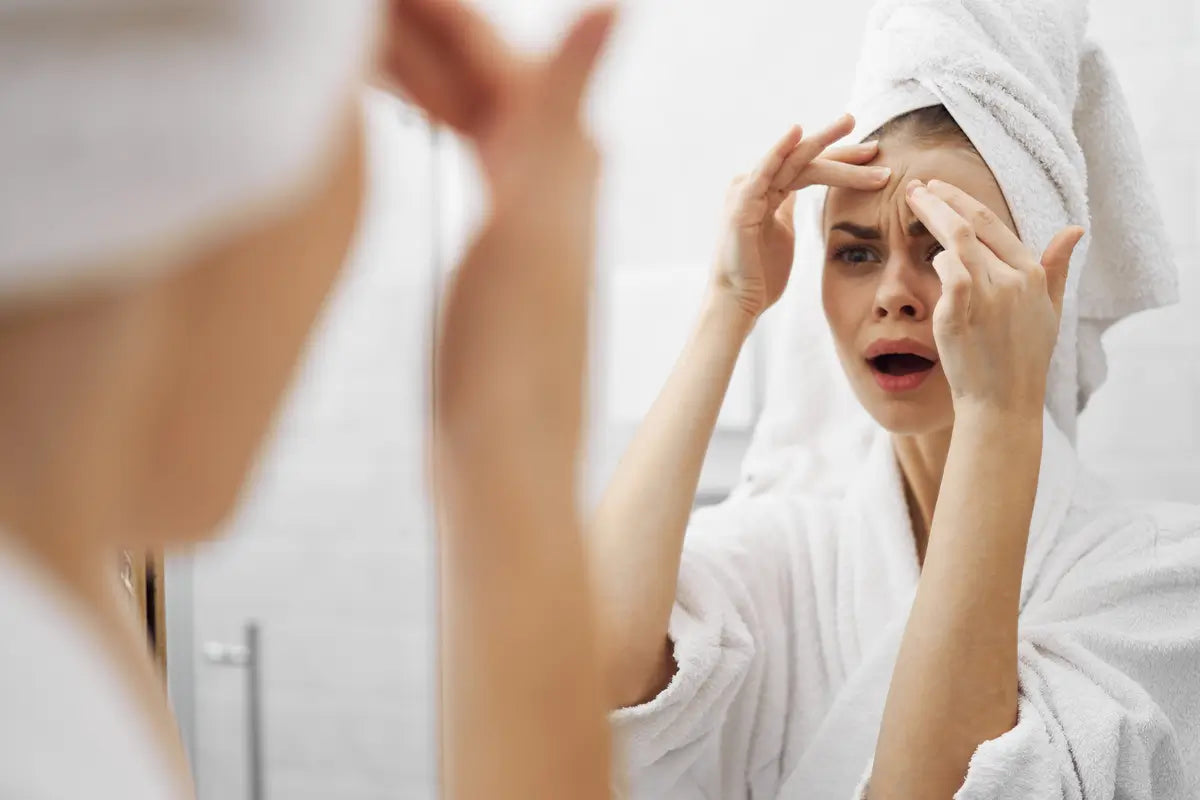
Popping pimples is one of the most common and destructive skincare habits. While it may provide a temporary feeling of "cleansing," it often leads to worsening acne, post-inflammatory hyperpigmentation, scarring, and recurrence of inflammatory lesions .
In this article I explain:
- why squeezing pimples is harmful to the skin (from a dermatological point of view),
- what are the long-term consequences of mechanical removal of lesions,
- when you absolutely must not squeeze pimples,
- and how to safely care for acne-prone skin instead of damaging it.
Squeezing pimples - why are we so tempted?
Popping pimples gives the illusion of control. A visible skin lesion is perceived as a "foreign body" that needs to be removed immediately. Additionally:
- the improvement in appearance seems immediate,
- there is a feeling of relief,
- this mechanism can be compulsive (skin picking).
Unfortunately, the skin does not regenerate in a second , and any mechanical interference triggers an inflammatory cascade that often lasts for weeks.
What is a pimple really? - briefly about the mechanism of its formation
To understand why squeezing pimples is a mistake, you need to know what an acne lesion is.
A pimple (inflammatory lesion) is the result of:
- overproduction of sebum,
- disturbed keratinization of the sebaceous gland orifices,
- multiplication of Cutibacterium acnes bacteria,
- inflammatory reaction of the dermis.
The purulent content is not found on the surface of the skin , but often deep in its structures.

Why is squeezing pimples harmful?
Spread of inflammation
When squeezing a pimple:
- the contents of the lesion are pressed deeper into the skin,
- bacteria penetrate into the surrounding tissues,
- instead of subsiding, the inflammation spreads .
Effect?
One pimple often turns into several new lesions .
Damage to the skin barrier
Squeezing pimples leads to:
- disruption of the continuity of the epidermis,
- micro-injuries,
- disorders of the protective function of the skin.
The skin becomes more susceptible to:
- infections,
- dryness,
- hyperreactivity,
- acne relapses.
Post-inflammatory hyperpigmentation (PIH)
One of the most common effects of popping pimples is post-inflammatory hyperpigmentation .
Mechanism:
- mechanical injury → severe inflammation,
- activation of melanocytes,
- overproduction of melanin at the site of the lesion.
Effect:
- red or brown spots,
- lasting for months,
- often more difficult to remove than the acne itself.
Acne scars
Popping pimples significantly increases the risk of:
- atrophic scars,
- hypertrophic scars,
- permanent skin irregularities.
Damage to the dermis during extrusion does not always regenerate properly , especially in thin, sensitive or mature skin.

Is it ever okay to pop pimples?
From a dermatological point of view - no .
The only situation in which mechanical emptying of lesions occurs is the procedure performed by a cosmetologist or dermatologist:
- in sterile conditions,
- with proper skin preparation,
- and proper post-treatment care.
Squeezing pimples yourself at home almost always ends in worsening the condition of your skin .
Worst places to pop pimples
Squeezing pimples is especially dangerous:
- in the area of the nose and the triangle of death,
- on the chin (highly vascularized area),
- on the cheeks (high risk of scarring),
- on the back and neckline (the skin heals slower there).
How to care for your skin instead of popping pimples?
An effective alternative is care that regulates, is anti-inflammatory and supports the skin barrier .
Key elements:
Cleaning
- delicate,
- no aggressive detergents,
- without disturbing the microbiome.
Sebum regulation
- ingredients that normalize the function of the sebaceous glands,
- without drying the skin.
Anti-inflammatory effect
- niacinamide,
- adaptogens,
- soothing and antioxidant ingredients.
Barrier regeneration
- ceramides,
- emollients,
- humectants that bind water in the skin.
It is systematic care , not squeezing pimples, that brings lasting improvement.
Why is “the drier you get, the better” a myth?
A very common mistake people make when squeezing pimples is:
- aggressive washing,
- alcoholic tonics,
- strong spot preparations.
Effect:
- the skin produces even more sebum ,
- the protective barrier weakens,
- acne is getting worse.
Paradoxically, dry acne-prone skin produces more pimples .
The Psychological Aspects of Popping Pimples
Squeezing pimples can be:
- reaction to stress,
- a form of emotional tension,
- a habit difficult to control.
If you notice that:
- you do it automatically,
- you can't stop,
- the skin is getting worse,
It is worth treating this as a signal to change your care routine and sometimes your lifestyle.
Squeezing pimples
Does squeezing pimples speed up healing?
No. Popping pimples prolongs the healing process and increases the risk of discoloration and scarring.
Why does another pimple appear after I pop it?
Because bacteria and inflammatory material are forced deeper into the skin, causing new inflammation.
Does popping pimples cause discoloration?
Yes. This is one of the main causes of post-inflammatory hyperpigmentation, especially in people with sensitive skin prone to hyperpigmentation.
Will pimples “go away on their own” if you don’t squeeze them?
In most cases, yes - provided that appropriate regulating and anti-inflammatory care is provided.
What to do instead of squeezing pimples?
Focus on gentle cleansing, sebum regulation, rebuilding the skin barrier and consistent care.
Summary - squeezing pimples is a road to nowhere
Popping pimples isn't a solution to acne. It only makes it worse. While it provides temporary satisfaction, in the long run it leads to:
- severe inflammation,
- discoloration,
- scars,
- skin weakening.
If you want to really improve the condition of your skin, stop fighting it mechanically and start supporting it biologically.
Share this article with someone who pops pimples. It will definitely help them.
Other similar articles:
Triangle of death on the face - what is it and how to safely care for the skin in this zone?
Chin Blemishes - Causes, Effective Care and Action Plan (Beauty Guide)
If you have oily or combination skin - Check the products