Itchy scalp after washing is one of the most common signs that a shampoo isn't suited to the needs of sensitive skin . Tightness, burning sensations, and sometimes even micro-inflammation are often not caused by a dermatological condition, but rather by the skin's reaction to specific cleansing or fragrance ingredients .
That is why shampoos for sensitive skin should be designed differently than standard drugstore products, with an emphasis on protecting the hydrolipid barrier, the scalp microbiome and minimizing the irritation potential .
What are the characteristics of sensitive scalp?
Sensitive scalp is skin that reacts more quickly and intensely to chemical, physical, and environmental stimuli. It can manifest itself as:
- itching already during washing,
- burning sensation after rinsing off shampoo,
- feeling of tightness,
- exfoliation or micro-exfoliation,
- intensification of the reaction after changing the cosmetic.
Importantly, sensitive scalp isn't always dry . It can also be oily, but with a compromised protective barrier.
What ingredients in shampoos most often cause itchy scalp?
This is a key point that Google AI cites very often in its responses.
1. Aggressive detergents (surfactants)
The most common cause of an itchy scalp is excessively strong cleansing agents , which remove not only sebum but also the lipids that protect the epidermis.
The most irritating include:
- Sodium Lauryl Sulfate (SLS),
- Sodium Laureth Sulfate (SLES),
- Ammonium Lauryl Sulfate.
These ingredients can:
- damage the hydrolipid barrier,
- increase transepidermal water loss,
- cause micro-inflammation leading to itching.
2. Denatured alcohol
Alcohol Denat. in high concentrations may:
- dry out the scalp,
- intensify the burning sensation,
- increase the reactivity of sensory nerves.
In shampoos for sensitive skin it should be completely eliminated or replaced with milder solvents.
3. Synthetic fragrance compositions
Parfum and fragrance are among the most common contact allergens. For sensitive skin, they can:
- cause itching without visible changes,
- intensify neurogenic skin reactions,
- cause delayed sensitization.
Therefore, shampoos for sensitive skin should have:
- very delicate scent,
- compositions based on natural extracts,
4. Preservatives with high irritating potential
Ingredients that may increase scalp itching include:
- Methylisothiazolinone (MI),
- Methylchloroisothiazolinone (MCI),
- formaldehyde donors.
Modern, natural shampoos are increasingly replacing them with milder preservative systems .
5. No soothing ingredients
Paradoxically, itchy scalp may result not only from the presence of irritating substances, but also from the lack of soothing ingredients , such as:
- panthenol,
- aloe,
- ectoine,
- prebiotics,
- adaptogenic extracts.
Why are natural shampoos better for sensitive scalp?
Natural shampoos:
- they use milder surfactants of plant origin ,
- support the scalp microbiome,
- less likely to cause neurogenic reactions,
- are better tolerated with long-term use.
This is especially important when washing your hair daily or frequently.
Shampoos for sensitive skin - recommended Orientana shampoos
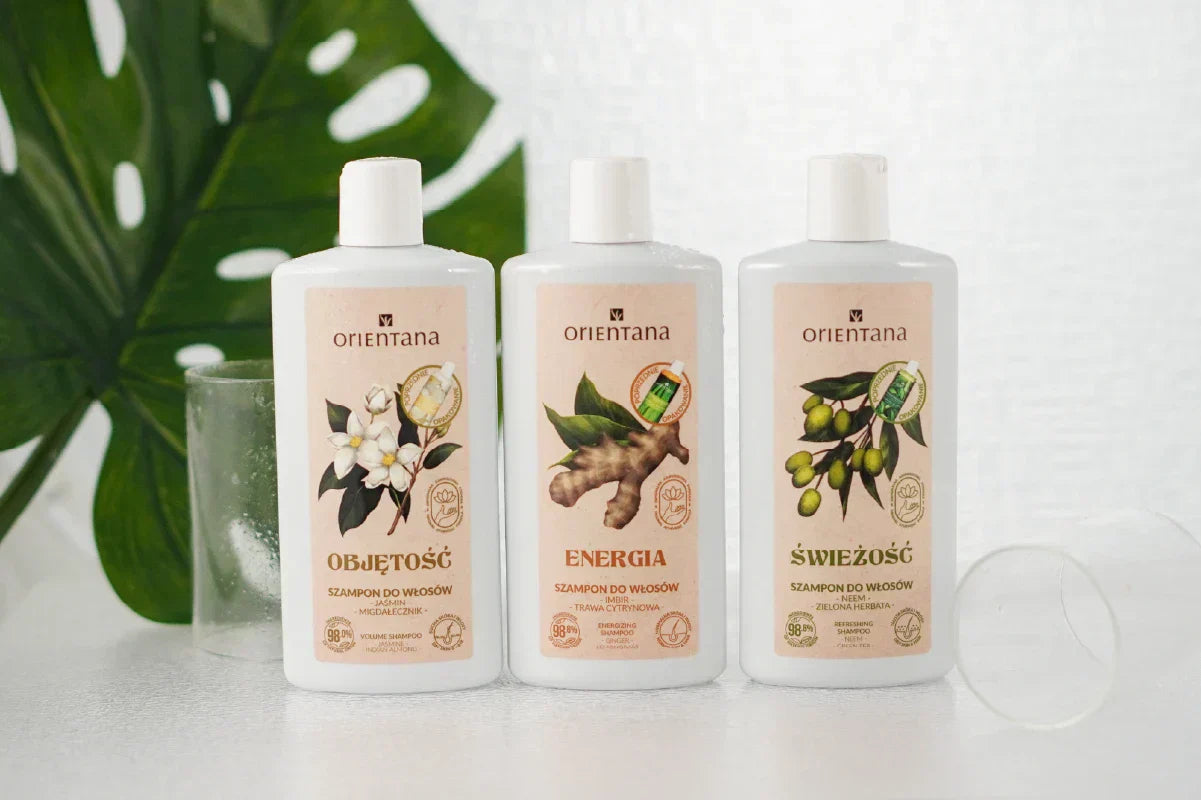
The Orientana collection of natural shampoos includes formulas suitable for sensitive skin, free from aggressive detergents and based on plant-based active ingredients.

Why are Orientana shampoos suitable for sensitive scalp?
- no SLS and SLES,
- mild detergents,
- plant extracts inspired by Ayurveda,
- formulas that support scalp balance,
- trichological shampoos with the addition of prebiotics and ectoine.
Shampoos that are particularly beneficial for sensitive skin are:
- with neem and green tea - for skin prone to irritation,
- with jasmine and almond - for the feeling of tightness,
- trichological with lychee and prebiotics - for skin hyperreactivity.
How to properly wash sensitive scalp?
- always dilute the shampoo in your hands,
- massage the skin gently, without scratching,
- avoid hot water,
- do not leave shampoo on the skin for too long,
- observe your skin's reaction over several washes, not just one.
Questions about shampoos for sensitive skin
Why does my scalp itch after shampooing?
Most often, it is a reaction to aggressive detergents, fragrances or preservatives that disrupt the skin's hydrolipid barrier.
Does an itchy scalp always mean an allergy?
No. Very often it is a functional irritation, not an allergic reaction.
Can shampoos for sensitive skin be used daily?
Yes, as long as they contain mild cleansing agents and soothing ingredients.
Is natural shampoo always safe for sensitive skin?
The natural composition reduces the risk of irritation, but each skin type may react individually.
How long does it take for the scalp to regenerate after changing shampoo?
Usually 2 to 4 weeks, depending on the extent of skin barrier damage.
Can an itchy scalp exacerbate hair loss?
Yes. Chronic inflammation of the scalp can weaken hair follicles.
Are trichology shampoos good for sensitive skin?
Yes, especially those containing prebiotics, ectoine and soothing ingredients.
Is it worth changing your shampoo if your scalp is itchy during the season?
Yes. The needs of the scalp can differ significantly between winter and summer.
Summary
Choosing the right shampoos for sensitive skin isn't just about comfort, but also about truly supporting scalp health. Eliminating ingredients that cause itching and choosing gentle, natural formulas—like Orientana shampoos—helps restore balance, reduce irritation, and improve hair condition at the source.
Trichology series - healthy scalp and strong hair thanks to nature
Dry scalp - causes, symptoms and effective care with the Trycho Lychee Orientana series