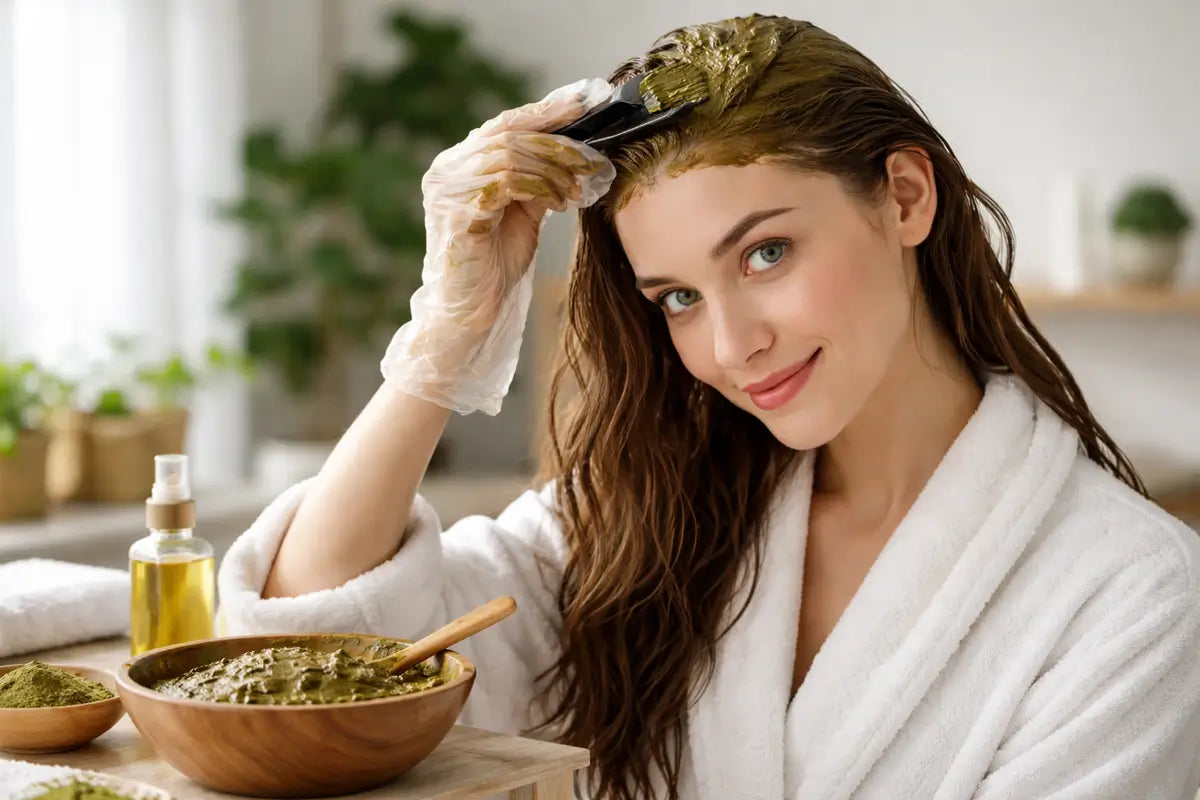
Henna for hair - interesting facts and secrets of natural coloring that you don't know
by
Anna Wasilewska - founder of the Orientana brand
Introduction - hair henna is not a dye. It's a process.
Hair henna doesn't work like classic drugstore hair dye. It doesn't provide a "one-size-fits-all" effect. It doesn't impose color.
Henna works with your hair.
That's why two people using the same mixture can achieve completely different results. And that's what makes henna not just a product - it's an experience. A ritual. A return to conscious hair care.
In this article, you will discover interesting facts that change the way you think about henna. This is knowledge that allows you not only to dye your hair - but to understand it.
What is hair henna really? (and why it works differently than dye)
Henna is made from the leaves of the plant Lawsonia inermis. Its active ingredient is a dye called lawsone.
It is this that is responsible for the entire "magical" effect.
But the key difference is that:
✳️ herbal henna does NOT lighten hair ✳️ herbal henna does NOT open the hair cuticle like chemical dye ✳️ herbal henna does NOT damage the hair structure
Instead, it binds to the hair's keratin.
This can be compared to the biological "envelopment" of the hair with pigment. Lawsone binds to proteins, creating a lasting but natural coloring effect.
What's more, hair henna also has a protective effect:
Why does hair henna never give an identical color?
This is one of the most common questions, and at the same time, henna's greatest advantage.
The final color depends on:
the natural pigment of the hair (melanin)
the sulfur content in keratin
hair porosity
coloring history
hair condition
Gray hair? It will be more intense, sometimes even vivid (because it lacks melanin), if red henna is used. Only red henna will cover gray hair and is therefore also the first stage of dyeing gray hair to another color, e.g. chocolate.
Damaged hair? It can "grab" more pigment.
Low porosity hair? The effect will be more subtle and cooler.
✳️ That's why henna never gives a "one-color-from-the-box" result. It gives your color.
Oxidation effect - why does the color change after 2 days?
This is the moment that surprises most people.
After rinsing off henna, the color often appears lighter, more reddish, or more intense. And then... it changes.
Why?
The lawsone dye oxidizes under the influence of oxygen. This process takes: ✳️ from 24 to even 72 hours
During this time:
the color deepens
becomes more natural
often slightly darkens
✳️ Therefore, do not judge the effect immediately after dyeing.
It's a bit like tea - it needs time to "mature".
Henna and pH - the secret only insiders know
The pH of the henna mixture has a huge impact on the hair coloring effect.
Acidic environment:
releases more pigment
gives a deeper, more intense color
That's why it's often used:
lemon juice
amla
hibiscus
Whereas a neutral or slightly alkaline environment:
gives a more delicate effect
✳️ This means you can consciously control the color.
Does henna thicken hair? Science says: yes
One of the most visible effects of using hair henna is:
✳️ increased hair volume
Why?
Henna:
creates a thin layer on the hair surface
increases its diameter
smoothes the cuticles
Effect:
hair appears thicker
is more shiny
frizz is reduced
✳️ This is natural hair "lamination".
Amla and other herbs - how they affect color and care
Henna rarely works alone. Most often, it is combined with other plants.
Amla
cools the shade
reduces redness
strengthens hair
Bhringraj
supports hair follicles
may reduce hair loss
Neem
works on the scalp
supports microbiome balance
✳️ This is no longer just coloring. It's trichological care.
Color mixing - natural hair colorimetry
Henna gives warm shades – from copper to mahogany. But what about browns and blacks?
Here enters the second hero: indigo.
✳️ henna = red pigment ✳️ indigo = blue pigment
Together:
they create browns
they create blacks
And now the most important thing:
more henna → warmer shade
more indigo → cooler shade
✳️ It's like mixing paints... but 100% naturally.
Hair Henna vs. Chemical Dyes - What You Need to Know
This is a topic that requires honesty.
Henna:
does not work like chemical dye
does not give a predictable result with subsequent chemical dyeing
After henna: ✳️ dye may take differently ✳️ color may be difficult to predict
Therefore:
it is worth planning your coloring consciously
do not treat henna as "temporary"
✳️ Henna is a decision, not a temporary experiment.
Biggest myths about hair henna
"Henna dries out hair"
No. A poorly chosen mixture might give that impression, but henna itself smoothes and strengthens hair.
"Henna only gives red color"
Not true. Thanks to mixtures, a full spectrum of shades can be achieved.
"Does not cover gray hair"
It does – often even better than dyes.
"It's difficult to use"
It's a matter of practice. After 2-3 uses, it becomes intuitive.
Henna in culture - more than cosmetics
Henna has been part of rituals for thousands of years.
India – mehendi decorations before marriage
Egypt – used by aristocracy
Middle East – symbol of protection and happiness
✳️ Hair color had cultural and spiritual significance.
How hair "learns" henna
This is one of the most fascinating aspects.
With regular use:
the color becomes more stable
hair "acts up" less color-wise
the effect is more predictable
✳️ pigment accumulates
This means that: Your henna after 3 months will work differently than at the beginning.
Pro tips that make a huge difference
heat = more intense color
longer time = deeper effect
oiling before henna = more subtle shade
strand test = must-have
Your henna = Your color
Henna gives something no other dye can.
✳️ control ✳️ personalization ✳️ care
If you want:
natural color
healthier hair
a "wow" effect that doesn't look artificial
✳️ reach for henna and start experimenting.
Check out our henna and create your own unique shade
FAQ
Why does henna change color after 2 days?
Because the pigment oxidizes under the influence of oxygen and deepens the color.
Does henna damage hair?
No, it acts superficially and strengthens the hair.
Can henna be mixed with other herbs?
Yes – this is the basis for color personalization and care.
Does henna thicken hair?
Yes – it creates a protective layer and increases optical volume.
How to cool down henna color?
By adding amla or increasing the indigo content.
Does henna cover gray hair?
Yes - often very intensely.
Summary
Hair henna is not for everyone. But if you understand it – you won't want to go back to dyes.
It's not a product. It's a relationship with your own hair.
Seria Clean Skin to owoc współpracy Orientana x Czytamy Etykiety - produkty 2w1 z czystymi składami, stworzone dla skóry wrażliwej, odwodnionej i reaktywnej. Dowiedz się, dlaczego oczyszczanie nie musi naruszać komfortu skóry.
Agresywne oczyszczanie niszczy naturalną równowagę pH skóry i osłabia barierę hydrolipidową. Sprawdź, jak rozpoznać zaburzone pH i jak je skutecznie przywrócić krok po kroku.
Niacynamid coraz częściej pojawia się w kosmetykach do oczyszczania. Sprawdzamy, czy ma to sens, jak działa witamina B3 w galaretkach i tonikach oraz które produkty warto wybrać.