In the world of cosmetology, active acids have always stirred controversy – some love them for their effectiveness, others fear irritation. Fortunately, science has advanced. Among the modern ingredients, gluconolactone has emerged – a gentle yet incredibly effective polyhydroxy acid (PHA) that combines exfoliating and conditioning properties without the risk of redness.
It's an ideal ingredient for sensitive, vascular, mature, and post-treatment skin. It's increasingly found in natural formulas and biotechnological cosmetics , including those offered by Orientana – a brand that combines nature and science.
Contents:
- What is gluconolactone?
- Chemical structure and PHA affiliation
- Mechanisms of action on the skin
- Comparison: Gluconolactone vs AHA/BHA
- For whom and when is it worth using gluconolactone?
- How to incorporate it into your skincare routine
- Products with gluconolactone offered by Orientana
- Summary
- FAQ
What is gluconolactone?
Gluconolactone (Gluconolactone) is an organic chemical compound belonging to the group of polyhydroxy acids (PHAs) . Its molecular formula is C₆H₁₀O₆ and its molecular weight is approximately 178 g/mol . Chemically, it is a derivative of gluconic acid – it is formed as a result of its internal cyclization, forming a stable lactone molecule.
It occurs naturally in honey, fruits , and glucose fermentation products. In cosmetology, it is valued for its gentle exfoliating, moisturizing , and antioxidant properties . For this reason, it is often called a "gentle alternative to AHAs."
Unlike glycolic or lactic acid, gluconolactone has a larger molecule size , which limits its penetration through the stratum corneum and minimizes the risk of irritation.
Source: Journal of Cosmetic Dermatology, 2023; INCIDecoder; Typology UK.
Chemical structure and PHA affiliation
PHAs (Poly-Hydroxy Acids) are the third generation of acids in cosmetology, following AHAs and BHAs. They are characterized by a larger molecule and the presence of multiple hydroxyl groups (-OH), which bind water and support the function of the hydrolipid barrier.
Gluconolactone is a lactone ring with six carbon atoms and numerous hydroxyl groups, making it not only an exfoliant but also a humectant. It is this structure that gives it multi-level effects, from gentle exfoliation to deep hydration.
Mechanisms of action of gluconolactone on the skin
Exfoliation - gentle exfoliation without irritation
Gluconolactone works on the skin's surface, loosening the connections between corneocytes in the stratum corneum. This gradually exfoliates the epidermis, leaving the complexion smoother and more radiant.
Moisturizing and humectant action
Each gluconolactone molecule has multiple hydroxyl groups that bind water molecules like a sponge. Therefore, it acts similarly to hyaluronic acid, increasing epidermal hydration and reducing transepidermal water loss (TEWL) .
Research shows that GLA has a significant effect on reducing skin pH and TEWL. GLA also has sebum-regulating properties. The difference between 10% and 30% niacinamide is minimal.
Antioxidation and protection against free radicals
Gluconolactone has the ability to chelate heavy metal ions (e.g., Fe³⁺), which limits the formation of free radicals. This prevents oxidative skin aging and supports the action of other antioxidants, such as vitamins C and E.
It is worth adding that PHAs in this respect act synergistically with polyphenols and adaptogens, e.g. Reishi or Ashwagandha, which are also found in Orientana cosmetics.
Strengthening the skin barrier and reducing TEWL
Regular use of gluconolactone improves the integrity of the epidermal barrier by increasing the synthesis of ceramides and lipids. This allows the skin to better retain moisture and become more resistant to external factors such as frost, wind, UV radiation, and smog.
Gluconolactone vs AHA/BHA - action comparison
| Property | AHA (e.g. glycolic acid) | BHA (salicylic acid) | PHA (gluconolactone) |
|---|---|---|---|
| Molecule size | small | mediocre | big |
| Exfoliating action | strong | medium | mild |
| Risk of irritation | high | moderate | low |
| Suitable for sensitive skin | ❌ | ⚠️ | ✅ |
| Moisturizing properties | medium | low | very high |
(own study based on data from INCIDecoder, Typology and Journal of Cosmetic Dermatology, 2023)
For whom and when is it worth using gluconolactone?
Gluconolactone is an ingredient that works well on almost all skin types, but is especially recommended for:
- sensitive and vascular skin - gentle, does not cause redness or burning,
- mature skin - has anti-aging properties, improves elasticity,
- dehydrated and dry skin - acts as a humectant,
- after cosmetic or dermatological treatments - supports regeneration,
- for people beginners in using acids - safe and non-aggressive.
How to Incorporate Gluconolactone into Your Skincare Routine
Use regularly, but in moderation.
Start with products with a concentration of 5-10%, 2-3 times a week.
Apply to dry skin.
PHAs work best at the right pH (approx. 3.5-4.5).
Do not combine with strong retinoids in one ritual.
On gluconolactone days, choose a light serum or moisturizer.
Protect your skin with SPF.
Although PHAs do not significantly increase photosensitivity, exfoliated skin requires protection.
Observe the effects after 2–3 weeks.
The skin becomes smoother, firmer, radiant and resistant to dryness.
Products with gluconolactone offered by Orientana
See page: Gluconolactone - Orientana
The Orientana brand offers gluconolactone in modern, multifunctional formulas that combine cleansing and care :
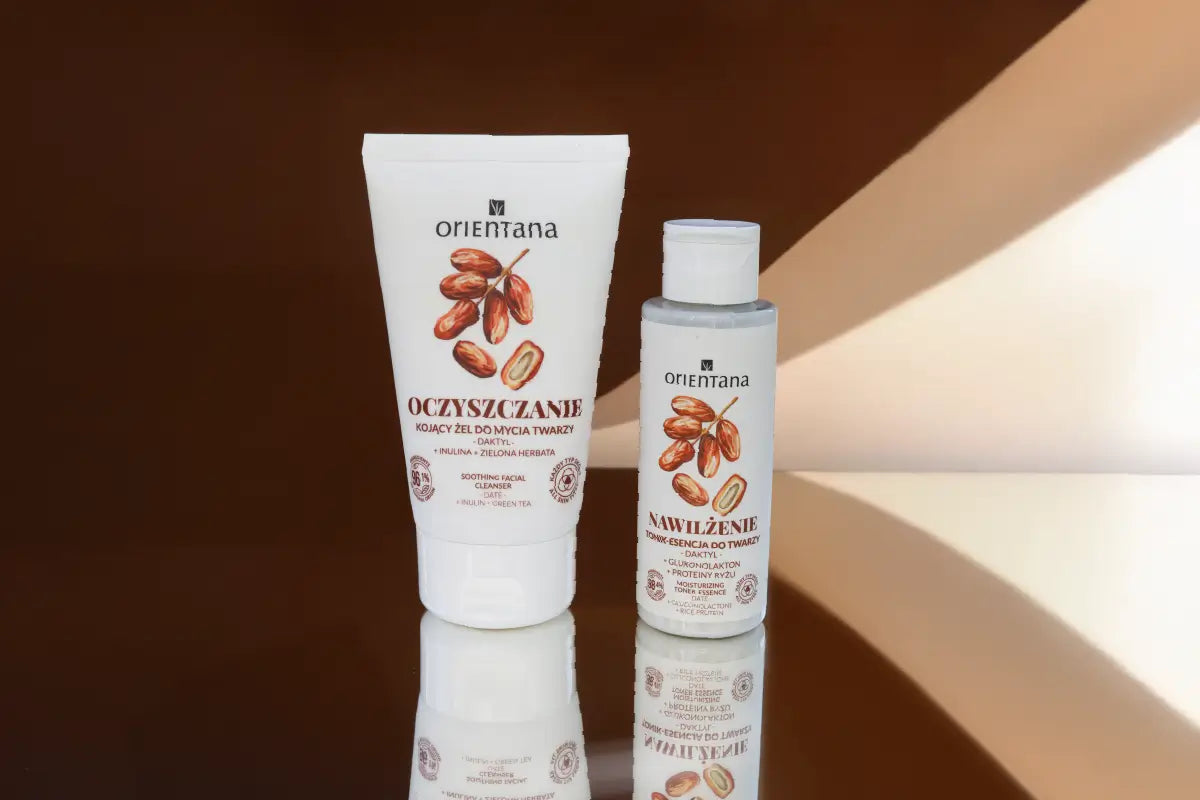
- Gentle facial cleansing gel with gluconolactone - gently removes impurities while supporting the microbiome and moisturizing.
- Revitalizing toning lotion (toning essence) with gluconolactone and date extract – tones, regenerates and prepares the skin for the next stages of care.

- Eye and eyelid serum and lion's wrinkle serum - gluconolactone combined with peptides and adaptogens has a moisturizing effect while other ingredients have a lifting and firming effect.

- TrychoL iczi Moisturizing Shampoo - Gently cleanses without tangling, while soothing and moisturizing the skin. Regular use restores comfort and balance, leaving hair feeling light, soft, and bouncy.

- TrychoLitchi Hair Serum – intensely smooths, moisturizes, and regenerates hair from within. It restores elasticity, softness, and natural shine. Upon application, it seals hair cuticles, leaving hair smooth, manageable, and pleasantly scented.
- TrychoLitchi hair lotion - actively stimulates hair follicles, increasing the rate of hair growth, while helping to regulate the oiliness of the scalp and lifting the strands at the roots.
Application tests confirm high effectiveness in improving skin hydration and comfort.
Summary
Gluconolactone is an ingredient that perfectly fits the "gentle effectiveness" trend—it combines exfoliation, hydration, and antioxidant protection. Its effectiveness is confirmed by scientific research, and its safety makes it suitable for use by people with the most sensitive skin.
If you are looking for cosmetics that use modern biotechnology but remain true to nature, reach for Orientana products with gluconolactone.
FAQ
Can gluconolactone be used daily?
Yes, if your skin tolerates it well. For sensitive skin, start with 2-3 times a week.
Does gluconolactone cause allergies?
Allergic reactions are very rare. This is one of the safest acids used in cosmetology.
Can you combine gluconolactone with retinol?
Yes, but it's best to alternate between them. Gluconolactone will moisturize and soften the effects of retinol.
Does gluconolactone increase sun sensitivity?
Not as much as AHA, but it's always worth using SPF, especially when exfoliating.
Is gluconolactone vegan?
Yes – it is obtained biotechnologically from plant glucose, without the use of animal ingredients.
Sources:
Evaluation of the effects of 10% and 30% gluconolactone chemical peel on sebum, pH, and TEWL . Jarząbek-Perz S., Dziedzic M., Rotsztejn H., and Kołodziejczak A., Evaluation of the effects of 10% and 30% gluconolactone chemical peel on sebum, pH, and TEWL, "Journal of Cosmetic Dermatology", 2023, vol.22.