Freckles are one of the most distinctive and, at the same time, most frequently searched for pigmented skin changes. For some, they are a charming distinguishing feature; for others, an aesthetic problem they wish to lighten or reduce. In this article, I explain what freckles are, why they form, whether they can disappear, how to distinguish them from other discolorations, and how to consciously and safely care for skin with freckles.
What are freckles?
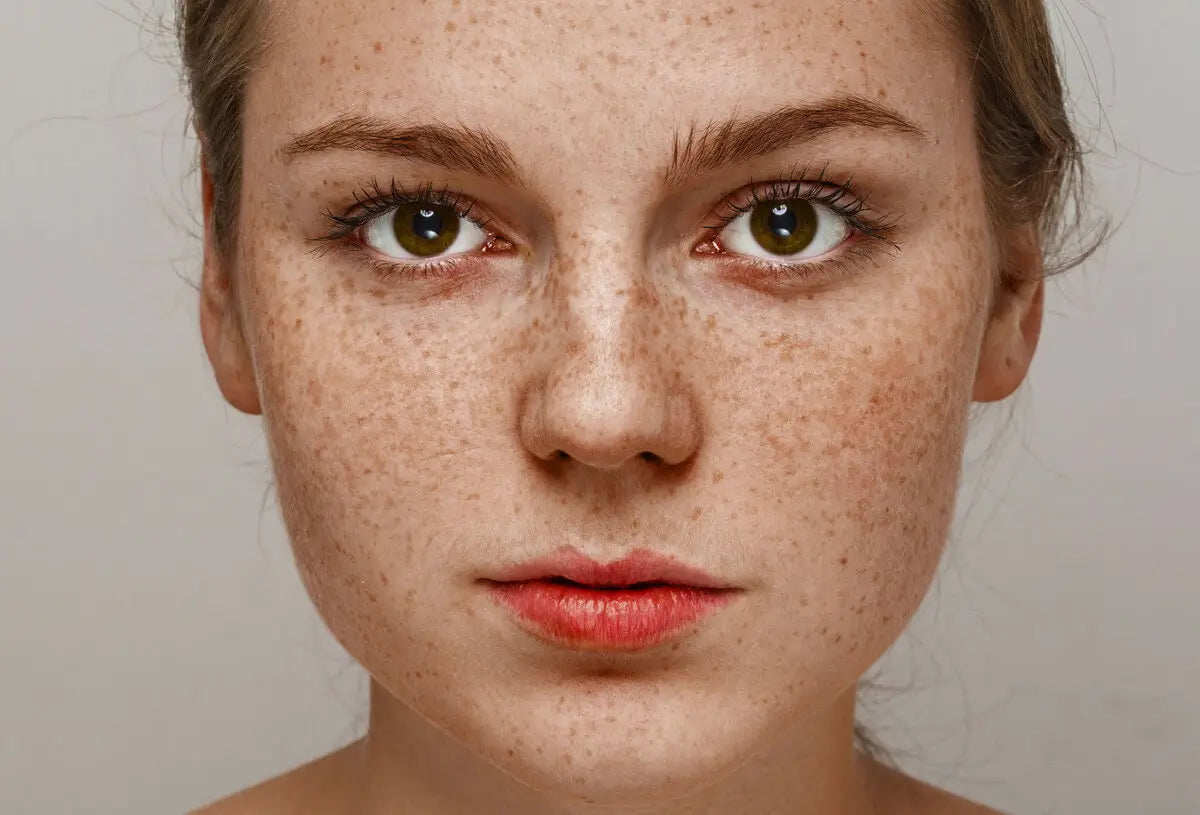
Freckles (Latin: ephelides) are small, light brown or reddish spots most commonly appearing on the face, shoulders, décolletage, and hands. They typically have a diameter of a few millimeters, an irregular shape, and intensify significantly under the influence of the sun.
Crucially, freckles are not the result of an increased number of melanocytes, but rather the result of uneven melanin production in existing pigment cells. This distinguishes them from many other skin discolorations.

Why do freckles form?
Genetics
The most important factor in the formation of freckles is genetics. The MC1R gene mutation is particularly significant, often occurring in individuals with fair complexions, red or light hair, and skin sensitive to UV radiation.
If freckles appeared in childhood, their genetic basis is very probable.
UV Radiation
The sun does not create freckles "from scratch," but it:
- activates melanocytes,
- increases melanin synthesis,
- causes freckles to become darker and more visible.
This is why they often fade in winter and intensify noticeably in summer.
Skin Phototype
Freckles are most common in individuals with phototypes I and II – very fair skin that is easily susceptible to sunburn.
Freckles vs. Discoloration – What's the Difference?
This is one of the most common questions typed into search engines.
Freckles:
- appear early (often in childhood),
- lighten in winter and darken in summer,
- are small and numerous,
- have a genetic basis.
Discolorations (e.g., melasma, sun spots):
- usually appear in adulthood,
- do not disappear seasonally,
- are larger, irregular,
- often associated with hormones, inflammation, or photoaging.
This distinction is crucial when choosing skin care.

Are freckles dangerous?
Freckles themselves are not a disease and do not pose a threat to health. However, skin on which freckles appear:
- is usually very fair,
- has lower natural UV protection,
- is more susceptible to photoaging and skin cancers.
Therefore, people with freckles should pay special attention to daily sun protection.
Can freckles disappear?
Freckles can:
- fade – especially in winter or with very consistent sun protection,
- become less visible with proper care,
- remain permanent if they have a strong genetic basis.
There is no single method that "removes freckles once and for all" without dermatological intervention.
Freckle skin care - what makes sense?
Sun Protection
This is the absolute foundation of freckle skin care:
- SPF 30–50 all year round,
- reapplication in summer,
- UVA and UVB protection.
Without this, no lightening actions will be effective.
Gentle Lightening
The goal of skin care should not be aggressive bleaching, but rather:
- evening out skin tone,
- limiting melanin overproduction,
- protection against new spots.
Ingredients that are well-tolerated by freckled skin:
- niacinamide,
- vitamin C (stable forms),
- PHA acids (e.g., gluconolactone),
- plant extracts with antioxidant properties.
Skin Barrier Support
Freckled skin is often thin and reactive. Therefore, crucial ingredients are:
- ceramides,
- squalane,
- beta-glucan,
- plant adaptogens.
A strong barrier = less melanocyte hyperreactivity.
Most frequently asked questions about freckles
Are freckles the same as discoloration?
No. Freckles have a genetic basis and react seasonally to the sun, while discolorations are usually permanent.
Why do freckles darken in summer?
Because UV radiation stimulates melanocytes to produce melanin.
Can freckles be completely removed?
Not naturally and permanently – they can only be lightened or their visibility reduced.
Can freckles appear suddenly in adults?
Usually, these are not freckles, but sun spots.
Does freckled skin age faster?
It is more prone to photoaging if not protected from UV.
Can freckles indicate illness?
No, they are not a symptom of illness themselves.
Does makeup worsen the appearance of freckles?
Heavy foundations can unevenly mask them; light formulas usually enhance the skin's natural appearance.
Can children have freckles?
Yes – they often appear as early as preschool age.
Summary
Freckles are a natural skin feature, not a defect. However, they require conscious care, based on sun protection, strengthening the skin barrier, and gently evening out skin tone. Instead of fighting them, we are increasingly learning to understand them – and to care for our skin so that it is healthy, calm, and resilient.