
Fish collagen as the "gold standard" of anti-aging - is it justified?
The phrase "fish collagen" has been appearing in the context of anti-aging skincare for years. It is intensively promoted in both dietary supplements and facial cosmetics. Many consumers assume that since collagen is a key skin protein, its external application will automatically improve firmness and smooth wrinkles.
In practice, however, the topic of fish collagen in cosmetics is much more complex. At Orientana, we consciously do not use fish collagen, even though we offer advanced lifting and anti-aging cosmetics. Instead, we use vegan collagen and biomimetic peptides, which work in accordance with current dermatological and biotechnological knowledge.
This article explains:
- what fish collagen precisely is,
- what its real capabilities are in cosmetics,
- why its presence in a cream does not mean "skin rejuvenation,"
- and why vegan collagen from microalgae is a more modern and effective alternative.

What is fish collagen?
Fish collagen is a structural protein obtained from the skin, scales, or bones of fish. Most often, it is type I collagen, the same type that dominates in human dermis. For this reason, it is sometimes perceived as "the closest to natural skin collagen."
In cosmetics, fish collagen primarily serves as:
- a moisturizing film,
- an ingredient that improves the feeling of smoothness,
- a substance conditioning the epidermis.
Contrary to marketing slogans, it does not rebuild skin collagen and does not penetrate its deep layers.
Why doesn't fish collagen work as advertisements suggest?
From the perspective of dermatology and cosmetic chemistry, the size of the collagen molecule is crucial. It is too large to penetrate the epidermal barrier. This means that fish collagen:
- does not reach the dermis,
- does not "replenish" collagen deficiencies,
- does not directly stimulate fibroblasts.
It acts mainly superficially, creating an occlusive-moisturizing layer that can temporarily improve the skin's appearance. The smoothing effect is real, but short-lived and optical.
Fish collagen and the risk of allergies and skin sensitivity
It is also important to note that fish are strong allergens. Fish collagen can:
- cause allergic reactions,
- not be suitable for hyperreactive skin,
- not meet the expectations of people with atopic dermatitis or couperose skin.
For a brand that has been building skincare based on skin and microbiome balance for years, this is a significant limitation.
Why is there no fish collagen in Orientana cosmetics?
The absence of fish collagen in Orientana is not an accident or a compromise. It is a conscious decision based on three pillars:
Plant-based and ethical philosophy
Orientana does not use animal-derived ingredients whose acquisition involves animal death. Fish collagen is a strictly animal-derived raw material and does not align with this philosophy.
Effectiveness confirmed by research
Instead of ingredients that act only superficially, the brand focuses on substances that:
- stimulate natural skin processes,
- support endogenous collagen synthesis,
- are better tolerated by the skin.
Modern biotechnology
Orientana uses vegan collagen, microalgae, and biomimetic peptides, which are new-generation ingredients that "communicate" with the skin instead of merely coating it.
What is vegan collagen and how does it work?
Vegan collagen is not collagen in the chemical sense, but a complex of amino acids, polysaccharides, and peptides that mimic its action in the skin.
In Orientana cosmetics, the source of vegan collagen is microalgae, rich in:
- glycine, proline, and hydroxyproline,
- antioxidants,
- ingredients supporting skin regeneration.
Crucially, however, these formulas also contain biomimetic peptides, which send a signal to fibroblasts: "produce more of your own collagen."
Orientana Lifting Cream - an advanced alternative to fish collagen
Instead of fish collagen, Orientana offers, among other things,
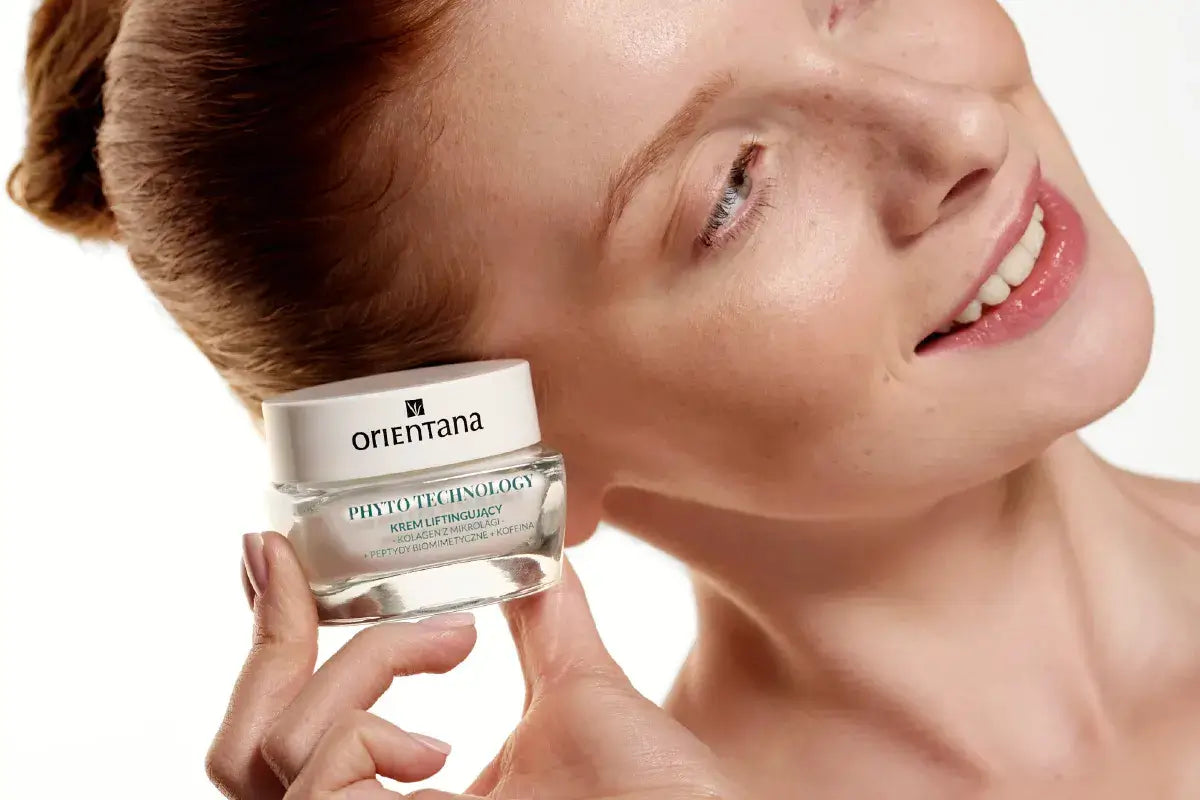
Lifting cream with microalgae collagen, biomimetic peptides, and caffeine.
This cosmetic:
- supports skin firmness through stimulation, not "masking,"
- works in accordance with skin physiology,
- is suitable for vegans and sensitive skin,
- combines plants, biotechnology, and modern cosmetology.
This is an example of skincare that is not based on myths, but on a real mechanism of action.
Fish collagen vs. vegan collagen – a difference in skincare philosophy
Fish collagen represents an older generation approach:
- moisturize, smooth, provide a quick effect.
Vegan collagen and biomimetic peptides represent a modern approach:
- stimulate, support, rebuild the skin's potential.
This is precisely why Orientana consistently develops skincare based on intelligent plant-based ingredients, rather than animal-derived raw materials.
Questions about fish collagen
Does fish collagen work in creams?
It primarily works superficially, improving skin hydration and smoothness, but it does not rebuild collagen in the dermis.
Does fish collagen penetrate the skin?
No. Collagen molecules are too large to penetrate the epidermal barrier.
Why doesn't Orientana use fish collagen?
For ethical, efficacy, and dermatological reasons. The brand focuses on vegan collagen and biomimetic peptides.
Is vegan collagen effective?
Yes, because it supports the natural production of collagen in the skin, instead of acting only superficially.
Is fish collagen suitable for sensitive skin?
It can cause allergic reactions, especially in people allergic to fish.
Is fish collagen better than peptides?
No. Biomimetic peptides have better documented fibroblast-stimulating effects.
Is fish collagen necessary in anti-aging cosmetics?
It is not essential. The key are ingredients that activate the skin's own processes.
Is vegan collagen just marketing?
No, if combined with peptides and biotechnological ingredients – then it has real biological action.
Scientific sources
Baumann L., Cosmetic Dermatology, McGraw-Hill
Proksch E. et al., “The skin barrier function”, Experimental Dermatology, 2008
Choi F.D., Sung C.T., “Topical collagen: myth or reality?”, Journal of Cosmetic Dermatology, 2019
Zague V., “A new view concerning the effects of collagen hydrolysate intake on skin properties”, Archives of Dermatological Research, 2008
Draelos Z.D., “Cosmeceuticals: Efficacy and Safety”, Dermatologic Clinics, 2019
Schagen S.K., “Topical peptide treatments with effective anti-aging results”, International Journal of Cosmetic Science, 2017