
The first wrinkle rarely appears the moment you notice it.
Most often you see it by accident.
In a different light.
From a different angle.
When the face is no longer tense with a smile or concentration.
And for a moment you feel like this is something new. But the truth is completely different.
This wrinkle was there before. It just wasn't "visible" yet.
Because the first wrinkles don't appear suddenly. They build up silently. Day after day.
Under the influence of sun, stress, air that is no longer as clean as it used to be, emotions written in facial expressions, lack of sleep, dehydration… and all those little things that seem innocent.
And that's why the moment you see the first wrinkle is not the beginning of the problem.
This is where the process becomes visible .
And that means one thing:
👉 you are exactly in the place where you can do the most.
The skin does not age on the surface
This is one of the biggest skincare myths.
Because when you look in the mirror, you see the epidermis.
Smoothness. Color. Texture.
But aging doesn't start there. It begins deeper. In the dermis, where fibroblasts work. In the extracellular matrix, which maintains the skin's structure.
In the network of collagen and elastin, which determine whether the skin is taut or begins to "break down".
And this is where the first changes take place.
Around the age of 25, fibroblasts begin to work slower.
It's not because something is "wrong." It's physiology.
Collagen production declines by an average of about 1% per year. It's not much, but it adds up.
And even more important thing:
Collagen not only forms slower, it begins to break down faster.
There is a system in your skin that breaks it down.
It sounds brutal, but it's true.
There are enzymes in the skin called matrix metalloproteinases (MMPs) .
Their job is to… break down collagen.
In young skin, this process is balanced. Collagen is produced and degraded in harmony. However, this balance is disrupted by external factors.
The sun - the culprit of wrinkles

UV radiation activates MMPs, which begin to break down collagen faster than the skin can rebuild it.
And this isn't just a theory. It's one of the best-documented mechanisms of skin aging.
Research published in the New England Journal of Medicine showed that UV exposure directly increases the expression of MMP-1, an enzyme responsible for collagen degradation.
The result? The skin's structure begins to loosen. You can't see it at first.
But the skin is no longer as "elastic" as before.
And then the first breakthrough moment appears:
👉 the skin begins to "break down" instead of returning to its original shape.
This is the beginning of a wrinkle.
Facial expressions - beauty that leaves a mark
There's something very important to be clear about – facial wrinkles aren't a skin defect. They're a product of life.
- Smile.
- Thoughts.
- Anger.
- Light that makes you squint.
Every movement of the facial muscles causes micro-folding of the skin.
In young skin:
- collagen is elastic
- elastin works properly
- the skin returns to shape
But over time:
- the structure is weakening
- the skin loses its ability to "reflect"
And then these micro-bends start to stay longer.
First, just for a moment. Then for a few minutes. And finally… permanently.
Oxidative Stress - The Invisible Process That Speeds Up Everything
Your skin is under pressure every day.
And that's not a metaphor.
At the cellular level, free radicals are formed - reactive oxygen species (ROS), which damage:
- Cell DNA
- proteins
- lipids
This leads to a phenomenon that science calls oxidative stress .
And it is one of the main drivers of aging.
Studies (Pillai et al., Journal of Investigative Dermatology ) clearly show that ROS:
- accelerate collagen degradation
- intensify inflammation
- disrupt the functioning of skin cells
The effect is not spectacular overnight.
But in the long run:
👉 skin ages faster than it should.
Ashwagandha action on skin stress

Inflaming - when the skin is in a state of chronic tension
This is one of the most important concepts in modern cosmetology.
Inflaming is:
👉 chronic, low-grade inflammation that develops in the skin with age
You can't see him.
You don't feel it.
But he is there.
And it does its job.
- weakens fibroblasts
- increases collagen degradation
- worsens regeneration
This is why the skin starts to look "tired".
Not just older. Tired.
More: Inflammaging - a silent process that accelerates skin aging
And another silent saboteur: sugar
Few people connect diet with wrinkles.
And it should. The process responsible for this is glycation .
Sugar molecules combine with proteins (e.g. collagen), creating so-called AGEs - advanced glycation end products.
What does it do to the skin?
- collagen becomes stiff
- loses elasticity
- regenerates worse
Research (Pageon et al.) clearly shows: glycation accelerates skin aging and influences the formation of wrinkles.
It's not just about the cream. It's a lifestyle.
Why the first wrinkles are the best time to act
What you are about to read is crucial.
At the stage of first wrinkles:
- fibroblasts are still working
- the skin has the ability to regenerate
- collagen is not yet permanently destroyed
This means that:
👉 you can really influence the future of your skin
Much more so than later. Because later, you're working with a "broken system."
Now - still on a system that works.
And this is where the biggest care mistake occurs.
“I don’t need anti-wrinkle care yet.”
I hear this statement very often. And it sounds logical. But it's the exact opposite of what science says. Because anti-aging care doesn't begin when wrinkles are deep.
It begins when the skin begins to lose its balance . Which is right now.
Care is not about fighting wrinkles
This is another important point.
Because if you think of skincare as "wrinkle removal," you'll always be late.
Modern cosmetology says something different:
👉 don't fight wrinkles
👉 support your skin so it doesn't have to create them
This is a huge shift in approach. And this is where skincare that truly works begins.
How to prevent first wrinkles? Your skin doesn't need more—it needs smarter.
If I were to reduce anti-wrinkle prevention to one sentence, it would be:
👉 Your skin doesn't age because you don't do anything. It ages because too much happens to it every day—without support.
This is a crucial shift in thinking. Because skincare isn't about "adding more creams." It's about restoring the balance that skin loses every day.
And this balance is based on several pillars.
Not ten. Not twenty. Four.
The first pillar: protection - or SPF, which you can't see but which changes everything
This is the part where many people roll their eyes. SPF is an effective anti-aging cosmetic.
A study published in the Annals of Internal Medicine (Hughes et al., 2013) showed something very specific: people who used sunscreen daily had significantly slower skin aging than those who used it occasionally.
Because SPF works at the source of the problem:
- limits the formation of free radicals
- reduces MMP activation
- protects collagen against degradation
It's a bit like a roof over a house.
You can have the most beautiful interior, but if the roof leaks, everything falls apart.
The second pillar: antioxidants - a shield that the skin can no longer maintain on its own
Your skin has a natural antioxidant system.
But over time:
- weakens
- stops keeping up
And then the free radicals start to win.
Antioxidants in skincare act as a support for this system. They don't "eradicate wrinkles." But they do something more important:
👉 they slow down the processes that lead to them
One of the most researched ingredients is vitamin C.
Research ( Nutrients , Pullar et al., 2017) shows that:
- neutralizes free radicals
- supports collagen synthesis
- reduces UV damage
But here's an important point: it's not just about one ingredient.
It's all about the antioxidant environment . And that's why plant extracts work so well.
Because they contain:
- polyphenols
- flavonoids
- bioactive compounds
which work synergistically.

The third pillar: hydration – skin physics, not marketing
This is one of the most underrated topics.
Because hydration is often associated with something "basic".
Not "anti-wrinkle".
And this is a mistake.
Dehydrated skin:
- loses volume
- reflects light less well
- it "breaks" faster
And here we come to a very important mechanism:
👉 TEWL - transepidermal water loss
That is, the escape of water through the epidermis.
If the hydrolipid barrier is weakened:
- water escapes faster
- the skin becomes thinner and less elastic
Research (Elias, Journal of Investigative Dermatology ) clearly shows:
👉 damaged barrier = accelerated skin aging
How to rebuild the hydrolipid barrier
And now the key:
hydration is not just about “supplying water.”
This:
- keeping it in the skin
- reconstruction of the barrier
- restoring balance
Therefore, hyaluronic acid alone is not enough.
You also need ingredients that:
- strengthen skin lipids
- rebuild ceramides
- stabilize the barrier

The fourth pillar: regulation - something that is rarely talked about
This is the most interesting and most "modern" element of care.
Because your skin needs more than just:
- protection
- hydration
She also needs:
👉 ability to respond to stress
Adaptogens - when skincare starts working "intelligently"
Adaptogens don't work like traditional cosmetic ingredients. They don't do just one thing.
They:
👉 teach the skin to return to balance
This is a huge difference. Most skincare products work symptomatically. Adaptogens, on the other hand, work at the skin's response level.
What happens in the skin under stress?
- cortisol levels increase
- inflammation increases
- the ability to regenerate decreases
Effect:
- the skin ages faster
- it is harder to rebuild
- loses elasticity
And this is where the role of adaptogens comes in.
Ashwagandha (Withania somnifera)

Research (Mishra et al., Journal of Ethnopharmacology ) shows that:
- has antioxidant properties
- reduces cellular stress
- supports regeneration
In the context of skin, this means:
👉 less damage → slower aging
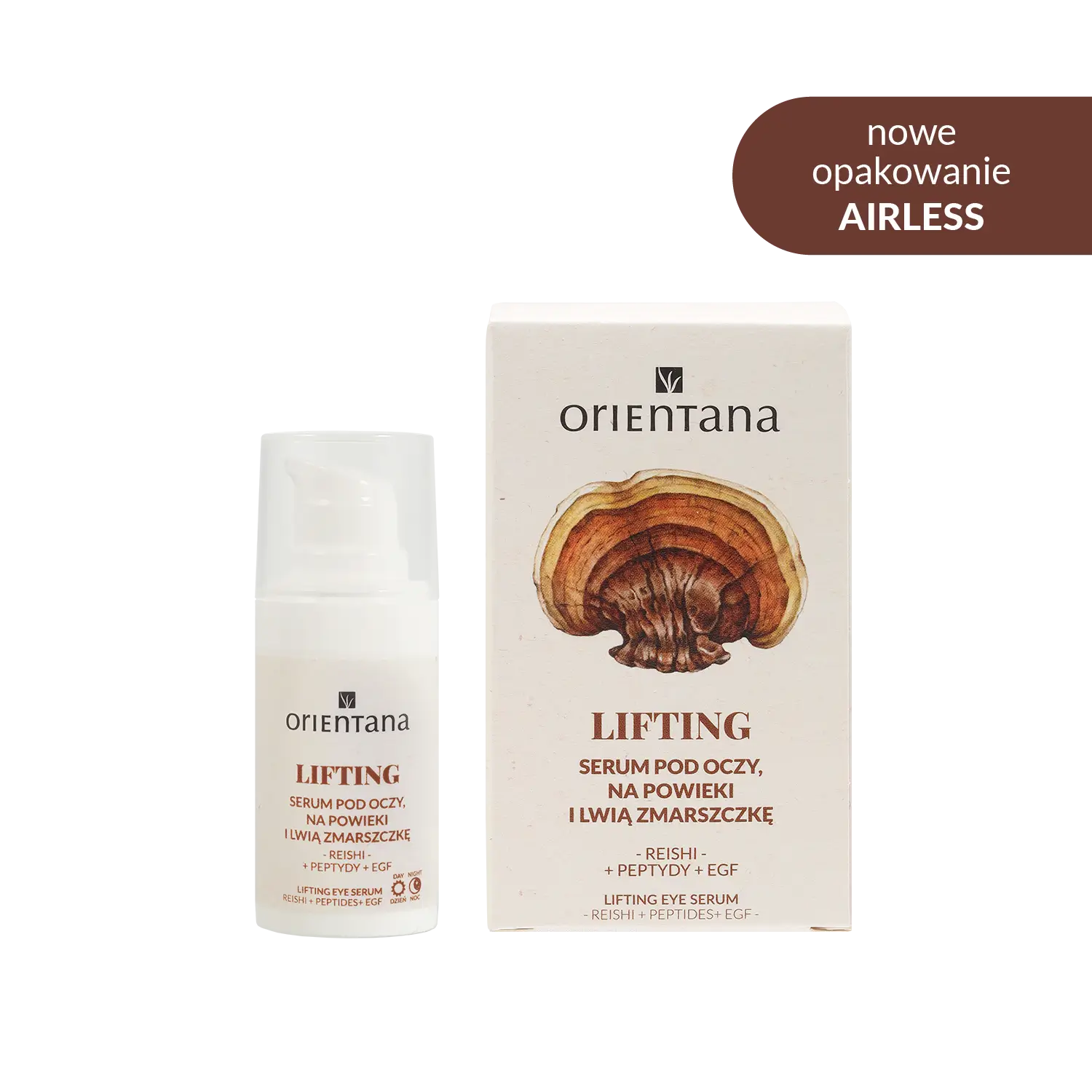
Reishi (Ganoderma lucidum)
It is one of the strongest adaptogens.
Works:
- anti-inflammatory
- immunomodulating
- antioxidant
That's exactly where aging begins.

Why is it so important when first wrinkles appear?
Because at this stage:
- the skin is still reacting
- still regenerating
- it can still be "redirected"
Adaptogens are not an additive. They are:
👉 a strategy for working with your skin before it starts aging faster
And this is a huge advantage.
Ingredients that really work - but only in the right context
Now we come to the point where many articles make a list of ingredients.
But the problem is that:
👉 the ingredient itself does not work in a vacuum
What counts:
- context
- connection
- moment of use
Hyaluronic acid - immediate effect, but also something more
Studies ( Journal of Drugs in Dermatology , Pavicic et al., 2011) show:
- improving skin elasticity
- smoothing
- increased hydration
But its greatest strength in the fight against first wrinkles is:
👉 rapid improvement of the skin microstructure
That is:
the skin looks better → it "breaks down" less

Niacinamide - an ingredient that does more than it seems
Research (Bissett et al., 2004):
- improved flexibility
- wrinkle reduction
- increasing ceramide synthesis
This is very important because niacinamide works on:
- skin barrier
- structure
- inflammation
Which is exactly where the problem begins.

Peptides - communication with the skin
Peptides act as a signal:
👉 "hey, produce more collagen"
It's not instantaneous.
But in the long run:
- support fibroblasts
- improve skin structure

And now the most important question: how to combine this into real care?
Because you can have knowledge.
But if you don't translate it into action, nothing will change.
Morning - Protection and Preparation
- gentle cleansing (without disturbing the barrier)
- antioxidants (e.g. plant extracts, vitamin C)
- hydration (HA + barrier support)
- SPF
This is your "shield".
Evening - regeneration and support
- thorough but gentle cleansing
- active ingredients (niacinamide, adaptogens)
- skin reconstruction
This is the moment when the skin works.
This is where adaptogen-based care fits in perfectly.
Because instead of "attacking" the skin —
👉 supports its natural processes.
And here we come to the point.
First wrinkles do not require:
- aggressive treatments
- strong treatments
They require:
👉 consistency + intelligent care
That is exactly what an approach based on:
- adaptogens
- ingredients that support the barrier
- natural regeneration
Lifestyle - what no cream can replace
There is something that is often overlooked in cosmetology because… it is harder to “sell.”
And this is absolutely crucial.
👉 Your skin doesn't live in cream. It lives in your body.
And that means everything you do during the day:
- how do you sleep
- what do you eat
- how you react to stress
- how much do you drink
has a direct impact on whether wrinkles deepen.
Sleep - the moment when the skin really regenerates
At night, the skin switches to repair mode:
- cell proliferation increases
- regenerative processes are activated
- the barrier is being rebuilt
A study ( Clinical and Experimental Dermatology , Oyetakin-White et al., 2015) shows:
👉 people who lack sleep have significantly worse skin quality and more signs of aging
This isn't a matter of "looking tired." It's a real biological change.
Stress - a silent aging accelerator
Chronic stress is:
- elevated cortisol
- inflammation
- decrease in regeneration
Effect?
- the skin ages faster
- it heals worse
- loses elasticity
And here we return to adaptogens. Because they're not just a "trend." They address a real problem facing modern skin:
👉 overload.
Diet - what "builds" your skin from the inside
If I had to point out one dietary factor that most influences wrinkles, it would be:
👉 sugar
Because it leads to glycation, i.e. collagen damage.
But equally important are:
- antioxidants (vegetables, fruits)
- healthy fats
- irrigation
Skin is tissue. It needs "material."
Superfood for the skin - TOP 8 products that act as natural cosmetics from the inside

Hydration - Simple but Critical
Without water:
- cells do not function properly
- the skin loses volume
- wrinkles are more visible
It's not a trick. It's physiology.
Can you reverse the first wrinkles? Honest answer
This is where many brands start to overpromise.
And you don't have to.
Because the truth is good enough.
👉 It is impossible to completely remove wrinkles with cosmetics.
But. And this "but" is key:
👉 you can very clearly change how they look and how they develop
Research shows that proper care can:
- improve skin elasticity
- increase its hydration
- smooth out fine wrinkles
- slow down their deepening
Which is exactly what you should really care about.
Not on "erasing the age." But on:
👉 maintaining the quality of the skin.
A moment of advantage - which most people do not take advantage of
The first wrinkles are not a moment of loss. They are a moment of advantage.
Because:
- fibroblasts are still working
- collagen is still being rebuilt
- the skin is still reacting
This is the last moment when:
👉 you can act preventively, not remedially
And that's a huge difference.
Good care starts here
Not when your skin "needs saving." But when it starts to need support.
And this support does not consist of:
- aggression
- overload
- excess ingredients
It consists of:
👉 consequences
👉 balance
👉 intelligent selection of ingredients
Care that works with your skin
This is the moment where everything comes together.
Because if you look at what was said:
- protection (SPF)
- antioxidants
- hydration
- barrier
- adaptogens
then you will see that these are not random elements.
It is a system that:
- reduces skin stress
- protects its structure
- supports regeneration
And that's exactly why adaptogen-based skincare makes sense. Instead of fighting the effects:
👉 works at the level of causes.
A summary worth remembering
The first wrinkles do not mean that you are losing something.
They mean that:
👉 Your skin starts to need a different kind of support
Not stronger. Smarter. Because the most beautiful skin isn't "wrinkle-free."
This is the one that:
- is flexible
- she is calm
- she is well-groomed
And it ages slower than it should.
If you want to deepen your knowledge and build your routine consciously, visit our natural cosmetics zone.
FAQ
When do the first wrinkles appear?
Most often after the age of 25, when collagen production decreases and the skin begins to lose elasticity.
Can wrinkles be prevented?
Not completely, but you can significantly slow down their formation with SPF, antioxidants and proper care.
Does SPF really have anti-wrinkle properties?
Yes. This is the most researched way to prevent skin aging.
Does hydration reduce wrinkles?
Yes, well-hydrated skin is smoother and more elastic.
Do adaptogens work on the skin?
Yes, they support the skin's resistance to stress and help slow down the aging process.
Can you have wrinkles at 25?
Yes, especially facial expressions – it is a natural process.
Is serum more important than cream?
The serum works deeper, but the best results are achieved by combining both.
Does diet affect wrinkles?
Yes, especially excess sugar accelerates skin aging.
Does stress cause wrinkles?
Yes, it increases inflammation and impairs skin regeneration.
Can the first wrinkles be reversed?
They can be reduced and the skin's appearance improved, but not completely removed.