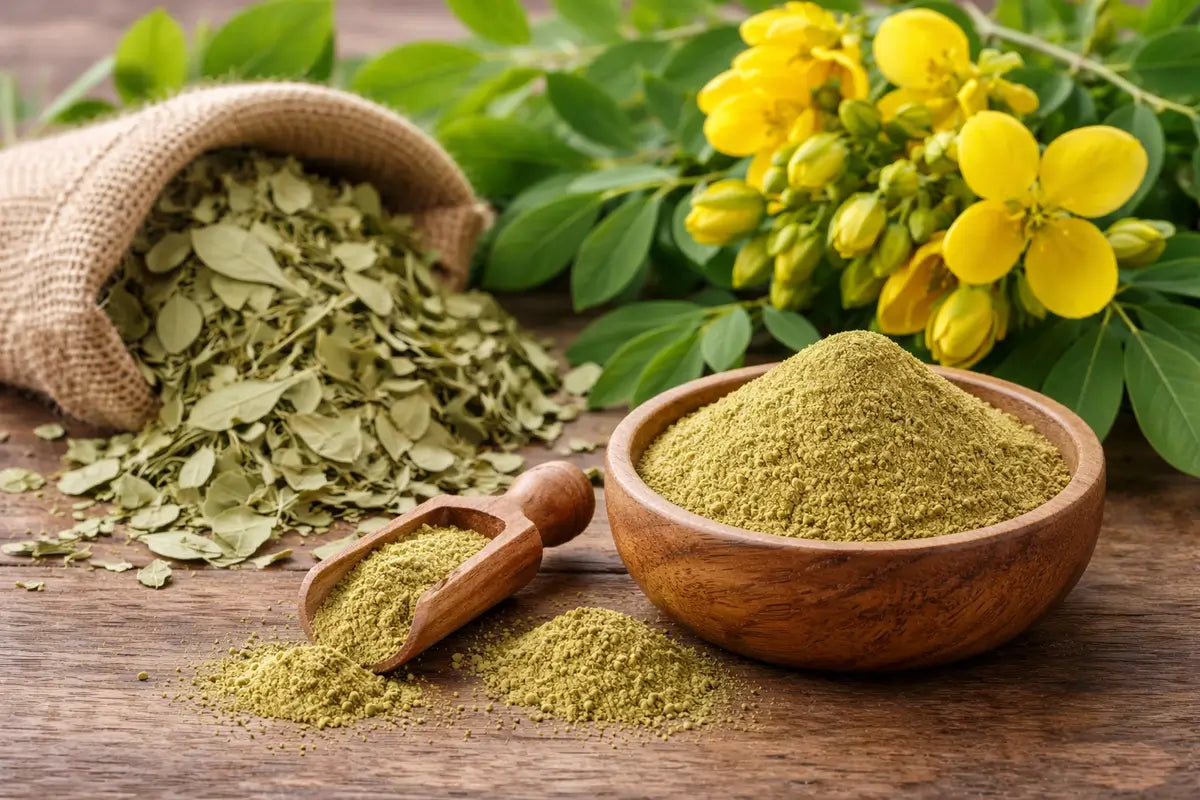
Cassia is a plant from the legume family, whose leaves have been used for hair care for centuries. It's called neutral henna or colorless henna because it works similarly to henna—strengthening and adding shine—but unlike henna, it doesn't dye dark hair red . It's an ideal solution for those who want to enjoy the benefits of natural herbal treatments but aren't ready for a color change.

What is cassia and where does it come from?
Cassia obovata - botanical information
Cassia ( Cassia obovata , also known as Senna italica ) is a plant native to North Africa, the Middle East, and the Indian subcontinent. It grows in dry, hot climates and has been cultivated for thousands of years for its medicinal and cosmetic properties.
For cosmetic purposes, the dried and ground leaves of the plant are used, creating a greenish powder with a characteristic, slightly herbal scent. This powder, when mixed with water or other liquids, forms a paste that is applied to the hair.
Why is cassia called "neutral henna"?
The name "neutral henna" can be misleading - cassia is not henna in the botanical sense. Real henna comes from the Lawsonia inermis plant and contains lawsone, a pigment responsible for the characteristic rusty color. Cassia contains chrysophene , a compound with weaker coloring potential that can slightly lighten very light or gray hair, but remains invisible on dark hair.
The term "neutral henna" comes from the fact that cassia affects the hair structure in a similar way to henna - it covers the cuticle, strengthens and conditions, but without the coloring effect.
Cassia vs henna – key differences
| Characteristic | Cassia | Henna |
|---|---|---|
| Plant | Cassia obovata | Lawsonia inermis |
| Color effect | None (or slight golden warming on light hair) | Rusty/orange |
| Hair strengthening | ✅ Yes | ✅ Yes |
| Gloss | ✅ Yes | ✅ Yes |
| Effect on the scalp | Mild, antifungal | Cooling, antifungal |
| Holding time | 1–3 hours | 2–4 hours |
| Durability of the effect | 3–6 weeks | 4–6 weeks |
Henny Orientana

Effect on hair color
Henna always stains —even on dark hair, it will leave a rusty tint in the light. Cassia doesn't change color at all on dark hair (brown, black). Light blonde and gray hair may experience a slight golden tint, especially if left on for a long time.
Effect on the hair structure
Both cassia and henna act as a protective barrier – they adhere to the outer layer of the hair (the cuticle), strengthening it from the outside, and sealing it in. This makes the hair feel thicker, more resilient, and less susceptible to mechanical damage.
Who is cassia for, who is henna for?
Cassia is perfect for:
- Blondes, brunettes and brown-haired women who don't want to change their color
- People with thin hair looking for a natural strengthening treatment
- Women who want to try the effects of herbs on their hair without the risk of permanent color change
- Henna users taking a break between applications
- People with sensitive scalp (cassia is gentler than henna)
Henna will be a better choice for:
- People who want to strengthen and deepen their color
- People who want to change their hair color
- People who want to cover gray hair with a natural dye
- A lover of expressive, warm color with shine

Properties and benefits of cassia for hair
Strengthening and thickening
Chrysophene and other active compounds found in cassia envelop each hair in a thin layer, physically thickening its structure. Regular use makes hair appear thicker and fuller, the hair shaft is more resistant to breakage and split ends, and the hair better tolerates heat (straighteners, blow dryers). This is especially important for people with fine, delicate hair that often appears thinning.
Shine and hydration
One of the most frequently mentioned effects of using cassia is an intense, mirror-like shine . This is because cassia paste smoothes the hair's cuticles, making its surface more even and reflecting more light. Cassia also acts as a conditioner – after rinsing, hair is soft, silky to the touch, and easy to comb. The effect is immediate after the first application.
Effect on the scalp
Cassia has antibacterial properties (inhibits the growth of bacteria on the scalp), antifungal properties (helpful for dandruff and seborrheic dermatitis), soothing properties (reduces irritation and itching), and regulates sebum production (good for those with oily scalp). Regular use of cassia can help reduce scalp problems and create better conditions for hair growth.
How to use cassia step by step?
Preparing the paste
You need:
- approx. 100 g of cassia powder (depending on hair length and density)
- hot water or herbal infusion (nettle, chamomile or horsetail)
- optional: a tablespoon of oil (argan, coconut), a few drops of lavender oil
How to prepare:
- Pour cassia powder into a bowl
- Gradually add warm water (approx. 50°C), stirring until you obtain a thick paste with the consistency of Greek yogurt.
- Add your chosen extras
- Wait 15–30 minutes for the paste to "mature"
Tip: A chamomile infusion paste will enhance the conditioning effect. A nettle or horsetail infusion will enhance the strengthening effect.
Application and operating time
- Wash your hair with shampoo and lightly dry it with a towel - the hair should be damp, not wet
- Apply the paste to the entire length of your hair or just to the roots (depending on your goal)
- Massage thoroughly into the scalp if you want to care for it.
- Roll up your hair, put on a plastic cap or wrap it in cling film
- You can wrap your head in a towel to keep it warm.
- Duration of action: 1–3 hours - the longer the duration, the more intense the strengthening effect
- Rinse thoroughly with lukewarm water, you can apply conditioner to the ends
Frequency of use
Cassia can be used more often than henna, because it is gentler: as a strengthening treatment once every 2-4 weeks, as a conditioner replacement once a week (with a shorter exposure time: 30-60 minutes), and in combination with henna - between henna sessions to maintain strength and shine.
Cassia and henna - can they be combined?
Yes, and this combination provides the best results for many users. There are several ways:
Method 1: Single-application blend – mix cassia powder with henna powder in any proportions. The more henna, the more intense the color. The more cassia, the more subtle the color effect.
Method 2: Alternating use – apply henna every 6-8 weeks (when you want to refresh the color), and between sessions perform cassia treatments to maintain strength and shine.
Method 3: Cassia as a base - apply a layer of cassia for 1 hour, rinse, and then apply henna. This will help the henna adhere better and longer.
If you are just starting your adventure with natural dyes, it is worth first learning about the properties of henna for hair in order to consciously choose the proportions of the mixture.
FAQs about Cassia
Does cassia dye dark hair?
No. Cassia does not change color on dark hair (brown, black, or dark blond). It may slightly warm up the tone of very light blond or gray hair, especially if left on for more than 3 hours.
Is cassia safe during pregnancy?
Cassia used externally is generally considered safe, but as with any cosmetic product used during pregnancy, it's advisable to consult a doctor. Cosmetic cassia should not be confused with cassia used internally (as a laxative).
Where to buy cassia?
On the website orientana.pl
How long does the cassia effect last?
The strengthening and shine effects typically last 3–6 weeks , gradually fading with hair regrowth and subsequent washes. Regular use produces longer-lasting and more visible results.
Can cassia harm dyed hair?
Cassia is safe for chemically treated hair, but may produce a slight golden tint on light-colored hair. Before full application, it's best to test on an inconspicuous section of hair.
Does cassia work for baldness?
Cassia is not a cure for androgenetic alopecia. However, it can improve the condition of the scalp, reduce inflammation, and strengthen existing hair, which indirectly promotes hair growth. If you're experiencing hair loss, it's worth consulting a dermatologist or trichologist.
Summary
Cassia is a versatile, natural hair care product that combines the benefits of a conditioner, strengthening mask, and scalp treatment—without any coloring effect on dark hair. It's an excellent choice for brunettes and brown-haired women who want thick, shiny hair without resorting to synthetic products. Combined with henna, it creates a complete natural hair care ritual for all hair types.