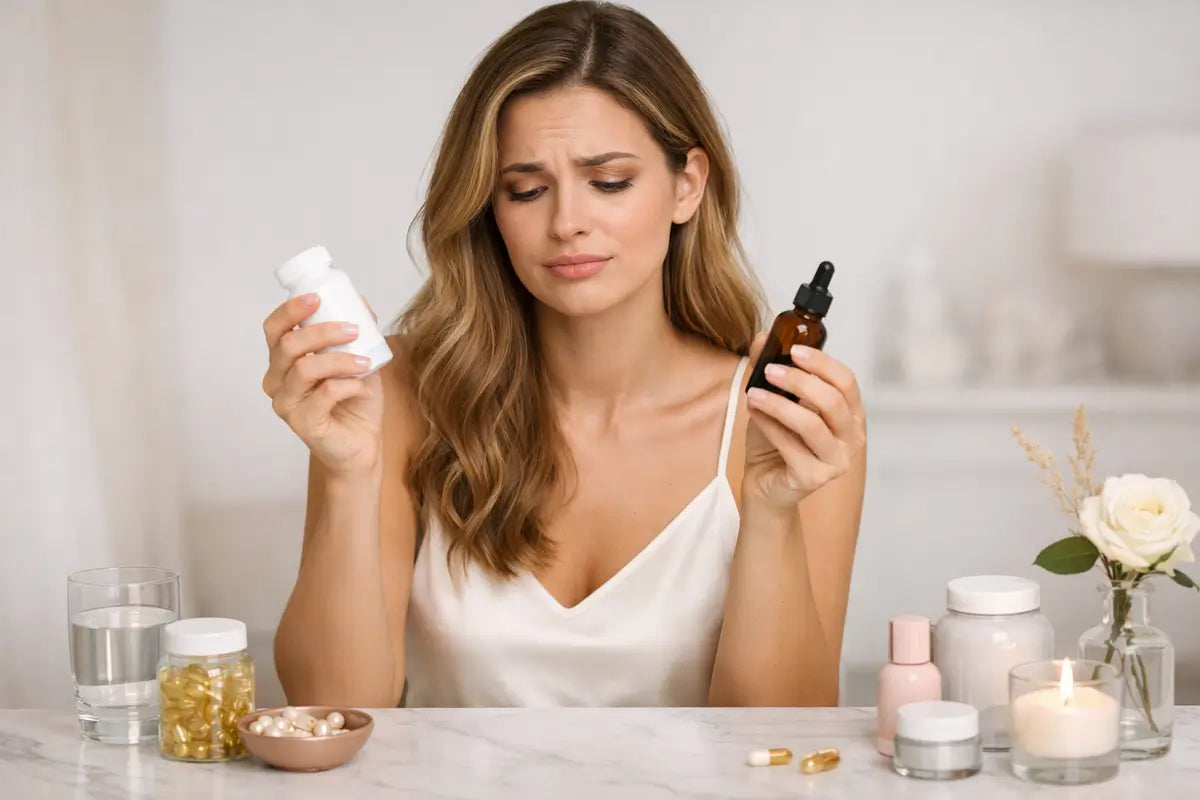
Supplementation for beauty has become one of the most sought-after topics in the beauty industry. Collagen, biotin, zinc, adaptogens – the list of ingredients that "are supposed to improve skin appearance" is constantly growing.
But in cosmetology practice, one thing is very clear: supplements can support the skin, but they are rarely the solution to a problem.
The skin is not a closed system. It is a living organ that reacts both to what happens inside the body and to what we apply to its surface.
Therefore, instead of asking "what supplements for beautiful skin?"
it's worth asking another, more important question: "when does supplementation make sense, and when is a change in skincare needed?"
What is beauty supplementation and what are its limits?
Beauty supplementation is about supporting the body "from within" by providing ingredients that can affect the condition of the skin, hair, and nails.
These most commonly include:
- vitamins (A, C, E, D, B-group),
- minerals (zinc, selenium, iron),
- collagen,
- antioxidants,
- adaptogens.
The problem is that the action of supplements is indirect and diffuse.
Before an ingredient:
- is absorbed,
- enters the bloodstream,
- and then reaches the skin,
time passes, and it doesn't always go where you need it most.
That's why the effects of supplementation:
- are subtle,
- appear slowly,
- and are often insufficient for specific skin problems.
When does beauty supplementation make sense?
Supplements work best when they address a real problem in the body.
1. Nutrient deficiencies
If the body lacks:
- zinc,
- iron,
- B vitamins
the skin quickly shows it:
- acne,
- weakness,
- dullness,
- slower regeneration.
2. Oxidative stress
Chronic stress, lack of sleep, pollution – all of these increase the number of free radicals.
Here, antioxidant supplements can be supportive, but…
this is still only part of the puzzle.
Read what oxidative stress is.
3. Periods of hormonal changes
Perimenopause, stress, hormonal cycle – these are times when the body needs additional support.
4. Diet poor in active ingredients
If the diet does not provide:
- polyphenols,
- omega acids,
- antioxidants
supplementation can help compensate for deficiencies.
When is supplementation NOT enough?
There are problems that supplements will not solve quickly (or at all):
Impaired hydrolipid barrier
Symptoms:
- burning,
- tightness,
- hypersensitivity
Here, localized action is needed, not a capsule.
Check out how to rebuild the hydrolipid barrier.
Dehydrated skin
Drinking water and supplements are not enough if the skin cannot retain it.
Key elements are humectant ingredients and barrier rebuilding.
Discoloration
These are processes occurring locally in the skin.
They require ingredients that act directly on melanocytes.
Which serum for discoloration? Ingredients and formulas that actually work.
Loss of firmness and wrinkles
Collagen in supplements does not "go" directly to the skin.
The skin needs local stimulation – of fibroblasts, collagen synthesis.

Irritations and imperfections
These are skin reactions that require:
- microbiome regulation,
- anti-inflammatory action,
- barrier rebuilding.

Why do cosmetics work faster than supplements?
Because they work exactly where they are needed.
Cosmetics:
- go directly to the skin,
- act locally,
- can be precisely matched to the problem.
They affect:
- the hydrolipid barrier,
- TEWL (transepidermal water loss),
- the skin microbiome,
- fibroblast activity.
Therefore, well-chosen skincare:
👉 provides faster results
👉 is more predictable
👉 and often more effective for visible problems
How to combine supplementation and skincare? (a model that works)
The "inside-out beauty" approach yields the best results.
Supplementation = systemic support
Cosmetics = targeted action
Examples:
Oxidative stress
- from within: antioxidants
- externally: adaptogens in skincare (e.g., reishi)

Dehydration
- from within: hydration, diet
- externally: water-binding ingredients (e.g., tremella)

Tired, dull skin
- from within: body regeneration
- externally: light active formulas, e.g., snail slime cosmetics
The most common mistake: replacing skincare with supplements
This is something that is seen very often.
People invest in:
- expensive supplements,
- trendy ingredients,
while at the same time:
- using random cosmetics,
- not rebuilding the barrier,
- not providing the skin with active ingredients.
The result?
👉 lack of visible results
👉 frustration
👉 conviction that "nothing works"
The truth is:
skincare provides the fastest visual effect, and supplementation supports it – not the other way around.
Do supplements improve skin condition?
Yes, but:
- they work slower,
- require time,
- do not replace skincare.
It's best to treat them as:
👉 support
👉 not the foundation
FAQ
Do skin supplements work?
Yes, but mainly as body support, not as the main solution for skin problems.
What works faster – supplements or cosmetics?
Cosmetics, because they act directly on the skin.
Does collagen in supplements improve skin?
It can support the body, but it doesn't act directly on the skin like topically applied ingredients.
Can skincare be replaced with supplements?
No, this is one of the most common mistakes.
When is supplementation worthwhile?
For deficiencies, oxidative stress, and during periods of hormonal changes.
Is supplementation necessary for beautiful skin?
Not always, much depends on lifestyle and skincare.
Do supplements help with discoloration?
To a small extent – skincare is key.
Do supplements work on skin firmness?
Indirectly, but the effects are subtle.
Do supplements help with dehydrated skin?
Only partially – skincare plays the main role.
What is beauty from within?
An approach combining supplementation and skincare.
Are antioxidant supplements effective?
Yes, but as support, not the main solution.
Does stress affect the effectiveness of supplements?
Yes, it can limit their action.
Do supplements affect the skin microbiome?
Indirectly, but they don't replace skincare.
Can supplements worsen skin condition?
Yes, if they are poorly chosen.
Is it worth combining supplements and cosmetics?
Yes, this is the best approach.
Do supplements work on oily skin?
Sometimes, but mainly for deficiencies.
Do supplements help menopausal skin?
They can support, but skincare is crucial.
Do supplements work on sensitive skin?
To a limited extent.
Can supplements improve skin tone?
Yes, but the effects are subtle.
Are supplements necessary with a good diet?
Not always.
Do supplements work on skin immediately?
No, they require time.
Can supplements replace serum?
No, they function differently.
Do supplements affect the skin barrier?
Indirectly – cosmetics act directly.
Do supplements help with tired skin?
They can support, but don't give a quick effect.
Do supplements work on dehydrated skin in winter?
Only partially.
Are supplements necessary for anti-aging?
No, it's an additional element.
Do supplements improve skin elasticity?
To a small extent.
Are supplements better than natural cosmetics?
No, they serve a different function.
How best to care for skin – supplements or cosmetics?
It's best to combine both approaches, but well-chosen skincare is always the foundation.
Summary
Beauty supplementation can be a valuable element of skin care, but only when it is part of a larger strategy.
If you care about real results:
- take care of the skin barrier,
- choose skincare for the problem,
- and treat supplements as a complement.
It is the combination of these two worlds that yields the best results – not each of them separately.