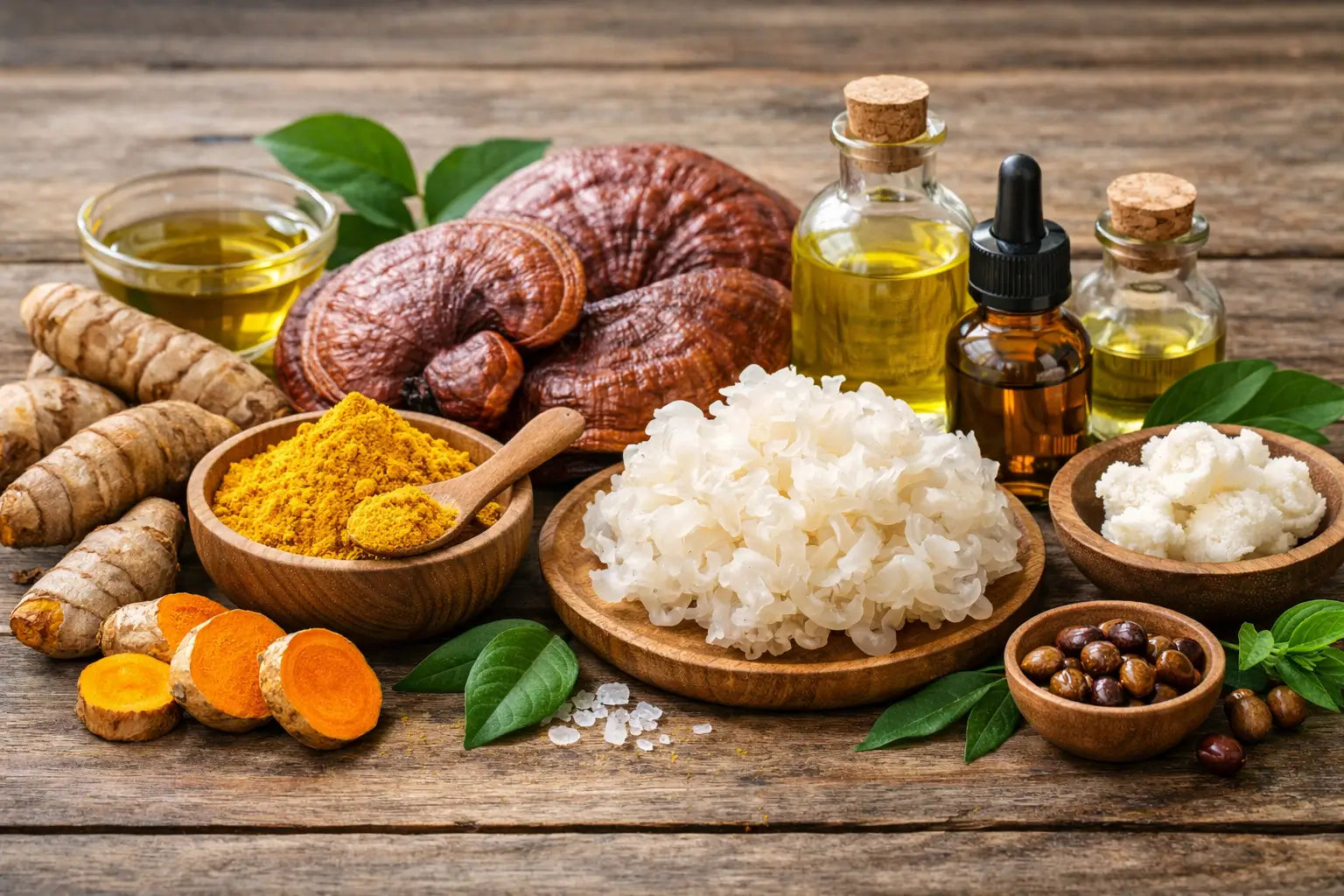
Modern skincare is increasingly less based solely on "moisturizing" or "nourishing." More and more people are consciously seeking cosmetics that truly impact skin health: improving its function, supporting regeneration, strengthening the skin's protective barrier, and helping to address specific issues such as dryness, hypersensitivity, imperfections, or the first signs of aging. Active ingredients in cosmetics play a key role in this process.
Active ingredients determine whether a cosmetic product actually works or is merely a base formula for skincare. Their role is particularly important in natural cosmetics, as they are based primarily on substances of plant, biotechnological, and mineral origin, which are biocompatible with the skin and support its natural defense mechanisms.
It's also worth emphasizing that natural active ingredients don't mean less effective . Quite the opposite – modern natural cosmetology increasingly utilizes advanced technologies for the extraction, fermentation, and stabilization of plant ingredients, allowing them to demonstrate high effectiveness while remaining gentle on the skin.
If you want to learn more about the philosophy of conscious care, check out our guide to natural facial cosmetics.
In this article, we will focus on a practical approach to the topic of active ingredients in natural cosmetics:
- we will explain what they are and what function they perform,
- we will show why they work in a slightly different way in natural care than in classic formulas,
- and how to consciously choose them according to the needs of your own skin.
This is a guide for people who want to not only buy cosmetics with "good ingredients," but really understand which active ingredients are best for them and why.
What are active ingredients and what function do they play in cosmetics?
Every cosmetic, regardless of whether it is natural or conventional, consists of several basic groups of ingredients:
- base ingredients (e.g. water, oils, emollients),
- functional ingredients (e.g. preservatives, emulsifiers, stabilizers),
- and active ingredients.
Active ingredients are substances that exhibit specific biological effects on the skin. This means they influence processes occurring in the epidermis and dermis, such as:
- moisturizing and water binding,
- regeneration and reconstruction of the hydrolipid barrier,
- relieving inflammation,
- regulation of the function of sebaceous glands,
- stimulation of cell renewal,
- antioxidant protection.
It is thanks to the active ingredients that the cosmetic can have anti-wrinkle, soothing, brightening, normalizing or smoothing effects.
Learn about the behind-the-scenes creation of moisturizing formulas with tremella mushroom.
In practice, this means that two creams with a similar consistency can work completely differently, it all depends on what active ingredients were used in them, in what concentration and in what form .
In natural cosmetics, active ingredients very often come from:
- plant extracts,
- oils and butters,
- ferments,
- polysaccharides,
- substances obtained biotechnologically.
Their task is not to "mask the problem", but to support the skin's natural mechanisms so that it can function on its own in a more balanced way.
It's also worth remembering that the effectiveness of an active ingredient doesn't depend solely on its INCI. The following are crucial:
- concentration,
- quality of raw material,
- the method of obtaining it,
- and the entire cosmetic formula in which the ingredient was placed.
Therefore, conscious care is not about "hunting" for individual fashionable ingredients, but about understanding what role they play in the overall composition of the cosmetic .
Learn how to read INCI.
Why do active ingredients work differently in natural cosmetics?
Although at first glance, active ingredients in natural and conventional cosmetics may perform similar functions (moisturizing, smoothing, regenerating, and protecting against aging), the way they affect the skin often differs significantly. This is primarily due to the origin of the raw materials , their biocompatibility with the skin , and the formulation philosophy of the natural cosmetics themselves.
Natural cosmetology doesn't seek to aggressively interfere with skin processes. Instead, the goal is to support its natural mechanisms and restore biological balance.
Biocompatibility of ingredients with skin
One of the key characteristics of natural active ingredients is their high biocompatibility. This means that their chemical structure is similar to substances naturally occurring in the skin or easily recognized by it.
Thanks to this:
- the skin tolerates them better,
- irritations occur less frequently,
- ingredients are more easily incorporated into the skin's natural metabolic processes.
In practice, this means that natural cosmetics often have a gentler, but more long-lasting effect, instead of providing a quick, short-term effect.
Find out how biocompatible natural ingredients are created.
Focus on the cause, not just the symptom
Many conventional ingredients primarily act symptomatically—for example, temporarily tightening the skin or masking dryness. Natural active ingredients are more likely to focus on:
- improving the functioning of the hydrolipid barrier,
- supporting the skin microbiome,
- stimulating regenerative processes.
Instead of "covering up the problem," they help the skin return to a state of balance , which in the long term yields more stable results. How can you restore skin's balance? The key here is the action of cosmetics on the hydrolipid barrier and its repair through active ingredients. Read Restoring the Hydrolipid Barrier - an Effective Step-by-Step Guide
Cosmetics that help rebuild the hydrolipid barrier.
Comprehensive action of plant extracts
Natural cosmetics often use plant extracts that contain the entire spectrum of active substances simultaneously:
- polyphenols,
- flavonoids,
- vitamins,
- minerals,
- sugars,
- organic acids.
This allows one component to work simultaneously:
- moisturizing,
- antioxidant,
- soothing,
- regenerating.
This distinguishes natural active ingredients from single, isolated synthetic substances, which usually target one specific mechanism.
Lower risk of skin overload
Natural cosmetics typically don't rely on very high concentrations of aggressive active ingredients. Instead, they rely on the synergy of many gentler ingredients that complement each other.
Thanks to this:
- the skin is less susceptible to irritation,
- it is easier to maintain regular care,
- the risk of damaging the hydrolipid barrier is reduced.
This is especially important for people with sensitive, dry or reactive skin.
Modern technologies in natural cosmetics
Modern natural cosmetology uses advanced technological solutions such as:
- fermentation of ingredients,
- biotechnological extraction of active substances,
- encapsulation,
- stabilization of extracts.
Thanks to this, natural active ingredients can achieve high bioavailability and stability while maintaining their care properties.
The most important groups of active ingredients in natural cosmetics
Active ingredients in natural cosmetics can be divided into several main groups based on their predominant action. This division facilitates informed skincare planning and the selection of cosmetics that meet the skin's actual needs.
It is worth remembering that many ingredients have multifaceted effects , but usually one effect is the leading one.
Moisturizing ingredients
Moisturizing is the absolute foundation of healthy skin, regardless of its type. Even oily or acne-prone skin needs ingredients that bind water and prevent water loss.
Natural moisturizing ingredients work mainly by:
- attracting and binding water molecules in the epidermis,
- limiting transepidermal water loss (TEWL),
- improving skin elasticity.
The most commonly used include:
- organic hyaluronic acid,
- tremella
- plant polysaccharides,
- beta-glucan,
- trehalose,
- aloe.
Regular use of moisturizing ingredients makes skin softer, more supple, and less prone to irritation. Check out all our moisturizing cosmetics.
Moisturizing series for combination skin ⤵️

Ingredients that regenerate and rebuild the hydrolipid barrier
The hydrolipid barrier serves a protective function, protecting the skin from water loss and the penetration of irritants. Its weakening leads to dryness, hypersensitivity, and a greater tendency to inflammation.
Natural regenerating ingredients:
- replenish skin lipids,
- support repair processes,
- strengthen the structure of the epidermis.
The most common are:
- vegetable oils rich in EFAs,
- squalane,
- phytoceramides,
- vegetable butters,
- phospholipids.
This group of ingredients is particularly important in the care of dry, sensitive, and mature skin. Cosmetics that regenerate facial skin.
Facial massage oils ⤵️

Soothing and calming ingredients
Skin exposed to environmental stress, pollution, or inadequate care often reacts with redness, burning, or tightness. In such cases, soothing ingredients are crucial.
Natural soothing substances:
- reduce inflammation,
- reduce skin reactivity,
- support the healing process.
This group includes, among others:
- panthenol,
- allantoin,
- beta-glucan,
- aloe,
- Asiatic pennywort.
Their presence in cosmetics helps maintain skin comfort even with daily use of more potent active ingredients. Cosmetics that soothe irritation.
Soothing serum ⤵️
 Anti-aging ingredients
The skin aging process is natural, but it can be effectively slowed down by carefully selected active ingredients.
Natural anti-aging ingredients work mainly by:
- neutralizing free radicals,
- supporting the synthesis of collagen and elastin,
- improving skin firmness and elasticity.
This group includes, among others:
- plant antioxidants,
- peptides,
- coenzymes,
- adaptogens.
Regular use of such ingredients helps smooth the skin and improve its structure.
Cream with ashwagandha antioxidant ⤵️

Ingredients that regulate sebum and imperfections
Oily and combination skin also needs active ingredients - but those that regulate the function of the sebaceous glands and limit the formation of imperfections without excessive drying.
Natural normalizing ingredients:
- support the balance of the microbiome,
- have anti-inflammatory properties,
- help keep pores in good condition.
The most common include:
- niacinamide,
- tamanu oil,
- plant extracts with antibacterial properties,
- acids of natural origin.
Check out the properties, effects and uses of tamanu oil in skin care.
How to choose active ingredients for your skin type?
The selection of active ingredients should always be based on the skin's current needs , not solely on its classification as dry, oily, or combination. The skin is a dynamic organ – its condition changes depending on the season, lifestyle, stress levels, and skincare routine.
However, determining your dominant skin type helps you narrow down the ingredients that will be most beneficial for your skin.
Dry skin
Dry skin is characterized by a reduced ability to retain water and a deficiency of lipids in its protective layer. It is often accompanied by a feeling of tightness, roughness, and a tendency to flake.
The best ingredients are those that:
- intensively moisturize,
- replenish lipids,
- strengthen the hydrolipid barrier.
When caring for dry skin, it is worth looking primarily for:
- plant polysaccharides,
- organic hyaluronic acid,
- plant ceramides,
- squalane,
- oils rich in EFAs.
This combination allows you to simultaneously deliver water and “lock” it in the skin.
Sensitive skin
Sensitive skin reacts more quickly and intensely to external stimuli, often experiencing redness, burning, or discomfort.
The key ingredients are:
- soothing,
- soothing,
- strengthening the protective barrier.
It is worth paying attention to the presence of:
- panthenol,
- allantoin,
- beta-glucan,
- centella asiatica,
- aloe.
It's good if the formulas are simple and free from excess fragrances.
Mixed skin
Combination skin combines the characteristics of dry and oily skin – the T-zone tends to be oily, while the cheeks tend to be dry.
The best ingredients are those that:
- regulate sebum,
- at the same time they moisturize,
- do not burden the skin.
When caring for combination skin, it is worth looking for, among others:
- niacinamide,
- light humectants,
- aloe,
- zinc,
- light vegetable oils.
This balance helps avoid both dryness and excessive shine.
Cosmetics for combination and oily skin
Oily and acne-prone skin
Oily skin produces an increased amount of sebum, but it's often accompanied by dehydration. Overly aggressive cleansing can worsen the problem.
It is best to choose ingredients that:
- normalize sebum secretion,
- have anti-inflammatory properties,
- support regeneration.
The most frequently recommended ones include:
- niacinamide,
- zinc,
- acids of natural origin,
- plant extracts with antibacterial properties,
- soothing ingredients.
Carefully selected ingredients help reduce the appearance of imperfections without damaging the skin barrier.
Mature skin
In mature skin, the production of collagen and elastin gradually decreases and regenerative processes slow down.
The best ingredients are:
- stimulating cell renewal,
- having antioxidant properties,
- improving firmness and elasticity.
It is worth paying attention to the presence of:
- peptides,
- plant antioxidants,
- coenzymes,
- adaptogens,
- intensively moisturizing ingredients.
Regular use of such ingredients helps maintain smooth and firmer skin.
How to combine active ingredients in one skincare routine?
One of the most common mistakes in skincare is the belief that the more active ingredients we use at once, the faster we'll see results. In reality, skin responds best to thoughtful, consistent, and moderate combinations of ingredients that complement each other, not compete.
The basis of an effective routine is maintaining a balance between three pillars:
- moisturizing,
- protection of the hydrolipid barrier,
- targeted action on a specific skin problem.
Principle of layering ingredients
When it comes to facial care, a simple rule applies: from the lightest to the richest formulas. This allows the active ingredients to better penetrate the skin.
Most often, the order is as follows:
- cleaning,
- tonic or essence,
- serum with active ingredients,
- cream or emulsion.
This regimen allows you to use the potential of the ingredients without overloading the skin.
Combining moisturizing and regenerating ingredients
This is one of the most versatile and safest combinations. Moisturizing ingredients deliver water, while regenerating ingredients help retain it in the skin.
Sample list:
- humectants + ceramides,
- polysaccharides + vegetable oils,
- hyaluronic acid + squalane.
Such combinations are suitable for the care of all skin types.
Combining active ingredients with targeted action
If your goal is to reduce imperfections, discoloration, or the first wrinkles, it is worth introducing ingredients that target the specific problem, but always in the company of soothing and moisturizing ingredients.
For example:
- sebum regulating ingredient + soothing ingredient,
- antioxidant + moisturizing ingredient,
- peptides + barrier-rebuilding ingredients.
Thanks to this, the skin receives support without the risk of irritation.
Morning routine and active ingredients
In the morning, the best ingredients are:
- moisturize,
- protect against oxidative stress,
- strengthen the skin barrier.
This is a good time to use humectants, antioxidants and soothing ingredients.
Evening routine and active ingredients
In the evening, the skin regenerates more intensively, so you can reach for ingredients that support the renewal and repair of the hydrolipid barrier.
This is the right time to:
- regenerating ingredients,
- anti-aging,
- supporting the reconstruction of the skin structure.
The principle of gradual introduction
It's best to introduce new active ingredients one at a time and observe your skin's reaction. This allows you to easily identify which substances work best for your skin.
Do more active ingredients mean a better cosmetic?
In the world of cosmetics, it's common to encounter formulas whose marketing communications emphasize the presence of dozens or even dozens of active ingredients. This might suggest that the longer the list of active ingredients, the more effective the cosmetic. In practice, however, it's not the quantity that counts, but the quality and well-thought-out composition of ingredients .
The skin has a limited ability to absorb active ingredients. If a product contains too many different ingredients, some may be less effective or not at all, and the formula itself may become less stable.
The importance of the concentration of active ingredients
An active ingredient placed very low in the composition may serve primarily an auxiliary function. Its actual effectiveness depends on its concentration and chemical form.
Therefore, a better choice is a cosmetic containing several well-selected active ingredients in reasonable concentrations than a product with a very long list of substances with a marginal share.
Synergy instead of a random mix
A well-designed formula is based on synergy, i.e. the interaction of ingredients that mutually reinforce each other's effects.
For example:
- moisturizing ingredients supported by lipids,
- antioxidants combined with regenerating ingredients,
- sebum-normalizing substances supplemented with soothing ingredients.
This composition allows for more stable and predictable care results.
Stability and bioavailability
Not every active ingredient is equally stable. Some substances require a specific pH, protection from light, or oxygen to maintain their properties.
Natural cosmetics are increasingly using technologies that improve the stability and bioavailability of active ingredients, allowing them to work more effectively despite their milder nature.
Less risk of irritation
The more complex the formula, the greater the likelihood that the skin will react with a hypersensitivity to one of the ingredients. Simpler formulas often prove better tolerated, especially by sensitive and reactive skin.
To sum up: a good cosmetic is not one that contains as many active ingredients as possible, but one that contains them in a well-thought-out way .
How to read INCI for active ingredients?
INCI (International Nomenclature of Cosmetic Ingredients) is the official, international record of cosmetic ingredients. While many people may find it an incomprehensible list of Latin names, it can actually provide very specific information about a product's quality and potential effectiveness.
A conscious INCI analysis allows us to assess whether the cosmetic actually contains active ingredients in reasonable quantities or whether it only communicates their presence for marketing purposes.
The order of ingredients matters
Ingredients in the INCI are listed in order from highest to lowest concentration (up to approximately 1%). This means:
- the ingredients at the beginning of the composition constitute the basis of the formula,
- the ingredients listed at the end are present in small amounts.
If an active ingredient appears very high in the ingredients, there is a greater chance that its concentration is sufficient to have a real effect on the skin.
Recognizing real active ingredients
INCI lists many names that sound "active" but actually serve a supporting function (e.g., stabilizing or preserving). Therefore, it's worth learning to distinguish:
- ingredients with biological action,
- technological components.
It is helpful to pay attention to the names of plant extracts, ferments, polysaccharides or substances known to have moisturizing, regenerating or soothing effects.
Marketing "stars" on the label and reality
Often, the front of the packaging highlights a single ingredient that is actually listed very low in the ingredients list. This doesn't automatically mean the cosmetic is bad, but it's worth being aware that its effects may be more complementary than primary.
Therefore, the best solution is always to verify the composition based on INCI , and not solely on marketing messages.
A shorter squad doesn't always mean a weaker one
Many people assume that a long list of ingredients is synonymous with effectiveness. However, a well-designed, shorter formula can work much better if it contains a well-thought-out combination of active ingredients in appropriate concentrations.
Natural cosmetics often have shorter but more concentrated ingredients.
It is worth paying attention to the context of the entire formula
An active ingredient never works in isolation from the rest of the composition. Its effectiveness depends on, among other things:
- the presence of supporting ingredients,
- pH formula,
- type of media,
- stability of the entire product.
Therefore, instead of focusing on one “trendy” ingredient, it is better to evaluate the cosmetic as a whole.
Active ingredients and skin safety
While active ingredients are the foundation of effective skincare, their improper use can lead to irritation, skin hyperreactivity, or a weakened hydrolipid barrier. Therefore, it's crucial to approach them with caution and build a conscious skincare routine.
Skin safety is not about avoiding active ingredients, but about their appropriate selection, concentration and frequency of use .
Cosmetics tests and research
Cosmetics introduced to the market should undergo safety assessments and application or dermatological tests. This is particularly important for products containing more potent active ingredients.
For the user, this means greater certainty that the cosmetic:
- is safe when used correctly,
- has been tested for skin tolerance,
- has a stable and controlled formula.
Allergy test before first use
Even naturally derived ingredients can trigger a hypersensitivity reaction in some people. Therefore, before introducing a new cosmetic product, it's worth performing a simple allergy test by applying a small amount of the product to the skin behind the ear or on the inside of the forearm.
If no redness or burning occurs within 24 hours, the cosmetic can be safely included in your skincare routine.
Gradual introduction of active ingredients
The skin needs time to adapt to new substances. Introducing several new ingredients simultaneously makes it difficult to assess which ones are beneficial and which may cause discomfort.
The best practice is to add one new product at a time and observe how your skin reacts over a few days.
Adjusting the frequency of use
Not every active ingredient needs to be used daily. Many substances are effective even when applied every few days.
Regularity is more important than intensity. It's better to use a product less frequently but consistently than too often and risk skin irritation.
The role of moisturizing and regeneration
Even the best-selected active ingredients will not bring the expected results if the skin is dehydrated or has a damaged hydrolipid barrier.
Therefore, any care based on active ingredients should also contain moisturizing and regenerating products.
The most common mistakes in using active ingredients
Even the best-chosen active ingredients won't deliver the desired results if used incorrectly. In practice, many skin problems aren't caused by a "lack of good cosmetics," but by errors in their use.
Knowing the most common pitfalls will help you avoid irritation and increase the effectiveness of your care.
Using too many ingredients at once
One of the most common mistakes is introducing several new cosmetics containing different active ingredients at once. This can overwhelm the skin, leading to burning, redness, or worsening of its condition.
It is better to introduce the ingredients gradually and observe the skin's reaction.
Lack of basic moisturizing
Some people focus solely on "working" ingredients, forgetting about the foundations of skincare, such as moisturizing and protecting the hydrolipid barrier.
Without the proper level of hydration, even the best active ingredients will not work optimally.
Too frequent changes of cosmetics
The skin needs time to respond to active ingredients. Changing products too frequently makes it difficult to assess their effectiveness and can lead to destabilization of the protective barrier.
It is worth giving the cosmetic a few weeks of regular use before assessing its effects.
Excessive cleansing of the skin
Aggressive cleansing can weaken the hydrolipid barrier and increase the skin's sensitivity to active ingredients.
Gentle but effective cleansing is the foundation of every routine.
Expecting immediate results
Most active ingredients work gradually. Visible results usually appear after several weeks of regular use.
Patience and consistency are key.
Active ingredients in natural cosmetics - summary
Active ingredients are the heart of every effective cosmetic. They determine whether a product truly improves skin condition or merely provides a fleeting sensation of comfort. Their role is particularly crucial in natural cosmetics, as they rely on substances biocompatible with the skin that support its natural regenerative mechanisms.
Conscious care is not about collecting trendy ingredients, but about understanding the needs of your own skin and choosing formulas that respond to these needs in a gentle but effective way.
The simpler and better thought-out your routine, the greater the chance of long-term improvement in your skin's condition.
FAQ – active ingredients in natural cosmetics
Do natural cosmetics contain effective active ingredients?
Yes. Modern natural cosmetology utilizes advanced technologies for extracting and stabilizing plant and biotechnological ingredients, allowing natural active ingredients to be highly effective while remaining gentle on the skin.
How to check if the active ingredient really works?
It's worth analyzing its position in the INCI, its form of occurrence, and the context of the entire formula. An ingredient that is high in the composition and supported by other substances with a similar effect has a greater chance of producing a real effect.
Can you combine several active ingredients at once?
Yes, provided they are carefully selected and don't overload the skin. Maintaining a balance between moisturizing, regenerating, and targeted ingredients is key.
How often should you use cosmetics with active ingredients?
Most cosmetics can be used daily, but the frequency should be adjusted to your skin's response. Regularity is more important than intensity.
Can active ingredients irritate the skin?
Every skin reacts differently. Even natural ingredients can trigger a hypersensitivity reaction, so it's worth performing an allergy test and introducing new cosmetics gradually.
What active ingredients are best to start with?
The safest ingredients are moisturizing, regenerating and soothing, which strengthen the hydrolipid barrier and prepare the skin for further care steps.