The trend of natural facial rejuvenation methods is growing rapidly. More and more people are seeking alternatives to aesthetic medicine and are becoming interested in manual techniques that stimulate skin regeneration.
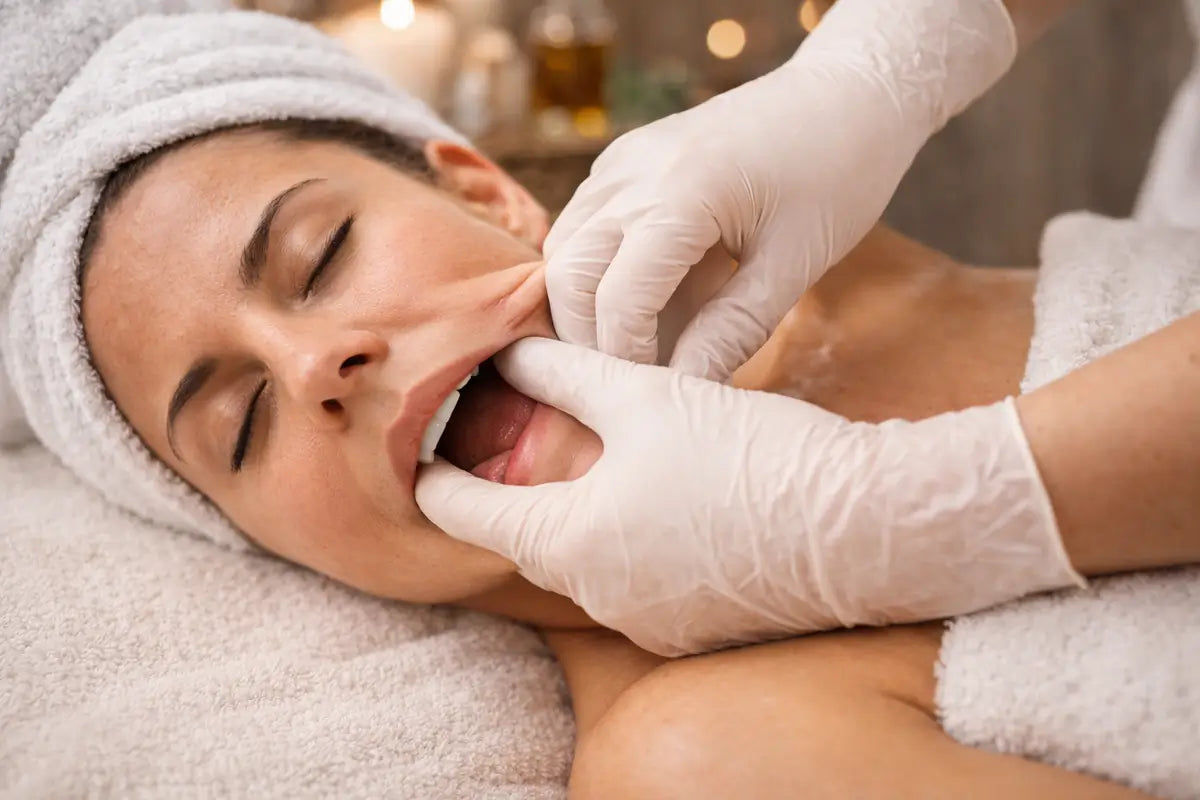
One of the most spectacular methods is transbuccal massage , i.e. facial massage performed simultaneously from the outside and inside of the oral cavity .
This technique allows you to reach the deep facial muscles that cannot be relaxed with a classic facial massage. This allows you to:
- improving the facial oval
- reducing jaw muscle tension
- smoothing nasolabial folds
- improving cheek tension
In the article I explain:
- how transbuccal massage works
- what effects does it give?
- what does the procedure look like in the office?
- can it be done at home
- how to combine massage with Orientana oils to enhance the lifting effect.
What is transbuccal massage?
Transbuccal massage is an advanced technique of manual work with the facial muscles, which involves simultaneous massage performed from the outside of the face and from the inside of the mouth . The name of the treatment comes from the Latin word bucca , meaning cheek . In practice, this means that the therapist works with the cheek tissues both through the skin and through a gentle massage performed inside the mouth.
This technique allows you to reach muscles that remain inaccessible during a classic facial massage. This is why transbuccal massage is considered one of the most effective methods for a natural facelift . It works not only on the skin's surface but also on the deeper muscle layers responsible for tissue tone and facial contouring.
In aesthetic cosmetology, transbuccal massage is used primarily as a treatment for modeling the lower part of the face .
It works particularly well on areas where the first signs of aging appear, such as the cheeks, jawline, and around the mouth . Regularly performing this massage helps restore muscle elasticity, improve blood circulation, and increase oxygenation of skin cells.
A major advantage of this technique is that it doesn't require the use of equipment or invasive methods. The entire procedure is performed using the therapist's hands, which apply pressure and relaxation to the facial muscles.
As a result, the treatment has both a lifting and relaxing effect. Many people notice not only improved skin appearance but also a reduction in tension in the jaw and cheeks.
In recent years, transbuccal massage has gained immense popularity among those interested in natural methods of skin rejuvenation . It is increasingly being offered in beauty salons as an alternative to more invasive aesthetic treatments. Its effects are particularly visible when the treatment is performed in a series and complemented with appropriate skin care.
A good complement to external massage is the use of plant oils, which provide adequate glide and additionally nourish the skin. Facial massage rituals often utilize oils rich in regenerative and antioxidant ingredients , such as those used in Orientana cosmetics.

Anatomy of facial muscles in transbuccal massage
To understand the effectiveness of transbuccal massage, it's worth considering the anatomy of facial muscles. Unlike muscles in other parts of the body, facial muscles are directly connected to the skin. This means that their every movement affects the appearance of the skin's surface and the formation of facial wrinkles.
There are over forty muscles in the face responsible for facial expressions, emotional expression, and functions such as chewing and speaking. Many of these muscles lose elasticity with age or become permanently tense . This tension leads to the development of wrinkles and changes in facial contours.
One of the key muscles targeted by transbuccal massage is the buccinator muscle , also known as the buccinator. It is responsible for cheek tone and tissue stability in this part of the face. When this muscle becomes too tight or weakened, the cheeks begin to sag, and nasolabial folds become more prominent.
The second important structure is the masticatory muscles , which are responsible for jaw movements during chewing. Modern lifestyles often cause these muscles to remain in a state of chronic tension. Prolonged jaw clenching can lead not only to headaches and tension in the temple area but also to deepening wrinkles in the lower part of the face.
The zygomatic muscles also play a crucial role, lifting the cheeks and contributing to the face's youthful, fresh appearance. With age, their tone decreases, which causes gradual sagging of tissues and loss of volume in the midface.
Transbuccal massage works directly on these muscles, both relaxing them and stimulating them to more active activity. This stimulation has a beneficial effect on skin microcirculation, which in turn improves skin nourishment and supports natural regenerative processes.
It's worth remembering that facial muscles respond to regular stimulation much like body muscles. When properly relaxed and strengthened, their tone improves, and skin becomes firmer. This is why facial massages, including transbuccal massage, are increasingly considered part of comprehensive anti-aging care.
What are the effects of transbuccal massage?
One of the main reasons for the popularity of transbuccal massage is its visible aesthetic effects. This treatment works simultaneously on several levels:
- improves muscle tone,
- supports skin microcirculation
- stimulates natural regenerative processes in tissues.
The first noticeable effect is an improvement in facial contours . By working on the cheek and jaw muscles, it is possible to gently lift tissues that begin to sag with age. The face then appears firmer and more defined.
Another effect is a reduction in the visibility of nasolabial folds . These folds often deepen due to tension in the cheek muscles and loss of skin elasticity. Transbuccal massage relaxes these structures and improves tissue circulation, resulting in a smoother appearance of the skin in this area.
The treatment also helps relieve tension in the jaw area . Many people unconsciously clench their jaws throughout the day, leading to excessive facial muscle tension. Transbuccal massage helps release this tension and restore proper muscle mobility.
Regular massage can also improve skin tone . Improved blood circulation means skin cells are better oxygenated and nourished, leaving the face looking more radiant and healthy.
It's worth remembering, however, that the best results come after a series of treatments. A single massage can provide a refreshing and slight lifting effect, while regular treatments can consolidate the improvement in muscle tone and skin firmness.
The effects of massage can be further enhanced with proper skin care. Facial massage rituals often utilize plant oils , which not only facilitate the massage movements but also provide the skin with nutrients. The plant oils used in Orientana cosmetics can be an excellent base for such rituals, as they are rich in natural antioxidants and regenerating substances.

Why We Clench Our Jaws - The Effect of Stress on Our Face
Modern lifestyles make facial muscle tension an increasingly common problem. Many people are unaware that they involuntarily clench their jaw or tense their facial muscles throughout the day. This phenomenon is directly related to stress and long-term mental strain.
When the body is under stress , muscles throughout the body tense . This also applies to the facial muscles, especially the masseter muscles, which are responsible for jaw movements. Prolonged tension in this area can lead to thickening of the jaw muscles, changes in facial contours, and deepening of facial wrinkles.
One of the most common problems is bruxism , the unconscious grinding of teeth that occurs most often during sleep. Bruxism can cause headaches, tension in the temple area, and excessive strain on the temporomandibular joints.
Transbuccal massage helps relax tense facial muscles and restore their natural elasticity. By working from the mouth, the therapist can directly reach the masseter muscles and gently relax them. Many people experience significant relief in the jaw area and a reduction in tension throughout the face after the treatment.
Regular massages can therefore be not only aesthetically pleasing but also therapeutic . They help restore facial muscle balance and reduce the effects of chronic stress.
Face yoga and transbuccal massage - why it's the perfect combination
In recent years, face yoga , a set of exercises for facial muscles designed to improve their tone and contour, has gained immense popularity. Similar to body exercises, regular activity of facial muscles can improve their condition and skin elasticity.
However, exercises alone aren't always enough. Facial muscles—like those in the neck and back—can remain in a state of chronic tension. If they're too tense, exercise can exacerbate the problem rather than solve it. That's why combining face yoga with transbuccal massage , which acts as a deep relaxation therapy, is becoming increasingly popular.
Facial yoga - slow aging, naturalness and conscious care without rushing
Transbuccal massage relaxes facial muscles from the inside, and then face yoga exercises help strengthen and maintain them. This combination is much more effective than using either method alone.
Regularly combining massage and exercise can bring many benefits. Primarily, it improves facial muscle tone, resulting in a more defined oval and lifted cheeks. It also improves blood circulation in the skin, allowing cells to receive more oxygen and nutrients.
Face yoga combined with transbuccal massage can also help reduce stress-related tension. Many people unconsciously tense facial muscles, especially around the jaw and mouth. Massage releases this tension, and the exercises help restore muscle balance.
A good time to perform this ritual is in the evening, when the skin is thoroughly cleansed and you can dedicate a few minutes to skincare. It's worth applying a plant oil at this time, which will provide adequate slip while simultaneously supplying the skin with nutrients. Orientana oils are well-suited for this type of ritual because they are rich in natural antioxidants and support skin regeneration.
The combination of face yoga and facial massage is an example of a holistic approach to skincare. Instead of focusing solely on cosmetics, it also considers the condition of facial muscles and the impact of lifestyle on the skin's appearance.
Transbuccal massage and other facial massages
There are many facial massage techniques available in the cosmetics market that claim to improve skin firmness and slow down the aging process. Among the most popular are Kobido massage, Gua Sha massage, and various lymphatic drainage techniques. Each of these techniques works in a slightly different way and affects different skin structures.
Kobido massage originates from Japanese tradition and is often called a natural facelift. It is characterized by dynamic, rhythmic movements that stimulate blood circulation and facial muscles. This treatment primarily affects the skin's surface and middle layers.
Kobido - Japanese facial massage for healthy and youthful skin
Gua Sha massage, on the other hand, uses special stones or plates, most often made of jade or rose quartz. This technique involves gently moving the tool across the skin, which promotes lymphatic drainage and reduces facial puffiness. This massage is particularly popular in Asian beauty rituals.
Transbuccal massage differs from these techniques primarily in its depth of action. By working from the oral side, it reaches muscles that are inaccessible during a classic facial massage. This is why this treatment can be particularly effective in sculpting the lower face and reducing tension in the jaw area.
Hadado Massage - The Japanese Secret of Youth for Your Skin
In practice, many beauty salons combine various massage techniques in a single treatment. Transbuccal massage can be part of a more extensive lifting ritual that also incorporates elements of Kobido massage or lymphatic drainage.
This approach works on various levels of the skin, from improving circulation and lymphatic drainage to deep work on the facial muscles. This makes the effects of treatments more comprehensive and long-lasting.
What does a transbuccal massage look like, step by step?
Many people wonder what exactly a transbuccal massage is like in a beauty salon. This treatment differs from a classic facial massage primarily in that part of the work is performed from the mouth. This allows the therapist to reach the deep muscles of the cheeks and jaw, which are responsible for facial tone and contouring.
While techniques may vary slightly from one salon to another, most transbuccal massages follow a similar pattern.
1. Preparing the skin for massage
The treatment begins with a thorough facial cleansing. Removing makeup and impurities is crucial, as the massage increases blood circulation and may slightly dilate pores.
After cleansing, the beautician typically applies an oil or serum to the skin, ensuring proper glide. Natural plant oils used during massage not only facilitate the movements but also nourish the skin and support its regeneration.
2. Initial external facial massage
The first part of the massage is performed on the skin's surface. The therapist uses rhythmic, warming movements that stimulate microcirculation and prepare the facial muscles for deeper work.
In this phase, the following are primarily relaxed:
- cheek muscles
- muscles around the mouth
- masseter muscles
- jaw line
The goal of this stage is to reduce tissue tension and improve skin elasticity.
3. Transbuccal massage from the oral cavity side
The most distinctive element of the treatment is a massage performed on the inside of the cheeks. The beautician wears disposable gloves and gently inserts their fingers into the mouth to work directly on the cheek muscles.
At this point, it is possible to precisely relax the buccinator and masseter muscles. The movements are performed very precisely and involve gently pressing, lifting, and stretching the tissues between the fingers placed inside and outside the cheek.
It is this stage that makes transbuccal massage considered one of the most effective methods of manual facial modeling.
4. Modeling the face oval
After working on the inside of the cheeks, the therapist moves on to the external massage again. This stage focuses on sculpting the lower face and jawline.
Lifting movements are performed to help lift the cheeks and improve facial contours. Prior muscle relaxation allows for more effective tissue shaping.
5. Relaxation and end of the treatment
Finally, a gentle, relaxing massage is performed, which soothes the tissues and improves lymphatic flow. Many salons also conclude the treatment with the application of a regenerating mask or nourishing cream.
The entire transbuccal massage typically lasts 45 to 60 minutes. After the treatment, the face often appears more relaxed, radiant, and slightly lifted.
Does transbuccal massage give an immediate lifting effect?
One of the most common questions from those interested in this treatment is whether transbuccal massage provides an immediate facelift effect . In many cases, the answer is yes, but it's important to understand exactly what causes this effect and why it varies from person to person.
Immediately after the treatment, many people notice that their face looks more rested, with cheeks appearing slightly lifted. Skin often becomes more radiant, and facial contours become more defined. This immediate lifting effect is primarily due to the relaxation of tense facial muscles and improved blood and lymphatic circulation in the tissues.
During a transbuccal massage, the therapist works directly on the cheek and jaw muscles, which in many people remain in a state of chronic tension. This is particularly true for the masseter and buccinator muscles, which can contribute to a heavier appearance of the lower face. When these muscles are relaxed, the tissues begin to fall into a more natural position, and the facial contour can appear subtly lifted.
The second important factor is improved microcirculation . Massage stimulates blood flow in the skin, allowing cells to receive more oxygen and nutrients. This is why skin often looks brighter and fresher after the treatment.
It's worth remembering, however, that the immediate lifting effect is usually subtle and natural. Transbuccal massage doesn't work in the same way as aesthetic medicine treatments , which fill tissues or mechanically lift the skin. Rather, it works by restoring facial muscle balance and improving tissue tone.
The most pronounced and lasting results usually appear after a series of treatments . Regular stimulation of facial muscles gradually improves their tone, and facial contours become more defined. Many people also notice a reduction in nasolabial folds and a reduction in tension in the jaw area.
Therefore, transbuccal massage is often considered not only a one-time treatment to improve facial appearance, but also as part of a long-term anti-aging regimen. Combined with proper skin care and regular massages, it can support a natural, healthy facial appearance for a long time.
How to perform a simple cheek lifting massage at home
While a full transbuccal massage should be performed by an experienced therapist, there are also simpler facial self-massage techniques that can be used at home. Regularly performing these movements helps improve skin tone and supports natural regenerative processes.
The first step is to thoroughly cleanse your face . Skin should be free of makeup and impurities to prevent irritation during the massage. Next, apply a few drops of plant oil to facilitate the massage movements.
Oil plays a crucial role in this ritual. It ensures proper glide of the hands over the skin while simultaneously providing it with nutrients. Natural plant oils used in skincare, such as those found in Orientana cosmetics, can additionally support skin regeneration and improve its elasticity.
After applying the oil, you can begin massaging the cheeks. The simplest technique is to gently lift the cheeks towards the temples. This movement is performed with the fingertips, moving them from the area around the mouth towards the cheekbones. It's important to move slowly and apply moderate pressure.
The next step is a jawline massage. To do this, move your fingers from the center of your chin towards your ears, gently lifting the skin upward. This movement helps refine your facial contours and reduce tension in the lower cheeks.
Finally, you can perform a gentle full-face massage to stimulate blood circulation and give your skin a refreshed look. Just a few minutes of this type of massage will leave your skin looking firmer and more radiant.
Regular self-massage can be a simple yet effective part of daily care. While it won't replace a professional salon treatment, it can significantly improve skin condition and delay the appearance of signs of aging.