
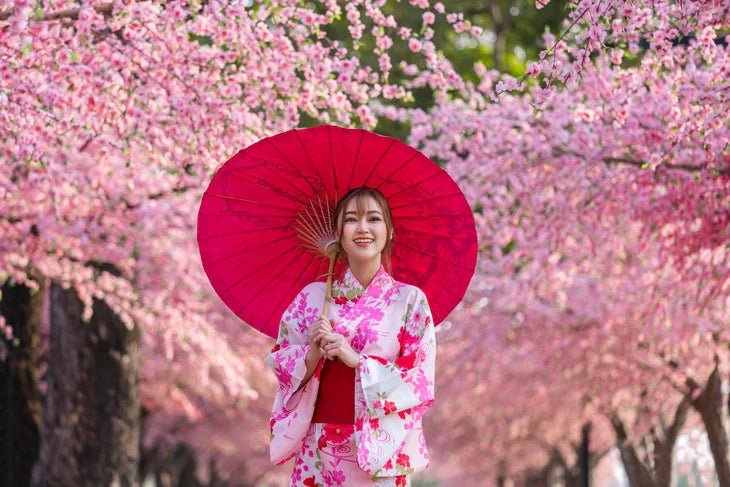
The Japanese sakura tree, known worldwide as the cherry blossom, is not just a visual symbol of spring in Japan—it is a cultural, emotional, and aesthetic phenomenon that has inspired art, spirituality, and daily rituals for centuries. Its delicate, pale pink petals appear suddenly, and their fleeting beauty touches the hearts of millions. It disappears as quickly as it appears—reminding us of transience, fragility, and the power of the present. It is precisely this ephemerality that gives sakura such a powerful appeal to the senses and emotions: captivating the eye, soothing the soul, evoking melancholy and delight all at once.

In this post, I tell you about the importance of sakura in Japanese culture, where you can find it in Orientana cosmetics, and I share information about where and when you can see blooming sakura in Poland.
In Japanese culture, sakura is more than just a tree—it's a symbol of life , rebirth, and spiritual harmony. Every year, thousands of people celebrate its blooming during hanami, pausing for a moment to contemplate the beauty of nature. This profound relationship with nature, seasonality, and the fleetingness of the moment has also inspired contemporary natural cosmetics.
In skincare inspired by Asian rituals, sakura plays a unique role – not only thanks to its delicate, powdery scent but also to the nourishing properties of its flower extract. It is the quintessence of slow beauty : subtle, gentle, and mindful – like the sakura itself.
Sakura - a tree with deep meaning
The sakura tree, also known as the Japanese cherry ( Prunus serrulata ), is native to East Asia and belongs to the rose family (Rosaceae). It is native to Japan, China, and Korea, although it is also planted in the United States, Canada, and Europe today, especially as an ornamental plant. Japan alone boasts over 200 species and varieties of sakura , the most popular of which is the Somei Yoshino , whose white-pink blossoms are almost a national symbol. These trees account for approximately 80% of all sakura trees growing in Japanese cities and parks.
Sakura blooms for a very short period – typically from late March to mid-April , depending on the region of Japan. Blooming begins in the south (Kyushu) and ends in the north (Hokkaido), creating a spectacular "wave of flowers" that is tracked not only by the public but also by special weather forecasts called sakura zensen . By comparison, the full bloom of sakura usually lasts only 7–10 days , and the falling petals resemble falling snow – a phenomenon called hanafubuki .
Ephemerality as a metaphor for life
It is precisely the fragility and transience of sakura blossoms that have earned them the status of a powerful philosophical symbol in Japanese culture. For centuries, sakura has embodied the idea of "mono no aware" – a profound, melancholic sensitivity to the transience of beautiful things. Its blooming reminds us of the cycle of life: birth, blossoming, and inevitable transience. This beauty, which lasts only a moment, teaches us to value the present moment – something incredibly precious in today's accelerated world.
In a survey conducted by the Japan Weather Association, as many as 76% of Japanese people admitted that sakura has emotional and spiritual value for them, and almost 90% take part in hanami celebrations at least once in their lifetime.
Sakura in art, literature and everyday life
The sakura motif permeates all areas of Japanese culture. It has appeared in literature since the 8th century, including in the oldest anthology of Japanese poetry, the Manyōshū , where the blossoming trees were celebrated as a manifestation of spiritual beauty. In the Heian period (794–1185), sakura became an inspiration for courtly waka poetry, and in later centuries also appeared in playwriting, ink painting (sumi-e), ukiyo-e woodblock prints, and contemporary pop culture.
For the samurai, the sakura symbolized an honorable death—like a petal falling from a tree in its full beauty, a samurai was expected to die with dignity at a moment of greatest strength. In modern times, the sakura remains an integral part of the cultural calendar—appearing on coins (e.g., the 100-yen coin), in kimonos, in wedding ceremonies, and even in the names of companies, food products, and cosmetics.
Today, Japan exports elements of the sakura cult worldwide—from hanami tourism to lifestyle products inspired by its aesthetics and scent. Sakura has become a global symbol of purity, femininity, gentleness, and elegance , as well as an important motif in natural cosmetics, representing values such as mindfulness, transience, and the beauty of everyday life.
Rituals and traditions related to sakura
The Sakura tree is a symbol of sensitivity, transience and spiritual beauty , and is accompanied by Japanese traditions described in detail below.
Hanami – a cherry blossom viewing festival
In Japan, where the sakura is one of the most important cultural symbols, celebrating its bloom takes the form of a unique ritual – hanami . Literally meaning "flower viewing," hanami is much more than that: it is a time for collective contemplation of the beauty and transience of life.
This custom dates back to the Heian period (794–1185) , when courtiers gathered under cherry blossom trees to compose poetry and feast. Over the centuries, the tradition spread to all social classes and became one of the most important seasonal events in Japan. Today, hanami means picnics with family and friends in parks filled with sakura—to the sounds of laughter, song, and the delight of the blossoms.
The spiritual dimension of hanami is combined with the philosophy of mono no aware —a profound sensitivity to the transience of things. The sakura tree blooms spectacularly, but only for a few days—a reminder of the fragility of life and the value of the present moment.
Sakura in art: tea ceremony, haiku, zen gardens
Sakura has inspired Japanese aesthetics and spirituality for centuries. Its image appears in countless art forms, from traditional woodblock prints to modern anime.
In the tea ceremony , itself a meditative ritual of harmony, peace, and respect, sakura serves as an aesthetic complement. A sprig of blossoming cherry placed in a tokonoma (decorative niche) emphasizes the seasonality and changeability of nature.
In haiku poetry, whose structure demands conciseness and a profound grasp of the moment, the sakura often becomes a metaphor for life, femininity, sadness, or rebirth. One classic poem reads:
"Under the sakura tree
no one talks about death –
only about beauty.”
In Zen gardens , sakura represents a moment of transition. Its presence along contemplative paths or koi ponds symbolizes not only the beauty of nature but also spiritual purification through contact with the ephemeral.
Cherry blossoms in the kitchen: sakura on a plate
Sakura is also used in the kitchen – both for decoration and flavor. Japanese cherry blossoms are marinated in salt and vinegar and then used to create original dishes and drinks with a distinctive, slightly tart, floral flavor.
Sakura leaves (especially the Oshima-zakura variety) are wrapped around mochi in traditional sakura mochi sweets, eaten during hanami. The petals are added to rice cakes, teas, and even lemonade – for example, in the form of sakura-yu infusion : a subtle tea with a blossom unfolding in the cup.
Nowadays, you can also find syrups, jams, ice cream and even beer with sakura , which fit into the trend of seasonal cuisine and the celebration of nature.
Primarily associated with aesthetics, the sakura tree plays a deeper role in Japanese culture—it connects people, inspires art, and even soothes the soul through its subtle flavors and scents. It's a flower that speaks volumes beyond words—all you have to do is stop and look.
The scent of sakura - light, fleeting, sensual
Although I've never been to Japan during the cherry blossom season, I know this scent. I've loved it so much for a long time that I wanted to create a cosmetic with that scent. It wasn't easy, but I succeeded.
The natural scent of sakura – i.e. Japanese cherry blossoms – is in practice almost impossible to obtain in the form of pure essential oil or absolute , because these flowers contain very few volatile fragrance compounds .
Characteristics of the sakura scent: floral, powdery, slightly almond
The scent of sakura is a subtle, almost ephemeral fragrance that captivates with its delicacy and elusiveness. It's neither intense nor overpowering—more of a whisper than a voice. It can be described as floral with powdery notes , reminiscent of the scent of fresh spring petals immersed in warm, soft air. Some varieties, particularly Prunus serrulata , also carry a faint almond or milky note , reminiscent of marzipan and the purity of childhood memories. It's a pure, calm, and nostalgic scent—never intrusive, always elegant.
Emotional and aromatherapeutic influence of scent – relaxation, gentleness, femininity
The aroma of sakura soothes the nervous system , inducing a state of relaxation and balance. It's a scent that envelops the senses, calms the mind, and brings a sense of comfort. In aromatherapy, it is believed to alleviate emotional tension , particularly those associated with overstimulation, stress, or melancholy.
Sakura is also a symbol of delicate femininity —not aggressive, but attentive, subtle, and sensual. Its scent can enhance self-esteem and body image, promoting a moment for oneself and a mindful skincare ritual. It's the perfect scent for evening relaxation, meditation, or an aromatherapy massage.
The role of sakura scent in perfumes and cosmetics – the difficulty of obtaining a natural aroma
Despite its popularity, the natural scent of sakura is difficult to obtain . Cherry blossoms don't contain a large amount of essential oils, so they can't be easily distilled like roses or lavender. For this reason, perfumery most often uses fragrance reconstructions —delicate compositions composed of floral, green, powdery, and almond notes that convey the sensation of cherry blossoms.
In cosmetics, the scent of sakura serves as a mood-setting accent —it doesn't overwhelm, but rather introduces a feeling of lightness and luxury. It can be found in body mists, balms, shampoos, and bath elixirs. It blends well with notes of peony, jasmine, green tea, and musk, creating the impression of clean skin and a peaceful morning .
Creating perfumes or cosmetics with the scent of sakura is a true art – it requires a sense of proportion and an understanding of the sensual nature of this plant. It's a scent that suggests rather than expresses, evokes memories rather than imposes them. And it's precisely in this subtlety that its power lies.
Sakura in Orientana cosmetics
Because I'd dreamed of a sakura scent in Orientana cosmetics for years, and as you already know, this scent is very difficult to create, I was very persistent. We worked on this product for a very long time because it was not only intended to be a perfume but also a skincare product.

In May 2025, our SAKURA JAPANESE hair and body mist premiered. It has a beautiful, long-lasting scent and is alcohol-free. If you use hair mists that perfume your hair, you know how difficult it is to find an alcohol-free fragrance. But in this case, there's no need to worry that the Orientana mist will damage your hair. On the contrary, the Orientana mist will moisturize your hair and skin!
In March 2026, the Japanese Sakura Firming Body Serum appeared in our store.
Japanese Sakura Firming Body Serum is a lightweight, quickly absorbing serum with a gel consistency, designed for skin in need of improved firmness and smoothness. Its formula with phyto-retinol, caffeine, niacinamide, and algin works multi-faceted – it supports skin firmness, smooths its surface, and improves its appearance without leaving a sticky feeling.
Regular use helps restore skin's elasticity and a fresh, well-groomed appearance. The delicate scent of cherry blossoms enhances daily care. The serum comes in a convenient spray bottle for easy application and is also suitable for pregnant and breastfeeding women.

Sakura-inspired cosmetics perfectly align with the concept of slow beauty – a trend that emphasizes a conscious, sensual, and ritualistic approach to skincare. Unlike quick fixes and aggressive treatments, slow beauty celebrates time for oneself , connection with nature , and the aesthetic experiences that flow from simple yet beautiful skincare gestures.
The scent of sakura, subtle and ephemeral, brings an element of contemplation to daily care. Its sensuality stems not from intensity, but from delicacy —it evokes the tranquility of a spring morning, the softness of petals falling on the skin, a moment of pause in the rush of everyday life. This aroma encourages us to slow down and focus on what is fleeting yet beautiful.
Sakura cosmetics—for example, in the form of a light body and hair mist —create an aesthetic ritual that works not only on the body but also on the emotions. Their formulas often emphasize naturalness, delicacy, and gentleness, making them ideal for skincare focused on skin comfort and soothing the senses . Alcohol denat. is not permitted in sakura cosmetics.
Slow beauty with sakura is not just about beauty care, but also a mindfulness practice . Each application becomes an opportunity to pause, listen to yourself, and build a relationship with your body. Sakura, as a symbol of transience and the beauty of the moment, reminds us that self-care can be a form of meditation—a simple yet profound act of self-care.
Sakura tree of inspiration – how to introduce this motif into everyday life?
Hanami – the Japanese festival of contemplating cherry blossoms – is a celebration of the momentary beauty and transience of life. This ritual can be carried into everyday life through a sensual experience that combines fragrance and body care. This sakura-scented hair and body mist acts as a personal spring cloud – light, floral, and powdery. It envelops you in subtlety, brings solace, and allows for a moment of escape from the daily grind. It's like perfume with a hint of cherry blossom.
Sakura can grace not only our skin but also our living spaces. Japanese aesthetics in the home embrace harmony and mindfulness. Introducing scented candles with a hint of cherry blossom is a way to create an intimate atmosphere of warmth and peace. Light, airy fabrics—linen or cotton—can evoke the lightness of petals falling from a tree. Fragrance compositions based on sakura—for example, essential oils in a diffuser—fill the home with a soothing, feminine, and sensual aroma. It's an invitation to practice simplicity, beauty, and presence.
Although sakura is considered a symbol of delicacy, its true power lies in its reminder of what is fleeting and therefore precious. In Japanese culture, the cherry blossom represents not only transience but also courage and freedom. For many women, it becomes a metaphor for feminine nature – sensitive but not weak; beautiful but aware of its strength. A life with a sakura motif is a life of mindfulness – focused on the here and now, nurturing daily rituals, appreciating silence, touch, scent, and gaze. Sakura inspires us to slow down and find joy in the smallest gestures.
Will you see a sakura tree in Poland?
In Poland, we also have streets and parks where the sakura tree delights our sense of smell and sight. In Poland, sakura trees, most often the Prunus serrulata variety, are planted as decorative urban landscaping – in parks, along avenues, or on the grounds of universities and cultural institutions. Below, I've listed some specific locations; perhaps you'll be able to visit them.
Warsaw
- Ujazdowski Park – one of the most famous places with blooming sakura trees.
- Pole Mokotowskie – an alley of Japanese cherries along the paths.
- Szczęśliwice (Ochota) – Drawska Street, near Górka Szczęśliwicka.
Wroclaw
- Japanese Garden in Szczytnicki Park – classic sakura plantings, especially around bridges and ponds.
- Maria and Lech Kaczyński Boulevard – along the Odra River, between the Grunwaldzki Bridge and the Peace Bridge.
Cracow
- Polish Pilots Park – at Aleja Jana Pawła II, especially in the area of Tauron Arena.
- Lema Street – a row of cherry trees near the sports complex.
Poznan
- Citadel Park – in spring, several large sakura trees bloom along the main avenues.
- Bukowska Street (near the Botanical Garden) – nearby you can find home and city sakura trees.
Białystok
- Lovers' Alley in Zwierzyniecki Park – several Japanese cherry trees planted along the paths.
- Akademicka Street – near the University campus you can see the seasonal blooming of sakura trees.
Łódź
- Klepacz Park – picturesque sakura trees in bloom (near the University of Technology).
- Piotrkowska Street (southern section) – single ornamental trees near new investments.
Lublin
- UMCS Botanical Garden – Japanese cherry in the ornamental plant collection.
- Racławickie Avenue / Głęboka Street – young plantings.
In Poland, sakura typically blooms from mid-April to early May , depending on the weather and region. See what it's like where you are:
Factors influencing the cherry blossom season in Poland
One of the key factors determining the timing of cherry blossoms in Poland is the weather pattern during winter and early spring. A mild, warm winter without prolonged frosts can accelerate the start of the tree's growing season. March is particularly important – if temperatures are higher than the long-term average, flowering can begin up to a week earlier than usual. Meanwhile, a cold and prolonged spring can delay the blossoms until late April, or sometimes even early May.
The location of a sakura tree has a huge impact on its flowering time. Trees in cities, especially in highly urbanized areas, often bloom earlier than those growing in the suburbs or rural areas. This is due to the so-called urban heat island effect – asphalt, concrete, and the concentration of buildings raise the air temperature in cities by up to several degrees compared to the surrounding area. Furthermore, sakura trees planted in wind-sheltered locations, such as against the south wall of a building, may be more protected from frost and enter the flowering phase sooner.
Not all sakura trees bloom at the same time – the differences depend on their botanical variety. For example, one of the most popular varieties in Poland – Prunus serrulata 'Kanzan' – typically blooms in the second half of April. However, the more delicate and earlier variety 'Shogetsu' can bloom up to a week earlier. Variations in flowering time between varieties can range from a few days to two weeks, meaning that even in the same location, sakura trees don't necessarily bloom simultaneously. Therefore, choosing the right varieties is important not only for aesthetics but also for phenology – especially in show gardens or city parks.
When is the best time to schedule photos or a visit?
The best time to admire the blooming sakura trees, and to take photos, is during the so-called full bloom (mankai). This is the moment when most of the buds on the tree have already opened and the crown is covered with a dense carpet of flowers – most often white or various shades of pink. The full moon usually occurs about 5–7 days after the first flowers appear, meaning practically after the first signs of bloom, but before the petals begin to fall.
This picturesque blooming stage is short—usually 7 to 10 days , depending on the weather. Warm, dry days help the flowers last longer, while rain or strong winds can dramatically shorten this period. Therefore, it's worth following local gardening reports or information from parks and botanical gardens to capture the sakura at its most beautiful.
For photography enthusiasts, the ideal time is just after sunrise or before sunset—the so-called golden hour —when the soft, warm light highlights the delicate nature of the flowers. Equally special are the moments when the petals begin to fall—the space around the trees is filled with a pink rain, creating a poetic atmosphere filled with melancholy and the charm of transience. In Japan, this stage is called hanafubuki— "flower storm"—and is also considered an ideal moment for contemplation and photography.
Questions
What does the sakura tree symbolize?
The sakura tree symbolizes transience, the beauty of the present moment, rebirth, and spiritual sensitivity. In Japan, it is a metaphor for life—short but intense.
When does sakura bloom in Poland?
In Poland, sakura typically blooms from mid-April to early May. The timing depends on the weather, location, and tree variety.
Why is sakura so important in Japan?
Because it combines aesthetics, the mono no aware philosophy, and social rituals. The cherry blossom is a moment of collective contemplation of transience.
Is the scent of sakura natural?
Natural sakura oil doesn't exist. The sakura scent is a perfume re-creation inspired by floral, powdery, and almond notes.
Can sakura cosmetics contain alcohol?
They shouldn't. Sakura-inspired cosmetics should be gentle, soothing, and in line with the slow beauty ideal—without alcohol denat.
What is a sakura tree?
The Sakura tree, also known as the Japanese cherry tree ( Prunus serrulata ), is considered one of the most important symbols of Japanese culture. Its brief bloom has become a metaphor for transience, the beauty of the moment, and mindful living.
Why does sakura bloom for such a short time?
The sakura blooms for a short time because its delicate petals are sensitive to wind, rain, and temperature. This ephemerality isn't a flaw—in Japanese culture, it's precisely this short lifespan that makes the sakura so symbolic.
What does sakura mean in the mono no aware philosophy?
In the mono no aware philosophy, sakura symbolizes the emotion that comes from the transience of beautiful things. Its blooming teaches us to accept change and appreciate the present moment rather than cling to permanence.
Does the sakura tree have spiritual meaning?
Yes. The sakura tree has strong spiritual significance in Japan. It symbolizes the cycle of life, rebirth, and acceptance of transience. It is often present in contemplative rituals and Zen aesthetics.
What is hanami and why is it important?
Hanami is the Japanese custom of viewing cherry blossoms. It is a time of gathering, reflection, and contemplation of nature. Hanami reminds us of the need to slow down and be present in the here and now.
How long does it take for sakura to be in full bloom?
The full bloom of sakura, known as mankai, typically lasts for 5 to 7 days. This is the best time to admire the trees and take photos before the petals begin to fall.
Does sakura grow in Poland?
Yes, the sakura tree grows in Poland as an ornamental plant. The most common varieties are Prunus serrulata , planted in parks, city avenues, and botanical gardens.
When is the best time to see blooming sakura trees in Poland?
The best time to view sakura blossoms in Poland is from mid-April to early May. The exact date depends on the weather, region, and tree variety.
Why do sakura trees bloom earlier in cities?
Sakura trees in cities often bloom earlier due to the urban heat island effect. Concrete and asphalt raise temperatures, which accelerates tree growth compared to suburban areas.
Do all sakura trees bloom at the same time?
No. Different cherry varieties bloom at different times. The differences can range from a few days to as much as two weeks, extending the blooming season in a given location.
Does the scent of sakura occur naturally?
The natural scent of sakura is very delicate and difficult to capture. Cherry blossoms don't contain large amounts of essential oils, so fragrances are often recreated in cosmetics.
What does sakura smell like?
The scent of sakura is subtle, floral, and powdery, with a delicate almond note. It is neither intense nor heavy—rather, it is pure, soft, and sensual, associated with femininity and tranquility.
Why does the scent of sakura have a soothing effect?
The aroma of sakura is soothing because it doesn't overstimulate the senses. Subtle floral and powdery notes promote calm, reduce tension, and build a sense of security.
Is sakura used in natural cosmetics?
Yes. Sakura is used in natural cosmetics primarily for its nourishing and fragrant properties. It aligns with the philosophy of gentle, mindful slow beauty care.
Why should sakura cosmetics not contain alcohol?
Sakura-inspired cosmetics should be gentle and soothing. Alcohol denat. could disrupt this effect, drying out the skin and hair, and contradicting the idea of delicacy and harmony.
Is Orientana Japanese Sakura mist suitable for hair?
Yes. Orientana Japanese Sakura Mist is suitable for both hair and body. It is alcohol-free, so it doesn't dry out your hair while gently moisturizing it.
Is the scent of sakura lasting?
The scent of sakura isn't intense, but it can be long-lasting if the fragrance is well-balanced. In cosmetics, it's meant to create a subtle enveloping effect, rather than an overpowering perfume.
Why is sakura associated with femininity?
Sakura is associated with femininity due to its delicacy, ephemerality, and aesthetic appeal. It symbolizes soft strength, sensitivity, and mindfulness—qualities often attributed to feminine energy.
I hope you've found this post interesting and that you'll try my Japanese Sakura mist. If you have any questions, please email Konsulta@orientana.pl. I also read emails there, although this is for our cosmetologist who is giving you advice.