
The skin barrier is one of the most frequently discussed topics in dermatology and cosmetology today, and for good reason. Its condition determines whether the skin is comfortable, resilient, and well-hydrated, or, on the contrary: stings, tingles, reacts with irritation, and "doesn't retain" moisture. In recent years, snail mucus has increasingly appeared in the context of skin barrier regeneration. Can it truly support the hydrolipid barrier? How does it work and when does it make sense in skincare? We examine this based on biological mechanisms and dermatological research.
Snail Mucus Cosmetics - Frequently Asked Questions
Table of Contents
- Why is the skin barrier easily damaged?
- Hydrolipid barrier and TEWL - what happens when the skin loses its integrity?
- What is snail mucus in cosmetics?
- How snail mucus affects the skin barrier - mechanisms of action
- Snail mucus and barrier regeneration after irritation
- Snail mucus and ceramides - are they the same?
- For which skin type is snail mucus best suited?
- How to incorporate snail mucus into your barrier repair routine
- Questions
- Scientific sources
Why is the skin barrier easily damaged?
In practice, the condition of the skin barrier can easily deteriorate. Daily contact with external factors, temperature changes, intensive cleansing, as well as stress or improperly chosen skincare products, weaken the skin's protective mechanisms much more often than one might think. As a result, the skin loses water faster, becomes more reactive, and prone to irritation. The causes may include:
- excessive skin cleansing and detergents,
- overuse of acids and retinoids,
- mechanical peels and friction,
- cold, wind, dry air,
- stress and skin inflammation.
Symptoms of a damaged barrier include a feeling of tightness, stinging, hypersensitivity, flaking skin, and paradoxical dryness despite using creams.

Hydrolipid barrier and TEWL - what happens when the skin loses its integrity?
One of the key parameters describing the condition of the skin barrier is TEWL (transepidermal water loss). When the barrier is weakened, TEWL increases, and the skin loses moisture faster, becoming susceptible to irritation and microdamage.
Dermatological studies clearly show that reducing TEWL is one of the primary goals of skincare aimed at regenerating the skin barrier. This is achieved both by restoring lipids and by improving the hydration and comfort of the epidermis.
What is snail mucus in cosmetics?
Snail mucus (INCI: Snail Secretion Filtrate) is a filtrate of snail secretion, used in skincare cosmetics for many years. Its composition is not uniform, but typically includes:
- moisturizing compounds,
- soothing substances (e.g., allantoin),
- protein and polysaccharide fractions,
- ingredients promoting epidermal regeneration.
It is worth noting that the effectiveness of snail mucus depends not only on the raw material itself but also on its concentration, quality, and the entire cosmetic formulation.
How does snail mucus work on scars and stretch marks?
How snail mucus affects the skin barrier - mechanisms of action
Hydration and improved skin comfort
One of the main mechanisms of action of snail mucus is the improvement of hydration in the stratum corneum. Well-hydrated skin functions more effectively as a protective barrier, is more elastic, and less prone to microcracks.
Impact on TEWL
Clinical studies have shown that cosmetics containing snail secretion filtrate can contribute to reducing TEWL, which means better water retention in the epidermis and indirect support for the hydrolipid barrier.
Soothing and regenerating action
Snail mucus is often used in skin care after dermatological and cosmetological procedures. Its soothing properties can reduce discomfort and support epidermal regeneration processes, which is crucial for a weakened barrier.

Snail mucus and barrier regeneration after irritation
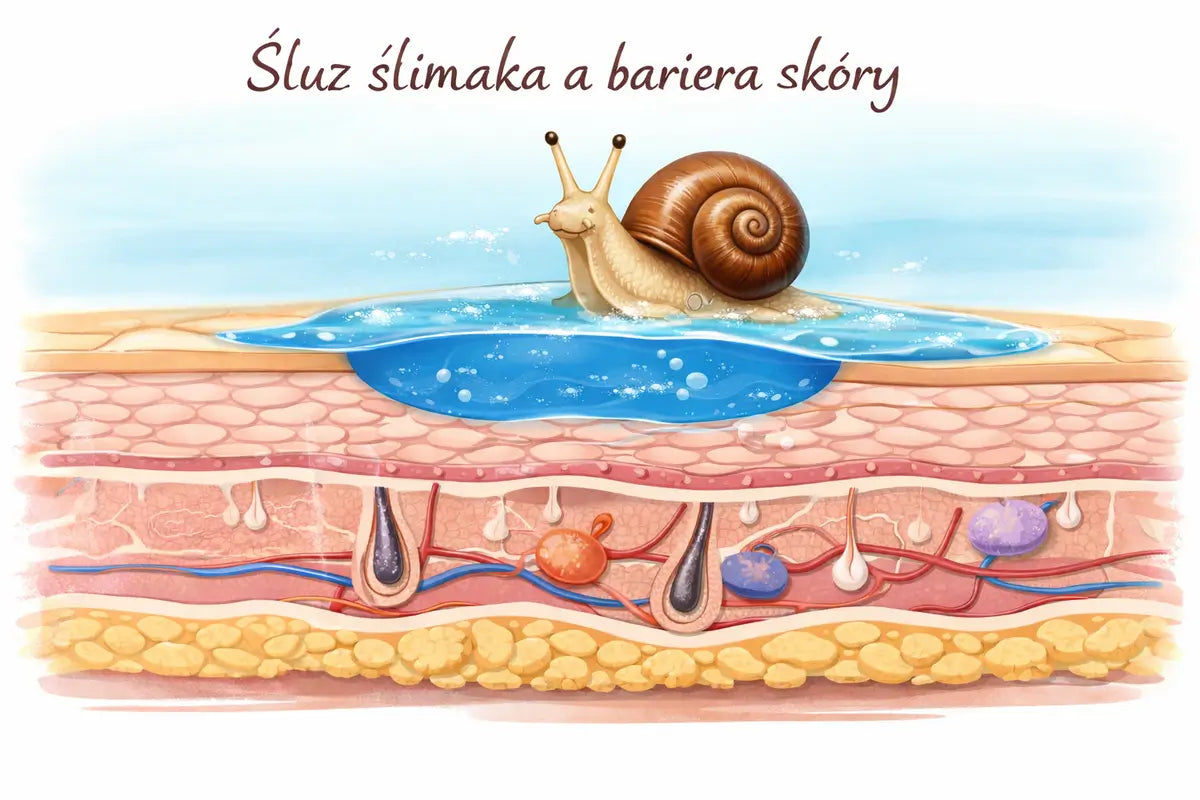
It's important to be clear: snail mucus does not replace skin barrier lipids, such as ceramides or cholesterol. It does not act as an intercellular "cement." However, it can play a very important supportive role by improving hydration, comfort, and conditions for natural epidermal regeneration.
Therefore, it works best as part of a regenerative skincare routine, especially in combination with gentle emollients and barrier-restoring ingredients.
Check out all cosmetics for a damaged hydrolipid barrier.
Snail mucus and ceramides - are they the same?
No. Ceramides are directly responsible for the integrity of the skin barrier. Snail mucus works differently:
- supports hydration,
- soothes irritation,
- promotes epidermal regeneration.
The best results in caring for a weakened barrier come from combining snail mucus with lipid ingredients, rather than treating it as the sole solution.
What does snail mucus cream help with? Discover the regenerating power of Orientana cosmetics

For which skin type is snail mucus best suited?
Snail mucus is particularly recommended for:
- dry and dehydrated skin,
- skin after acid and retinoid treatments (during the regeneration phase),
- skin exposed to environmental stress.
Individuals with active inflammation or allergies should introduce it carefully, performing a patch test.
How to incorporate snail mucus into your skin barrier repair routine?
In regenerative skincare, simplicity is key. The routine should include:
- Gentle cleansing without disrupting the barrier.
- A product with snail mucus as a moisturizing and soothing step (e.g., in the form of an essence).
- A cream to seal the care and limit TEWL. (e.g., snail mucus cream)
- Sun protection during the day.
In Orientana's offer, the role of barrier support can be played by, among others, SNAIL MUCUS Face Essence and SNAIL MUCUS Natural Face Cream, used as part of a regenerative routine.
Natural face cosmetics with snail mucus from Orientana brand

Questions
Does snail mucus rebuild the hydrolipid barrier?
Not directly. It supports its function by improving hydration and epidermal regeneration.
Does snail mucus reduce TEWL?
Studies indicate that it can contribute to reducing TEWL, improving water retention in the skin.
Is snail mucus good for damaged skin barrier?
Yes, as part of a soothing and regenerating skincare routine, but ideally in combination with lipids.
Can snail mucus be used after retinol?
Yes, during the skin regeneration phase, when the goal is soothing and improving comfort.
Is snail mucus suitable for sensitive skin?
Often yes, but it is always advisable to perform a patch test.
Does snail mucus replace ceramides?
No. It acts complementarily, not interchangeably.
Sources
Snail mucus - regeneration, healing, skin
Truchuelo et al., 2020, Clinical efficacy of a cosmetic product containing snail secretion filtrate, Journal of Cosmetic Dermatology
➡️ clinical study, improved hydration and skin tolerance
Snail mucus and epidermal regeneration
Gentili et al., 2018, Snail secretion filtrate stimulates fibroblast migration and wound healing, Molecules
➡️ biological mechanisms: fibroblast migration, regeneration
Skin barrier and TEWL theoretical basis
Elias PM, 2005 Stratum corneum defensive functions, Journal of Investigative Dermatology
➡️ foundation of knowledge on barrier, TEWL, lipids
Hydration and barrier function
Rawlings & Harding, 2004, Moisturization and skin barrier function, Dermatologic Therapy
Review: cosmetics and skin barrier
Draelos ZD, 2018, Cosmeceuticals and the skin barrier
Dermatologic Therapy