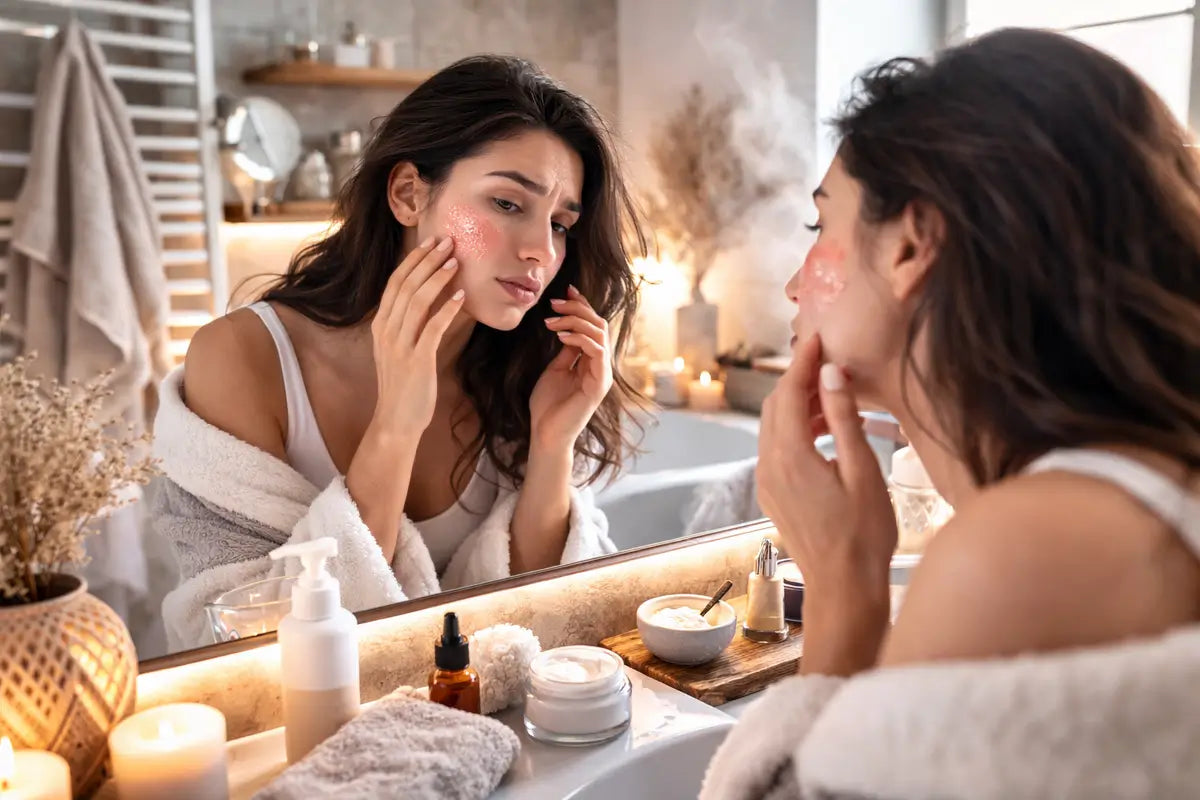
Burning, stinging, a feeling of heat, and sometimes even visible redness – if your skin reacts this way to cosmetics containing acids, you're no exception. Many people with sensitive skin conclude that "acids are not for me."
However, this is an oversimplification. The problem isn't the idea of exfoliation itself, but choosing the wrong type of acid for your skin's condition .
Modern cosmetology increasingly favors an alternative: lactobionic acid , a PHA (polyhydroxy acid) ingredient. This ingredient not only doesn't irritate but actually supports the regeneration of sensitive, vascular, and reactive skin .
In this article you will see exactly:
- why other acids can intensify irritation,
- how lactobionic acid works at the biological level,
- and how to practically create care that does not damage the skin barrier, but rebuilds it .

Why does sensitive skin react with irritation to acids?
What is sensitive skin - type or condition?
Sensitive skin isn't always a "skin type." It's often a functional condition associated with:
- overactivity of nerve endings,
- chronic inflammatory microstate,
- disturbed hydrolipid barrier.
This means that even combination or oily skin can behave like sensitive skin.
You can learn more about sensitive skin here: Sensitive Skin
The role of the hydrolipid barrier
- The hydrolipid barrier is responsible for:
- protection against external factors,
- maintaining hydration,
- control of substance permeation.
Its damage leads to:
- increase in TEWL (transepidermal water loss),
- increased permeability,
- easier penetration of irritating substances.
Find out how to care for the hydrolipid barrier
Why can AHA and BHA irritate?
AHA (e.g. glycolic, lactic) and BHA (salicylic) acids:
- have a low molecular weight → quickly penetrate the skin,
- operate at a lower pH,
- accelerate exfoliation by loosening the connections between cells.
Effect:
fast action = greater risk of irritation,
- especially with a weakened barrier.
Lactobionic acid vs. other acids - key differences

What is lactobionic acid?
Lactobionic acid is a polyhydroxy acid (PHA) produced from lactose.
It is characterized by:
- large molecule,
- many hydroxyl groups,
- high water binding potential.
Why does it work more gently?
The most important difference:
slower skin penetration
Thanks to the larger molecule:
- does not penetrate rapidly into deeper layers,
- works more superficially,
- does not cause a strong inflammatory reaction.
PHA vs AHA vs BHA (in practice)
- AHA → rapid exfoliation, greater risk of irritation
- BHA → deep pore cleansing
- PHA → hydration + regeneration + gentle exfoliation
for sensitive skin: the choice is obvious → PHA
Read PHA Acids: A Gentle Revolution in Skin Care
The mechanism of action of lactobionic acid on the skin
Moisturizing and water binding
Lactobionic acid acts as a strong humectant:
- attracts water molecules,
- increases the hydration of the stratum corneum,
- improves skin elasticity.
Support for the hydrolipid barrier
Research shows that PHA:
- reduce TEWL,
- support the reconstruction of the barrier,
- improve the integrity of the epidermis.
This is a key difference from AHA.
Anti-inflammatory effect
Lactobionic acid:
- reduces redness,
- soothes irritations,
- reduces skin reactivity.
Antioxidation
Acts as an antioxidant:
- neutralizes free radicals (ROS),
- supports protection against oxidative stress,
- slows down the aging process.
Why do other acids irritate but lactobionic acid does not?
It's not a question of "if acid works", but how it works .
Key differences:
- penetration rate,
- particle size,
- influence on skin pH,
- exfoliation intensity.
AHA/BHA = quick effect + risk
PHA = Gradual Action + Safety
Who is lactobionic acid best for?
- sensitive skin
- vascular skin
- skin with erythema
- dehydrated skin
- skin after retinol
- skin with a disturbed barrier
When does the skin react badly to acids?
Symptoms:
- baking
- reddening
- peeling
- feeling of tension
In such a situation, the barrier should be rebuilt, not "acted harder"
How to use lactobionic acid to avoid skin irritation?
- start with 2–3 times a week
- use moisturizer after application
- avoid combining with strong acids at the beginning
- observe the skin's reaction
What cosmetics should I choose for sensitive skin?
The key formulas are:
- they do not breach the barrier,
- contain soothing ingredients,
- support skin regeneration.
In practice, cosmetics that combine soothing and regenerating properties work well - such as smoothing and soothing serums with mucin

This is an example of a formula that:
- supports the hydrolipid barrier,
- reduces irritation,
- improves skin comfort without weighing it down.
Sensitive skin care - scheme
In the morning
- gentle cleansing
- soothing serum
- cream + SPF
Evening
- gentle cleansing
- lactobionic acid (selected days)
- regenerating serum
- rebuilding cream
You can find more about the principles of conscious care in the natural cosmetics section.
Is lactobionic acid better than other acids?
There is no one “best” acid for everyone.
But:
for sensitive and reactive skin
lactobionic acid is one of the best choices
FAQ
Does lactobionic acid irritate the skin?
Lactobionic acid is a PHA and is much gentler than AHA or BHA. Its larger molecules allow it to penetrate the skin more slowly, reducing the risk of irritation and making it suitable for sensitive skin.
Can lactobionic acid be used daily?
In many cases, yes, especially at low concentrations. However, it's best to start with a few times a week and observe your skin's reaction, gradually increasing the frequency.
Is lactobionic acid suitable for vascular skin?
Yes, because it has soothing and anti-inflammatory properties. It can help reduce redness and strengthen the skin barrier, which is crucial for sensitive skin.
Can you combine lactobionic acid with retinol?
Yes, but with caution. Lactobionic acid is mild, so it can be used in a retinol routine, preferably on separate days or if skin tolerates it well.
Does lactobionic acid work on redness?
It can support the reduction of redness thanks to its anti-inflammatory effect and strengthening of the hydrolipid barrier, which reduces skin reactivity.
Does lactobionic acid exfoliate the skin?
Yes, but very gently. Its exfoliating action is much gentler than that of AHAs, so it doesn't cause intense flaking.
Can lactobionic acid be used in summer?
Yes, because it does not increase sun sensitivity as much as other acids, but it is still recommended to use SPF.
Is lactobionic acid suitable for pregnant women?
It is considered safe, but it is always worth consulting your doctor before using it.
Summary
Sensitive skin doesn't mean giving up on active skincare. It means making a conscious choice.
Lactobionic acid shows that you can:
- exfoliate the skin without irritation,
- moisturize and regenerate at the same time,
- support the barrier instead of weakening it.
This is why it is becoming one of the most important ingredients in modern sensitive skin care.
And if you want to go a step further - choose formulas that combine its action with regeneration and soothing of the skin, so that the care works not only on the surface, but also on a biological level .