Fine hair is one of the most common, yet most demanding, hair types. While it may appear healthy and soft at first glance, it's actually much more susceptible to mechanical damage, overuse of cosmetics, and scalp imbalances. Caring for it requires not only the right products but, above all, an understanding of the biology of the hair and scalp .
In this article, you'll find a comprehensive, expert treatment of fine hair : from its structure, through its real needs, to a detailed care routine based on trichological knowledge and natural active ingredients. This is complemented by a discussion of the Orientana Lychee trichology series , also designed for fine and sensitive hair.
What is fine hair - a trichological definition
In trichological terms, fine hair is hair with a thin shaft diameter , meaning a thin cortex and cuticle. It should not be confused with thinning or disease-damaged hair. A person can have a lot of hair, and yet all of it will be fine.
The delicacy of the hair is a feature of:
- genetic,
- hormonally modulated,
- sensitive to lifestyle and care.
Thin hair has less resistance to:
- friction,
- high temperature,
- irritating substances,
- excess of cosmetics with heavy formulas.

How to recognize fine hair?
Fine hair has very distinctive features that are often downplayed or misinterpreted.
Most often:
- they quickly lose volume after washing,
- are soft and "flowing",
- easily becomes greasy at the roots,
- they react badly to heavy masks and oiling,
- they break easily when combing,
- are susceptible to static electricity and damage.
From a trichologist's perspective, the key is that the problem is not the hair itself, but its overload and the imbalance of the scalp .

The structure of delicate hair and its care needs
Each hair is made up of three layers: the medulla, the cortex, and the cuticle. For fine hair:
- the hair cortex is thinner,
- less resistant casing,
- the protective barrier becomes damaged more quickly.
This means that fine hair:
- lose water faster,
- they are less resistant to detergents,
- require strengthening but light ingredients.
Too intensive care, instead of helping, worsens their condition .
Fine hair and scalp - a key relationship
One of the most common mistakes in caring for fine hair is focusing solely on length. However, hair quality depends directly on the condition of the scalp .
The scalp of fine hair often:
- is sensitive,
- easily irritated,
- produces sebum unevenly,
- reacts to aggressive washing with overproduction of sebum.
Therefore, modern care for delicate hair should be trichological , not solely cosmetic.
The most common mistakes in the care of delicate hair
In trichological practice, the same patterns are most often observed, which lead to the deterioration of the condition of thin hair.
The most common errors include:
- using strongly cleansing "volumizing" shampoos,
- excess silicones and sticky substances,
- applying masks and conditioners to the scalp,
- too frequent oiling with heavy oils,
- intense heat styling,
- lack of protection of the hydrolipid barrier of the scalp.
Fine hair doesn't need "more" cosmetics - it needs better ones .

How to care for delicate hair - a step-by-step trichological approach
Cleansing the scalp - the foundation of care
A shampoo for delicate hair should:
- effectively cleanse the scalp,
- do not disturb the hydrolipid barrier,
- do not cause sebum rebound effect,
- support the skin microbiome.
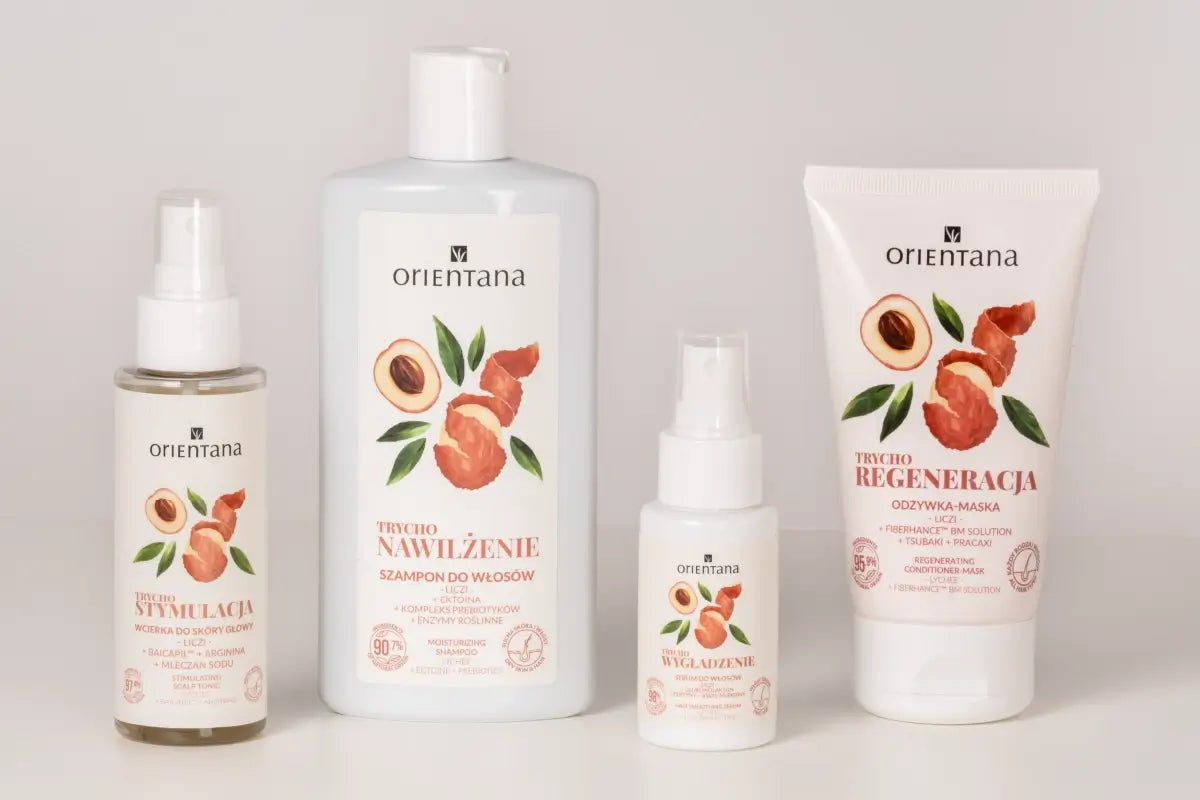
Orientana Trycho Lychee Shampoo was developed in accordance with these principles. Its purpose is not to aggressively degrease, but to restore the scalp's balance , which in the long run improves the condition of fragile hair at the roots.
Length Nutrition - Lightness instead of burden
Fine hair reacts very quickly to formulas that are too rich. A conditioner should:
- strengthen the hair structure,
- improve flexibility,
- facilitate combing,
- do not leave an incriminating film.
Trycho Lychee Orientana Conditioner works in line with this philosophy, strengthening fine hair while maintaining its natural lightness and elasticity.
Always remember to use conditioners and masks only on the lengths and ends of your hair .
Regeneration - mask for delicate hair
For delicate hair, the mask:
- should not be used too often,
- must have a light, trichological formula,
- should strengthen, not burden.
Trycho Lychee Conditioner-Mask has been designed to:
- improve hair's resistance to breakage,
- support the regeneration of the thin structure,
- not cause a "flap" effect.

Styling delicate hair - how not to ruin the effects of care?
Styling is one of the biggest challenges with fine hair. Fine hair:
- overheats faster,
- tolerates friction worse,
- breaks more easily.
This is why:
- it is worth limiting high temperatures,
- use light styling products,
- avoid aggressive backcombing,
- protect hair while sleeping and drying.
Proper care makes fine hair more resilient and visibly thicker over time , even without intense styling. TrychoLiczi Hair Serum is the perfect solution.
Fine hair and volume - facts and myths
One of the biggest myths is the belief that fine hair needs to be "thickened" at all costs. In practice:
- heavy cosmetics reduce volume,
- strong detergents worsen the condition of the scalp,
- Excessive styling weakens the hair.
True volume in fine hair comes from:
- healthy scalp,
- flexible hair structure,
- light, regular care.
Why is the Orientana Lychee Trichology series suitable for delicate hair?
The Trycho Lychee Orientana series was created as a response to the real needs of people with thin, delicate hair and sensitive scalp.
Its key assumptions are:
- trichological approach to care,
- light, non-overburdening formulas,
- support for the scalp microbiome,
- strengthening the hair structure without overloading it.
Lychee extract, known for its antioxidant and protective properties, supports the natural defense mechanisms of the hair and scalp, which is crucial for thin hair structure.
Delicate hair and long-term care effects
With regular use of appropriate care:
- delicate hair becomes more resistant,
- their fragility decreases,
- their elasticity improves,
- the hairstyle looks fuller and healthier.
Trichological care is a process , not a quick beauty trick. Fine hair rewards you with improved condition when treated with care and consistency.
FAQ - delicate hair
What is fine hair?
Fine hair is hair with a thin structure, susceptible to stress and damage.
Can fine hair be thick?
Yes, gentleness refers to the thickness of the hair, not its quantity.
What cosmetics are best for delicate hair?
Light, trichological formulas that strengthen without weighing down.
Can delicate hair be oiled?
Yes, but very carefully and with light oils, less frequently than with thick hair.
Is the Trycho Lychee series suitable for everyday care?
Yes, it is designed for regular use on fine hair.
Summary - conscious care for delicate hair
Fine hair requires precise, gentle, and trichological care based on an understanding of its biology. Supporting the scalp, protecting the delicate hair structure, and avoiding overload are key.
The Trycho Lychee Orientana series perfectly meets the needs of delicate hair, offering care that:
- strengthens,
- protects,
- does not burden,
- works long-term.