
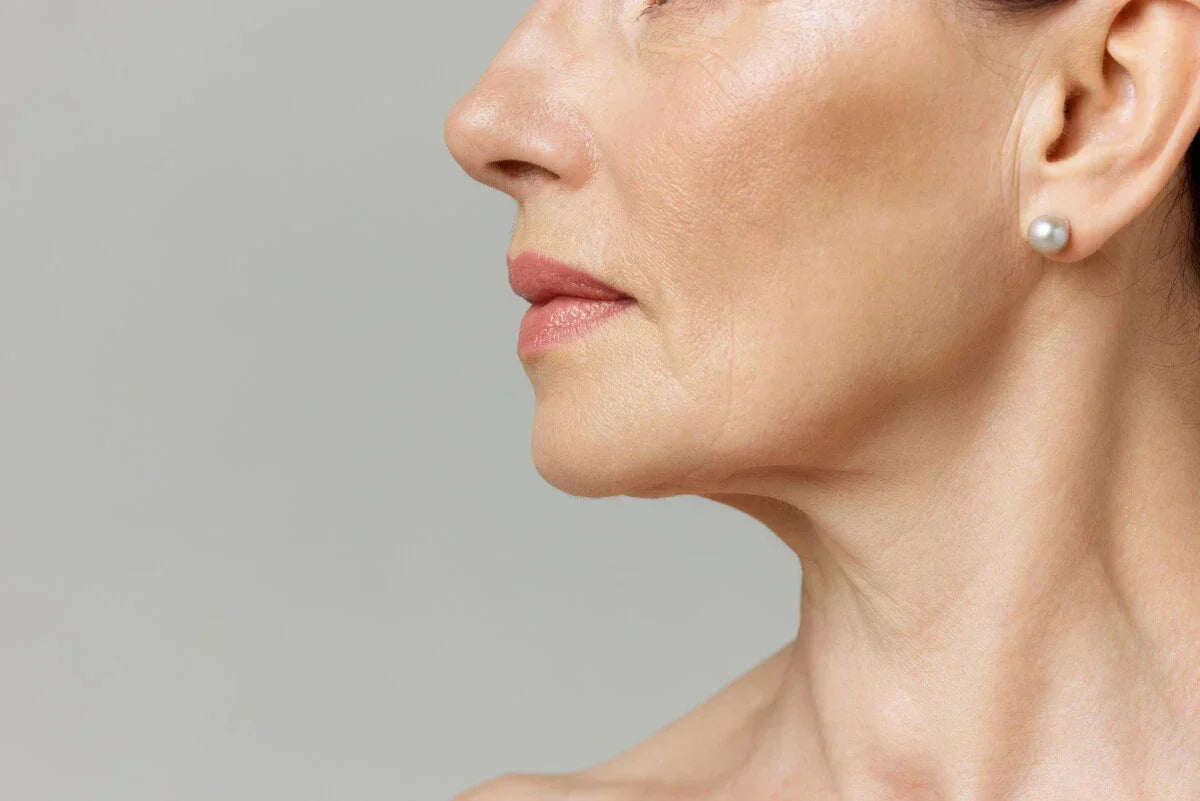
A double chin is one of the most common aesthetic concerns in the lower part of the face. Contrary to popular belief, it does not exclusively affect overweight individuals. It can also appear in lean and young people, as its formation is linked not only to adipose tissue but also to the anatomical structure of the face, skin condition, muscle tone, and lymphatic system function.
From the perspective of cosmetology and skin physiology, a double chin results from several simultaneous processes occurring in the tissues: muscle weakening, loss of skin firmness, impaired lymphatic drainage, and changes in the structure of adipose tissue.
Understanding these mechanisms allows for better selection of prevention and skin care methods in this area.
What is a double chin?
A double chin is a fold of tissue that appears in the area between the chin and the neck. It most often results from the accumulation of adipose tissue, skin laxity, or fluid retention in the tissues.
Anatomically, this area includes:
- the lower part of the mandible
- the platysma muscle
- subcutaneous fat tissue
- a network of lymphatic and blood vessels
If the balance between these structures is disturbed, the contour of the lower face begins to blur, and a characteristic fold appears under the chin.
The role of the platysma muscle
One of the most important elements affecting the appearance of this area is the platysma muscle.
It is a thin, broad muscle running from the chest and collarbones up to the lower part of the face. It is responsible for the tension of the neck skin and the stabilization of the jawline contour.
With age, the platysma gradually loses its tension, leading to:
- sagging of the lower facial tissues
- deepening of skin folds
- loss of a defined jawline
Weakening of this muscle is one of the key factors in the formation of a double chin.
Loss of collagen and elastin
The skin in the chin area is one of the relatively thin and delicate areas of the face. With age, there is a natural decrease in collagen and elastin production.
Fibroblasts, the cells responsible for producing the skin's supporting fibers, become less active. As a result:
- the skin loses elasticity
- its ability to maintain tension worsens
- tissues begin to sag under the influence of gravity
This process is referred to as collagen atrophy, which is one of the main mechanisms of skin aging.
The significance of fat tissue in the chin area
The lower part of the face contains a thin layer of fat tissue, which acts as a cushion and support.
However, under certain conditions, it can accumulate excessively. This is promoted by, among other things:
- genetic predispositions
- weight fluctuations
- slowed cellular metabolism
- hormonal changes
Excess fat tissue leads to the formation of a visible fold under the chin, even if the skin remains relatively firm.

Lymphatic drainage disorders
The lymphatic system is responsible for removing excess fluids from tissues and transporting metabolic waste products.
If its function is slowed, lymphatic stagnation may occur, manifesting as:
- tissue swelling
- a feeling of heaviness in the skin
- worsening of facial contour
Lymphatic stagnation often occurs in people who lead sedentary lifestyles or work long hours with their heads tilted forward.
The impact of body posture on double chin formation
Increasingly, attention is being paid to the connection between body posture and the appearance of the lower face.
Prolonged tilting of the head while using a phone or working at a computer leads to what is known as smartphone neck. In such a position:
- neck muscles shorten
- chin tissues are constantly compressed
- the skin loses tension
As a result, over time, a skin fold may become permanent in this area.
What happens in the skin during double chin formation?
The process of double chin formation is a result of several biological mechanisms interacting.
Among other things, the following occur in the tissues:
- decreased fibroblast activity
- degradation of collagen fibers
- worsening microcirculation
- lymphatic drainage disorders
- weakening of muscle tone
These changes lead to a gradual loss of skin firmness and deterioration of the lower facial contour.
Is a double chin inevitable?
Although the skin aging process is natural, it does not mean that everyone will develop a double chin.
Its development is influenced by many factors, such as:
- lifestyle
- level of physical activity
- skin care routine
- body weight
- genetic predispositions
Conscious skin care, maintaining correct body posture, and regular facial muscle activity can significantly slow down the process of firmness loss in this area.
Why understand skin physiology?
Understanding the processes occurring in the skin allows for a more conscious approach to skincare.
A double chin is not just an aesthetic problem – it is often a sign that the tissues need support. Proper care, skin stimulation through massage, and facial muscle activity can support the skin's natural regenerative mechanisms.
In cosmetology, the importance of mechanotransduction, i.e., the reaction of skin cells to mechanical stimuli such as massage or facial muscle exercises, is increasingly emphasized. These processes are what make regular beauty rituals truly improve skin tension and the appearance of the facial contour.
Frequently asked questions about double chin
Does a double chin always mean being overweight?
No. A double chin can also appear in lean individuals. In many cases, its cause is loss of skin firmness, genetic predispositions, or weakening of the neck and lower face muscles. Poor posture, such as prolonged tilting of the head while using a phone, is also a common factor.
At what age does a double chin most often appear?
It can appear as early as after 25–30 years of age, when collagen and elastin production in the skin begins to decline. In some people, it appears earlier due to genetics or facial anatomical structure.
Is a double chin related to skin aging?
Yes. With age, fibroblasts produce less collagen and elastin, leading to a gradual loss of skin firmness. Tissues begin to sag under the influence of gravity, and the contour of the lower face becomes less defined.
Does genetics influence a double chin?
Yes. Genetics can affect jaw shape, fat distribution, and skin elasticity. Therefore, in some individuals, a double chin appears even with a healthy body weight.
Can rapid weight loss cause a double chin?
Yes. Rapid weight loss can lead to skin laxity, as the skin does not always keep up with shrinking after a reduction in fat tissue volume.
Does body posture affect the formation of a double chin?
Yes. Prolonged tilting of the head, e.g., while working at a computer or using a phone, can lead to weakening of neck muscles and worsening of skin tension in the chin area.
Can lymphostasis cause a double chin?
Yes. Lymphostasis can cause tissue swelling in the lower part of the face. In such cases, a double chin may be partly a result of fluid retention in the tissues.
Can a double chin appear suddenly?
Most often, it is a gradual process. Changes in skin and muscle structure occur slowly, so a double chin usually appears as a result of long-term changes in the tissues.
Can a double chin worsen over time?
Yes. If no measures are taken to support skin and muscle condition, the process of firmness loss can progress, and the chin fold becomes more visible.
Is a double chin always the result of fat accumulation?
No. In many cases, it is a result of skin laxity or weakening of neck muscles. Sometimes, water retention in tissues is also a cause.
Does body weight affect a double chin?
Yes, but it is not the only factor. Excess fat tissue can increase the volume of tissues under the chin, but in many people, a double chin appears regardless of weight.
Does the skin on the chin differ from facial skin?
Yes. The skin in this area is often thinner and more prone to loss of firmness. Additionally, it is strongly affected by gravity and neck muscle movements.
Is a double chin purely an aesthetic problem?
Most often, yes. In the majority of cases, it is not related to diseases but is a result of natural aging processes and changes in skin and muscle structure.
Can stress affect the appearance of the lower face?
Indirectly, yes. Stress affects cortisol levels in the body, which can worsen skin regeneration and promote water retention in tissues.
Can the formation of a double chin be prevented?
Yes. Maintaining good posture, regular facial muscle activity, skincare, and a healthy lifestyle are very important in prevention.