
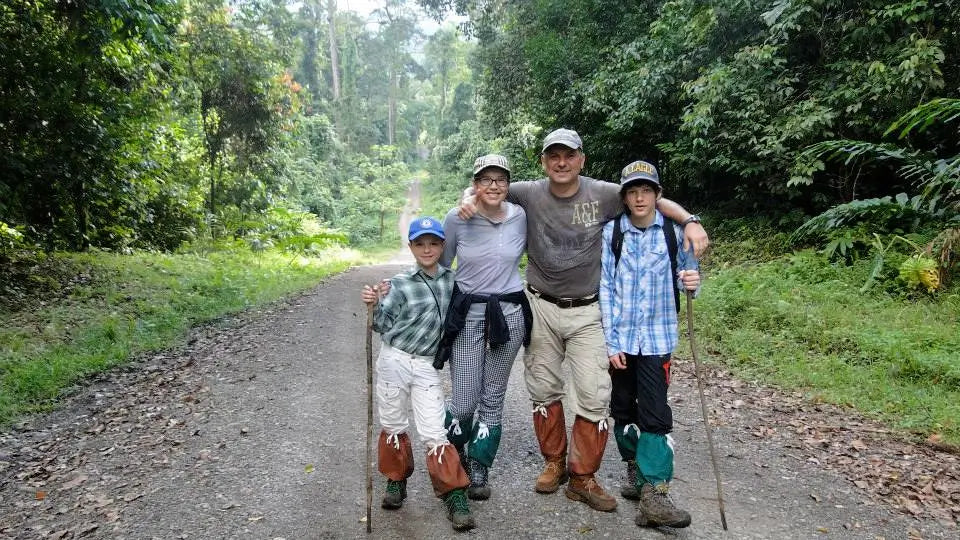
A few years ago, my whole family and I flew to Borneo – one of the most extraordinary islands in the world, where nature still abides by its primeval laws. We spent a dozen days in the Malaysian part of the island, in the state of Sabah, immersed in the humid, dense rainforest. I had long dreamed of seeing orangutans in their natural habitat – not in a zoo, not in a sanctuary, but where they truly live.
Borneo – an island where nature is greater than man
Borneo is the third-largest island in the world, divided between Malaysia, Indonesia, and Brunei. It is one of the most important places on Earth in terms of biodiversity. The rainforests here are over 100 million years old – older than the Amazon.
From the very first day, I felt like it was a completely different world. The air was heavy with humidity, smelling of earth, leaves, and something difficult to describe, like life in its purest form. The sounds were constant: cicadas, birds, the calls of unseen animals. The jungle never falls silent.

National Park – why is access so restricted?
We were directed to one of the national parks in Sabah – the Danum Valley Conservation Area, one of the best-preserved places on all of Borneo. Entry was only possible after showing documents and prior registration.
At first, it surprised me – after all, it's "just" a jungle. I quickly realized that this was no ordinary forest. It is one of the last fragments of primal nature in the world, which must be protected almost like a treasure.
The reason? Not only the protection of the ecosystem, but also... people.
Our guide and first encounter with the jungle
We spent several days trekking from morning to evening with a guide. For tourists, he was "Mike," but his real name was Darum. He taught us to look at the jungle differently – not as chaos, but as a precise, perfectly functioning system.
The park covers approximately 43,800 hectares. Over 340 bird species and about 120 mammal species live here. The first few days brought encounters that are hard to forget.

Fauna of Borneo – a jungle full of life
Of course, the orangutans aroused the greatest excitement. We saw the first ones faster than I expected. They sat high in the trees, calm, majestic. Their movements were slow, deliberate – completely different from what you see in internet videos.
But Borneo is not just about them. We also saw:
- elephants – smaller, but incredibly dignified
- proboscis monkeys with their characteristic large noses
- hornbills – some of the most exotic birds in the world
- an countless number of insects I had never seen before
What struck me most was how everything is interconnected. Every species has its place and role.
Flora – the green architecture of nature
The vegetation was as impressive as the animals. Giant dipterocarp trees formed a roof tens of meters above our heads. Lianas entangled everything they encountered, and ferns and mosses covered every inch of the ground.
Somewhere in this jungle, there also grows Rafflesia arnoldii – the largest flower in the world, which can reach over a meter in diameter and… smells like decaying meat.
This place was beautiful, but also wild and uncompromising.
The dark side – animal smuggling
During our treks, Mike told us something that changed my perspective on many things. One of the reasons for such strict protection of the jungle is animal theft.
Although exporting them from Malaysia is illegal, there are organized groups that kidnap young animals and smuggle them to other countries. They then end up in private homes as "exotic pets."
Those cute videos we see online – monkeys in clothes, bathed in tubs, playing like children – often have a very brutal background. These animals were taken from their mothers and will never return to their natural environment.
That was the moment I truly felt that tourism and our choices have consequences.
Palm oil and jungle deforestation – the biggest threat
An even bigger problem is the mass deforestation of forests for palm oil plantations. Palm oil is now found in a huge number of products – from food to cosmetics.
To make way for plantations:
- rainforests are cut down
- they are often burned
- entire ecosystems are destroyed
Orangutans lose their homes, but… they return to the same places. They don't understand that their forest is gone. As a result, they are treated as pests – killed or captured.
This was one of the most moving aspects of this trip.
My reflection after Borneo
After returning, I started looking at everyday choices completely differently. These are not abstract decisions. They have a real impact on places like Borneo.
It's not just about grand gestures. Sometimes it's enough to:
- not support content showing wild animals as "toys"
- choose products without palm oil or from certified sources
- be a conscious consumer
As someone who creates cosmetics, I know how important ingredient decisions are. That's why I believe brand responsibility starts right here – with the raw material.
Borneo taught me one thing: nature doesn't need us. We need it.