
What are peptides?
Peptides are among the most advanced and biocompatible active ingredients used in modern cosmetology. Although for many years they were primarily reserved for aesthetic dermatology and professional cosmetics, they are now increasingly appearing in home care, particularly in serums, boosters, and eye cosmetics.
Chemically speaking, peptides are short chains of amino acids joined by peptide bonds. Amino acids are the basic building blocks of skin proteins such as collagen, elastin, and keratin. This is why peptides are so well recognized by the skin and demonstrate high bioavailability.
Unlike classic moisturizing or occlusive ingredients, peptides don't act solely on the surface. Their main role is to transmit precise biological signals to the skin, triggering specific repair and regeneration processes.
You could say that peptides act as "messengers" that inform skin cells what actions should be taken - for example, increasing collagen production, accelerating epidermal renewal or strengthening the protective barrier.
Definition of peptides in cosmetology
In cosmetology, peptides are defined as bioactive molecules with signaling properties capable of modulating skin cell activity. This means that they do not replace natural processes occurring in the skin, but support and stimulate them.
This is a key difference compared to ingredients that only act symptomatically. Peptides don't "fill" wrinkles or simply create a smoothing film. Their function is to improve skin quality from within by influencing cell metabolism.
Thanks to this, cosmetics with peptides are often referred to as preparations with biomimetic effects, i.e. imitating the natural physiological mechanisms of the skin.
How do peptides differ from proteins and amino acids?
Amino acids are single building blocks. Proteins, on the other hand, are long, complex chains of amino acids with high molecular weight.
Peptides occupy an intermediate position—they are shorter than proteins but more complex than individual amino acids. This "middle" molecular size has enormous practical importance.
- Proteins are usually too large to effectively penetrate the stratum corneum of the epidermis.
- Amino acids easily penetrate the skin, but do not carry precise biological information.
- Peptides combine the advantages of both - they are small enough to penetrate the epidermis, yet complex enough to transmit specific cellular signals.
It is this property that makes peptides considered one of the most intelligent active ingredients.

Why are peptides called signaling components?
In young, healthy skin, communication between cells is constantly taking place. Fibroblasts receive signals to produce collagen, keratinocytes regulate the rate of epidermal renewal, and immune cells maintain microbial balance.
With age, this communication gradually weakens. The skin produces less collagen, regenerates more slowly, and is less able to cope with external factors.
Peptides are designed to mimic natural protein fragments found in the skin. When they reach cells, they are recognized as a signal to trigger specific processes.
In practice, this means that peptides can:
- stimulate fibroblasts to synthesize collagen and elastin,
- increase the production of extracellular matrix components,
- support the repair processes of the epidermis,
- modulate inflammatory responses.
Thanks to this, they act causally, not just symptomatically.
Biomimetic peptides and skin physiology
The term "biomimetic" means "imitating nature." In the context of peptides, it refers to molecules designed to structurally resemble fragments of natural skin proteins.
This design allows the skin to "understand" the peptide's message and react predictably. This is a huge advantage over many older active ingredients, which had more general effects.
Biomimetic peptides are part of the modern trend of regenerative cosmetology, which aims to support the skin's natural self-renewal capabilities instead of aggressively stimulating it to react.
How do peptides work on the skin?
The effects of peptides are multifaceted and depend on their type, concentration, and cosmetic formula. However, the common denominator of all peptides is their ability to improve the quality and functioning of skin at the cellular level.
Regular use of cosmetics with peptides leads to a gradual but lasting improvement in the condition of the skin, not just a temporary smoothing effect.
Stimulation of collagen and elastin production
Collagen and elastin are responsible for skin firmness, elasticity, and density. Their synthesis declines with age, leading to sagging and wrinkling.
Signal peptides stimulate fibroblasts to increase production of these structural proteins. As a result, the skin gradually regains better structure and firmness.
Importantly, this is a physiological process - the skin itself produces more collagen, instead of being merely "filled" from the outside.
Smoothing facial wrinkles
Some peptides have the ability to modulate neuromuscular transmission. They gently relax facial muscles, helping to reduce the appearance of facial wrinkles, such as crow's feet and forehead lines.
This effect is sometimes compared to a very gentle, cosmetic alternative to injection treatments without any risk and without immobilizing facial expressions.
Improvement of skin firmness and density
By affecting the extracellular matrix, peptides contribute to increased skin density. The skin becomes firmer, more elastic, and more resistant to gravity.
This is particularly important in the care of mature skin and when facial contours are lost.
Regeneration and healing of micro-damages
Peptides support epidermal repair processes, accelerating cell renewal and regenerating the protective barrier. This allows the skin to recover more quickly after irritation, cosmetic treatments, or exposure to unfavorable environmental factors.
Support for the hydrolipid barrier
A healthy hydrolipid barrier is the foundation of well-functioning skin. Peptides indirectly strengthen its structure by improving the quality of epidermal lipids and increasing the production of structural proteins.
The skin becomes less susceptible to dryness, burning and hypersensitivity.
Moisturizing and protective effect
Although peptides themselves are not classic humectants, their effect on improving the functioning of the skin makes it retain water better and more effectively utilizes the moisturizing substances present in the formula.
The result is skin that is softer, smoother and more resistant to external factors.

Types of peptides used in cosmetics
Although all peptides share a common characteristic—the ability to transmit biological signals, not all peptides function in the same way. Modern cosmetology distinguishes several main groups of peptides, each with its own mechanism of action and the effects they produce on the skin.
Understanding these differences allows you to better select cosmetics for your individual skin needs and consciously build care based on highly effective ingredients.
Signal peptides
Signal peptides are the best-studied and most frequently used group of peptides in cosmetics.
Their main role is to stimulate fibroblasts to increase the production of structural skin proteins such as collagen, elastin and proteoglycans.
Signal peptides act as a "repair" message to cells. The skin receives information that its supporting structure requires strengthening, leading to a gradual improvement in firmness and density.
Regular use of cosmetics with signal peptides promotes:
- smoothing out wrinkles,
- improving skin tension,
- smoothing out irregularities,
- strengthening the skin structure.
Signal peptides are particularly recommended in anti-aging care and anti-aging prevention.
Biomimetic peptides
Biomimetic peptides are molecules designed to mimic fragments of natural proteins present in the skin as closely as possible.
Thanks to this, they are perfectly recognized by cells and are characterized by very high biocompatibility.
Their advantage lies in their subtle yet long-lasting effects. Instead of aggressive stimulation, they support the skin's natural regenerative processes.
Biomimetic peptides are often used in skin cosmetics:
- sensitive,
- weakened,
- after cosmetic procedures,
- with a disturbed hydrolipid barrier.
This is the perfect choice for people who want anti-aging benefits but without the risk of irritation.
Transport peptides
Transport peptides act as carriers for selected ions and trace elements, such as copper or magnesium.
Their task is to deliver these ingredients directly to skin cells, where they can be used in regenerative processes.
Transport peptides support:
- healing of microdamages,
- tissue reconstruction,
- improving skin elasticity,
- repair processes after exposure to oxidative stress.
They are particularly valued in regenerative cosmetics and in skin care that requires intensive support.
Neuropeptides
Neuropeptides are a group of peptides that influence communication between nerve endings and facial muscles.
They work by gently limiting excessive muscle contractions, which helps smooth out facial wrinkles.
The effect is subtle and natural - the face retains its facial expressions, but the facial lines become less visible.
Neuropeptides are often used in cosmetics:
- under the eyes,
- on the forehead,
- around the mouth,
- for skin with visible facial wrinkles.
Collagen peptides
Collagen peptides are collagen fragments with a lower molecular weight that demonstrate good bioavailability and the ability to interact with the skin.
Their presence in cosmetics supports:
- hydration,
- smoothing,
- improved flexibility,
- strengthening the skin structure.
Additionally, collagen peptides can act as a signal to the skin, encouraging it to produce its own collagen.
New generation peptide complexes
Modern formulas increasingly use complexes containing several types of peptides simultaneously.
Such connections allow for multi-directional action:
- some peptides stimulate collagen production,
- others smooth out facial wrinkles,
- others support regeneration and the skin barrier.
The result is a more comprehensive improvement in skin condition with just one product.

Peptides and skin aging
Skin aging is a multifactorial process. It encompasses both changes occurring in the deeper layers of the skin and a weakening of the protective functions of the epidermis. With age, the skin's ability to regenerate declines, collagen and elastin production decreases, and cells respond more slowly to repair stimuli.
Peptides are part of a modern approach to anti-aging, which does not involve masking symptoms, but supporting the physiological mechanisms of skin renewal.
Why does collagen synthesis decline with age?
Around age 25, collagen production begins to gradually decline. This process continues with each passing year, leading to:
- loss of firmness,
- the appearance of wrinkles,
- weakening of the skin structure,
- deterioration of the facial oval.
Fibroblasts - cells responsible for collagen production - become less active and less responsive to natural regenerative signals.
Peptides help restore some of this communication.
How peptides slow down the aging process
Peptides act as a “reminder” to skin cells that they should continue to produce structural proteins.
Regular use of cosmetics with peptides:
- stimulates fibroblasts to synthesize collagen and elastin,
- improves the organization of collagen fibers,
- increases skin density,
- supports repair processes.
The result is a gradual smoothing of the skin and improvement of its quality, not just a momentary tightening effect.
Peptides in anti-aging prevention
Peptides aren't just for mature skin. They're also perfect for preventative care.
Incorporating peptides at the first signs of aging:
- delays the formation of wrinkles,
- helps maintain firmness,
- supports the natural balance of the skin.
This approach is consistent with the philosophy of modern cosmetology: prevention is better than cure.
Peptides for first wrinkles vs. mature skin
In the care of skin with first wrinkles, peptides have a mainly preventive and strengthening effect.
In the care of mature skin, their role is more restorative - they support the reconstruction of the skin's structure and improvement of its density.
In both cases, the mechanism of action remains the same, only the care goal changes.
Eye peptides - why are they so effective?
The skin around the eyes is the thinnest and most delicate on the entire face. It contains fewer sebaceous glands, loses moisture more quickly, and is more prone to wrinkles.
This is why the eye area is often the first to show signs of aging.
Peptides are one of the best-suited ingredients for the care of this area.
The specificity of the skin around the eyes
Skin under the eyes:
- is thinner than on the cheeks or forehead,
- has a weaker protective barrier,
- reacts faster to stress, fatigue and dehydration.
It needs ingredients that work effectively, but at the same time gently.
How peptides reduce wrinkles under the eyes
Neuropeptides and signaling peptides help:
- relax minor muscle tensions,
- stimulate collagen production,
- improve skin elasticity.
This makes crow's feet and fine lines less visible and skin appears smoother.
Peptides for dark circles and puffiness
Although peptides are not typical draining ingredients, they support skin regeneration and improve its quality, which may contribute to:
- brightening the eye area,
- improvement of skin tension,
- reducing the visibility of signs of fatigue.
The best results are achieved when peptides are combined with other ingredients that support microcirculation and hydration.
Serum vs. Eye Cream with Peptides
Serums with peptides usually have a lighter consistency and a higher concentration of active ingredients.
The eye cream also provides protection and comfort.
The best solution is to use a serum under the cream or choose a product that combines both functions.
What to combine peptides with in skincare?
One of the greatest advantages of peptides is their high compatibility with other active ingredients. Unlike many potent substances, peptides rarely cause irritation and are ideal for layering skincare.
Appropriate combinations of ingredients enhance the action of peptides and target care to specific skin needs: hydration, regeneration, firming or wrinkle reduction.
Peptides and EGF
EGF (epidermal growth factors) and peptides are a duo particularly valued in regenerative care.
Peptides transmit signals to skin cells, while EGF supports cell renewal and proliferation. Together:
- accelerate skin regeneration,
- improve its density,
- smooth out fine wrinkles,
- support recovery after treatments.
This combination works well both in anti-aging care and for weakened, dehydrated or tired skin.
Peptides and ceramides
Ceramides are a fundamental component of the skin's hydrolipid barrier. Their combination with peptides creates a synergistic effect:
- peptides stimulate regeneration,
- ceramides strengthen the barrier structure,
- the skin retains moisture better,
- susceptibility to irritation is reduced.
This is the perfect combination for dry, sensitive skin with a disturbed protective barrier.
Peptides and hyaluronic acid
Hyaluronic acid provides immediate hydration and smoothing, while peptides have a long-term effect on improving skin quality.
Common use:
- gives a quick comfort effect,
- improves skin elasticity,
- supports the smoothing of wrinkles,
- enhances the "plump skin" effect.
This is one of the most universal and safe connections.
Peptides and adaptogens
Adaptogens support the skin in coping with oxidative and environmental stress. When combined with peptides:
-
strengthen the skin's immunity,
-
limit the negative impact of external factors,
-
support regenerative processes,
-
improve the overall condition of the skin.
It's a great choice for skin exposed to stress, pollution and fatigue.
Peptides and niacinamide
Niacinamide improves the function of the hydrolipid barrier, regulates sebum secretion, and evens out skin tone. Combined with peptides:
- strengthens the skin structure,
- improves its elasticity,
- supports anti-aging effects,
- helps achieve a more uniform color.
Can you combine peptides with retinol and acids?
Yes, but it is worth maintaining a sensible strategy.
Peptides are best used in regenerative skincare, for example, in the morning or evening without retinol or acids. This allows:
- support skin regeneration,
- reduce the risk of irritation,
- help restore skin balance faster.
For people with sensitive skin, a good solution is to use peptides in the morning and retinol in the evening.
How to use cosmetics with peptides?
To fully utilize the potential of peptides, both regularity and the correct order of application are important.
Application order
- Cleaning
- Tonic/essence
- Serum with peptides
- Cream
- (Morning) SPF cream
Peptides are best applied to slightly damp skin.
Morning or evening?
Peptides can be used both morning and evening.
- In the morning they support skin protection and immunity.
- In the evening they support regeneration.
The best results are achieved when used twice a day.
What concentrations are effective?
Home care cosmetics use safe and effective peptide concentrations that allow for effective results when used regularly.
In practice, the quality of the peptides and the entire formula of the cosmetic are more important than the percentages themselves.
How long to wait for results?
The first effects in the form of improved hydration and smoothing can be noticed after a few days.
More visible structural changes, such as improved firmness and wrinkle reduction, usually require 4-8 weeks of regular use.
What kind of skin are peptides best for?
Peptides are exceptionally versatile ingredients, so they can be used in the care of many skin types. Their greatest advantage is that they are non-aggressive, but support the skin's natural regenerative mechanisms.
Properly selected cosmetics with peptides can be the foundation of care both for the first signs of aging and for more advanced skin needs.
Dry skin
Dry skin is characterized by a weakened hydrolipid barrier and a tendency to rapid water loss.
Peptides support the reconstruction of skin structure and improve its ability to retain moisture. As a result, skin becomes softer, smoother, and less prone to tightness.
They work best in combination with humectants and lipids.
Sensitive skin
Sensitive skin requires ingredients that work effectively, but at the same time gently.
Biomimetic peptides are well-tolerated and do not cause severe reactions. They help strengthen the skin's protective barrier and reduce its susceptibility to irritants.
This is a good choice for people who want anti-aging benefits but cannot use stronger ingredients.
Mature skin
Peptides play a key role in the care of mature skin.
Regular use of cosmetics with peptides:
- improves firmness,
- increases skin density,
- smoothes wrinkles,
- supports regeneration.
Peptides can be the basis of anti-aging care.
Dehydrated skin
Dehydrated skin needs ingredients that not only moisturize but also improve its functioning.
Peptides support regenerative processes and help the skin better utilize moisturizing substances.
The result is a long-lasting feeling of comfort and improved flexibility.
Skin showing signs of fatigue
Gray, dull, lackluster skin often requires support at the cellular level.
Peptides help improve skin quality, resulting in a more rested, fresh appearance.
Orientana cosmetics with peptides
In Orientana cosmetics, peptides are combined with other active ingredients that enhance their effects and respond to various skin needs.
Formulas are designed to:
- support natural skin regeneration,
- improve its firmness and elasticity,
- strengthen the hydrolipid barrier,
- provide comfort even for sensitive skin.
The offer includes, among others:
- peptide serum for the face,
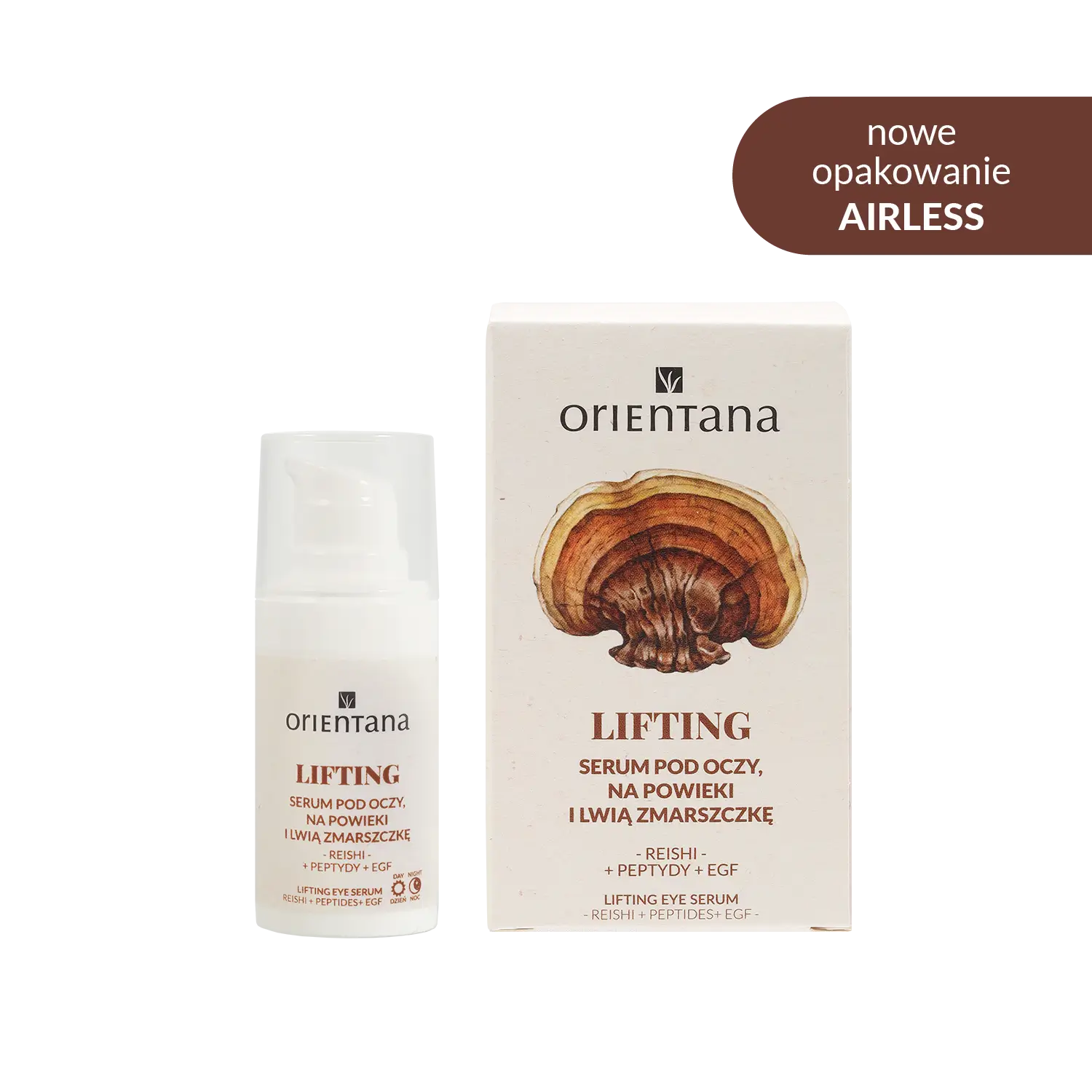
- eye serum with peptides,
- formulas combining peptides with EGF, ceramides and adaptogens.
This makes it possible to create a comprehensive care regimen based on peptides.
Frequently asked questions about peptides in cosmetics
Do peptides really work?
Yes. Peptides are among the most researched active ingredients in cosmetology. They work by transmitting signals to skin cells, supporting collagen production, regeneration, and improved skin quality.
How long does it take to see the effects of using peptides?
The first smoothing and hydration results may appear after a few days. More noticeable firmness improvements and wrinkle reduction are typically achieved after 4-8 weeks of regular use.
Are peptides safe for sensitive skin?
Yes. Biomimetic peptides, in particular, are highly biocompatible and well-tolerated even by sensitive skin.
Can peptides be used daily?
Yes. Peptides are intended for daily care, both morning and evening.
Do peptides clog pores?
No. Peptides themselves do not have comedogenic properties. The final effect depends on the cosmetic's overall formula.
Are peptides better than collagen in cosmetics?
Peptides work more effectively than collagen applied topically because they signal the skin to produce its own collagen.
Can peptides be combined with vitamin C?
Yes. Peptides and vitamin C complement each other well – vitamin C supports collagen synthesis, and peptides enhance the regenerative signal.
Can peptides be used in summer?
Yes. Peptides do not increase skin sensitivity to the sun.
Do peptides help with facial wrinkles?
Yes. Some peptides gently relax muscle tension, which reduces the appearance of facial wrinkles.
Are peptides suitable for under the eyes?
Yes. It's one of the best ingredients for eye care.
Can peptides be used with retinol?
Yes, preferably in separate care stages (e.g. peptides in the morning, retinol in the evening).
Are peptides suitable for acne-prone skin?
Yes, especially if your skin is also dehydrated or irritated.
Do peptides help with loss of firmness?
Yes. They stimulate collagen production and improve skin density.
Can peptides be used during pregnancy?
Most peptides are considered safe, but it is always worth checking the product's composition or consulting a specialist.
Is a peptide serum enough instead of a cream?
It is worth covering the serum with cream to protect the skin and enhance the effect.
Do peptides work on discoloration?
Indirectly, they improve skin quality and regeneration, which may result in a more uniform skin tone.
Can peptides replace Botox?
No. They can gently smooth out facial wrinkles, but they do not replace aesthetic medicine treatments.
Are peptides natural?
They may be synthesized or produced biotechnologically, but are biocompatible with the skin.
Are peptides suitable for young skin?
Yes. They also work well as anti-aging preventatives.
Can I use several peptide products at the same time?
Yes, if the formulas are light and well tolerated.
Do peptides work immediately?
They provide a quick smoothing effect, but the best results are visible with regular use.
Can peptides cause irritation?
Rarely. They are among the best-tolerated active ingredients.
Peptides are intelligent, next-generation active ingredients that support the skin's natural regenerative mechanisms. Regular use of peptide-based cosmetics helps improve firmness, smooth wrinkles, and strengthen the hydrolipid barrier.
This is the foundation of modern anti-aging care.