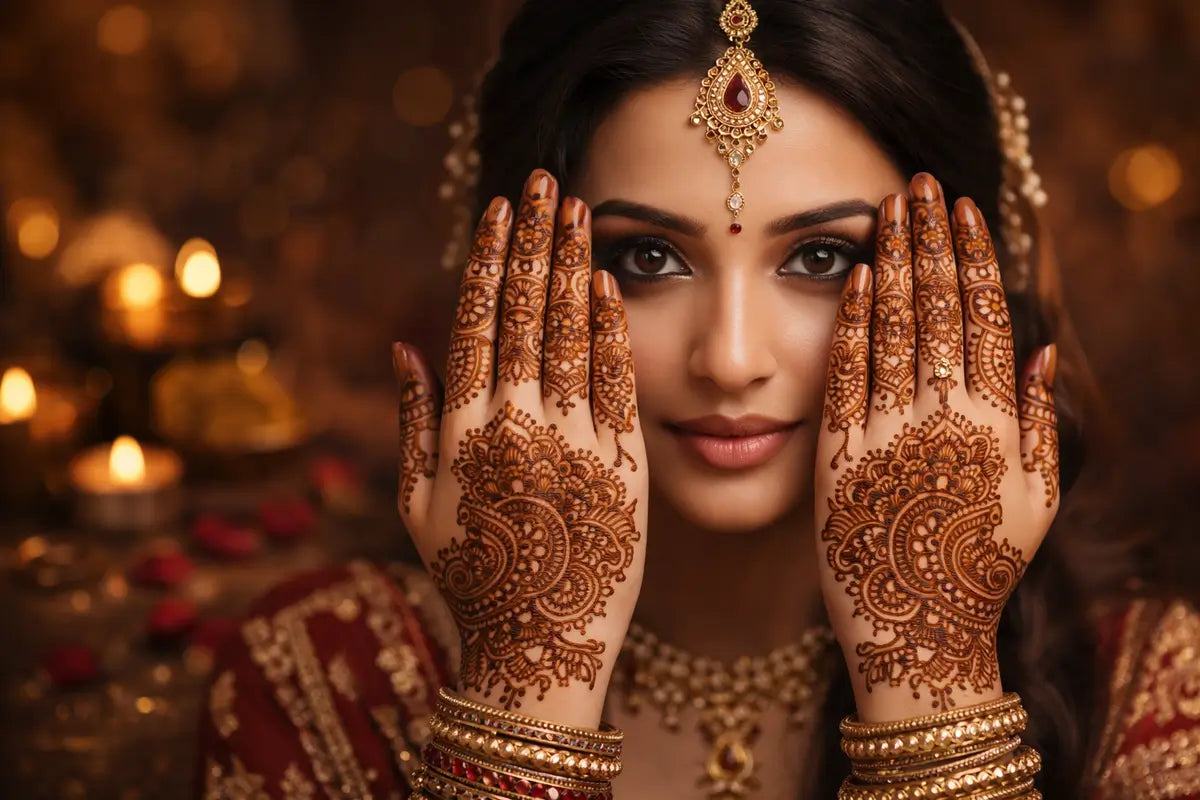
When I was in India, I was invited to my friend's sister's wedding. Not as a tourist, not as an outsider observer, but as someone who could enter this culture and see, touch, feel.
The mehendi night took place the day before the wedding.
The house was full of women. They sat together on the floor, laughing, singing, talking. The air was filled with a scent – earthy, slightly herbal, characteristic of fresh henna.
The bride sat in the middle.
Calm. Focused. As if already somewhat beyond everyday life.
The artist began applying the patterns – slowly, precisely, without rush. Every line had meaning. Every motif was part of a larger story.
And then I understood something that today is fundamental to my thinking about cosmetics:
👉 mehendi is not a product
👉 it is a ritual
👉 it is a relationship with the body and time
I was invited to also have mehendi done. When the henna paste touched my skin, I felt coolness, dampness, and… a halt.
It was the opposite of everything the modern beauty market offers.
No immediate effect. No "wow in 5 minutes."
The effect appeared slowly.
And that's exactly how henna works.
Mehendi - what is it?
Mehendi is the traditional art of body adornment using natural henna, a dye obtained from the plant Lawsonia inermis.
Mehendi is most often applied to:
- hands
- feet
- forearms
The patterns are temporary – they only dye the stratum corneum of the epidermis and disappear after a few to several days.
However, it is important to understand a key difference:
- mehendi is a ritual and an art form
- henna is a raw material and an active ingredient
This distinction is important, because in Europe, we often reduce mehendi to a "henna tattoo," losing its entire cultural context.

Where does mehendi come from and what does it mean in Indian culture?
Mehendi has thousands of years of history and is deeply rooted in the cultures of India, the Middle East, and North Africa.
It is best known as an element of wedding ceremonies.
The mehendi night is a moment of:
- celebration of femininity
- community
- transition to a new stage of life
The patterns are not accidental.
They symbolize:
- love and the bond between partners
- happiness and prosperity
- protection from the "evil eye"
A curious fact I heard on site:
the darker the mehendi color, the stronger the love between spouses
This is, of course, symbolism, but it shows how deeply this ritual is embedded in emotions.
How henna works on skin and hair
This is the point where most articles end with "natural dye."
And the truth is much more interesting.
The main active compound in henna is lawsone – a molecule that has the ability to bind with keratin.
Mechanism of action:
- lawsone reacts with skin and hair proteins
- forms stable, but superficial bonds
- does not penetrate deeply like chemical dyes
Effects on skin:
- gentle coloring
- antibacterial action
- slight cooling and soothing
Effects on hair:
- thickening of the hair shaft
- smoothing of the cuticle
- increased shine
- improved volume
What's important:
👉 henna does NOT damage hair
👉 it acts more like a structural mask than a dye
And that was one of the pivotal moments for me as a cosmetic creator.
I understood that coloring can be thought of not as an intervention, but as support for the hair structure.
Read Why is it worth dyeing hair with henna? 7 reasons why henna is better than dye

Mehendi vs. henna - is it the same?
This is one of the most frequently searched questions.
The answer is simple, but important:
- mehendi = ritual, art, tradition
- henna = plant and dye
One could say:
👉 every mehendi uses henna
👉 but not every henna is mehendi
In cosmetics, we use henna mainly for:
- hair coloring
- scalp care
Is mehendi safe?
Yes, under one condition.
👉 it must be natural henna
What to watch out for:
The biggest problem is so-called "black henna."
It contains PPD (p-phenylenediamine) – a strong allergen used in chemical dyes. I often see such "hennas" on vacation. Don't do it!
It can cause:
- irritations
- allergic reactions
- permanent skin damage
Therefore:
👉 true mehendi has a color from orange to brown
👉 it is never black
This is a key piece of information that I always emphasize.
Mehendi on hair - natural coloring and care
In India, henna is not just a body ornament.
It is an element of daily hair care.
It is used as:
- a natural dye
- a strengthening mask
- a grooming ritual
For whom does henna work best:
- thin and delicate hair
- damaged hair
- problematic scalp
Effects:
- increased volume
- improved structure
- natural shine
It was this aspect that inspired me to work on henna at Orientana – as a product that not only colors but also genuinely improves hair condition.
read my post Where does hair henna come from? The history of a plant that has dyed hair for thousands of years
How to do mehendi at home
Although true mehendi is a cultural experience, you can try a simplified version.
Step by step:
- prepare the henna paste
- apply the design (with a cone or applicator)
- leave on for 2–6 hours
- do not wash off with water immediately
- allow the color to develop (24–48 h)
Tip:
the longer the paste stays on the skin, the more intense the color
Common mistakes when using henna
- too short application time
- using low-quality henna
- expecting results like with chemical dye
- lack of patience
Henna teaches one thing:
👉 effects come with time
Mehendi in modern skincare - does it make sense today?
Absolutely, but with one condition:
👉 if we understand its meaning
Today we see a huge return to:
- slow beauty
- rituals
- natural ingredients
But it's not about "returning to the past."
It's about combining:
👉 tradition + science
👉 nature + technology
And that's exactly what we do at Orientana.
We don't copy rituals.
We reinterpret them. So that they work in the realities of modern skin and lifestyle.
Summary
Mehendi is much more than an adornment.
It's:
- history
- a ritual
- a way of thinking about skincare
For me, it was a breakthrough moment.
Because I understood that the best ingredients are not always new.
Sometimes they are simply… well-forgotten.
FAQ
Does mehendi come off on its own?
Yes, mehendi gradually fades with the natural exfoliation of the epidermis.
How long does mehendi last?
Usually from 7 to 14 days, depending on care and skin type.
Does henna damage hair?
No, it has a strengthening and smoothing effect.
Can mehendi be done during pregnancy?
Natural henna is considered safe, but it's always good to check the ingredients.
Does henna cover grey hair?
Yes, but the effect is more natural than with chemical dyes.
What is mehendi?
Mehendi is the traditional art of body adornment using natural henna, a dye from the plant Lawsonia inermis. Designs are mainly created on the hands and feet. The effect is temporary and lasts from a few to several days.
Are mehendi and henna the same?
Not exactly. Mehendi is a ritual and a form of body adornment, while henna is a plant and a dye used to create the designs. Every mehendi uses henna, but henna can also be used, for example, for hair dyeing.
How long does mehendi last on the skin?
Mehendi usually lasts from 7 to 14 days. The duration depends on the application area, skin type, and care. On the hands and feet, the color lasts longest because the skin there is thicker.
Is mehendi safe for the skin?
Yes, if natural henna is used. So-called black henna, which contains PPD—a strong allergen—should be avoided. Natural mehendi has a color from orange to brown and is safe for most people.
Can mehendi be done during pregnancy?
Natural henna is considered safe during pregnancy because it acts superficially and does not penetrate deeply into the body. However, it's worth making sure that the product does not contain chemical additives or PPD.
Does mehendi hurt?
No, mehendi is completely painless. Henna paste is applied to the surface of the skin and does not damage its structure. It often even provides a delicate cooling and soothing sensation.
How does mehendi color develop?
Mehendi color develops due to a compound called lawsone, which binds to keratin in the skin. Initially, it is light orange, and within 24–48 hours, it darkens to a brown shade.
Why does mehendi darken over time?
This is a natural process of dye oxidation. After the paste is removed, henna reacts with oxygen and skin proteins, causing a gradual deepening of the color over several tens of hours.
Can the mehendi effect be accelerated?
The process cannot be significantly accelerated, but it can be intensified. Keeping the paste on the skin longer, avoiding water for the first few hours, and using natural oils after application helps.
Does mehendi come off by itself?
Yes, mehendi disappears spontaneously with the natural exfoliation of the epidermis. It does not require removal. This process usually takes from a few to several days.
Can mehendi be removed faster?
Yes, but only partially. Skin exfoliation, frequent washing, and the use of oils can help. However, mehendi cannot be completely removed instantly because the dye binds to keratin.
Is mehendi permanent like a tattoo?
No, mehendi is a temporary adornment. Unlike a tattoo, it does not penetrate deep into the skin and is not permanent. The effect lasts for a maximum of several days.
How to do mehendi at home?
To do mehendi at home, you need to prepare henna paste, apply it to the skin with an applicator, and leave it on for several hours. After removing the paste, the color develops within 24–48 hours.
How long should henna be left on the skin?
Preferably from 2 to 6 hours. The longer the paste remains on the skin, the more intense and durable the mehendi color you can achieve.
Can mehendi be done on any body part?
Yes, but it is most visible and durable on the hands and feet. On other body parts, the color may be lighter and last for a shorter time.
Does henna damage hair?
No, henna does not damage hair. On the contrary, it strengthens, thickens, and smooths it. It acts like a natural mask, improving hair structure.
Does henna cover gray hair?
Yes, henna covers gray hair, but two-step dyeing is necessary.
Does henna change hair structure?
Yes, but in a positive way. Henna coats the hair and strengthens its structure, giving it volume and shine, without damage.
Does mehendi have a conditioning effect on the skin?
Natural henna has antibacterial and slightly cooling properties. It can support skin comfort, although its primary function is coloring.
Can mehendi cause allergies?
Natural henna rarely causes allergic reactions, but it is always advisable to perform a patch test. The greatest risk is associated with black henna containing PPD.
How to recognize natural henna?
Natural henna gives an orange to brown color and has an herbal scent. If the effect is black, it likely contains chemical additives.
Can mehendi be done on children?
Yes, if natural henna without chemical additives is used. However, caution should be exercised and a skin test performed.
Does mehendi stain clothes?
Yes, fresh henna paste can stain fabrics. After the dye binds to the skin, the risk of staining is minimal.
Can mehendi be done in winter?
Yes, but the color may be less intense. Warmth promotes the dye reaction, so in colder conditions, the effect may be weaker.
Does mehendi have symbolic meaning?
Yes, especially in India. Mehendi symbolizes happiness, love, and protection. It is an important element of wedding ceremonies.
Why is mehendi done before a wedding?
It is part of a tradition that is meant to bring good luck and prosperity to the bride. It is also an opportunity for gathering and celebration among women.
Does mehendi affect body temperature?
Henna has cooling properties, which is why it is also used in India for comfort in hot climates.
Can henna be used on eyebrows?
Yes, but products specifically designed for this purpose should be used, and caution should be exercised to avoid irritation.
Is henna ecological?
Natural henna is a plant-based and biodegradable ingredient, making it more environmentally friendly than chemical dyes.
Can mehendi be done independently without experience?
Yes, but it requires patience. Mehendi designs are precise, so beginners are recommended to start with simple motifs.
Does mehendi smell?
Yes, natural henna has a characteristic, herbal scent that is slightly earthy and natural.
Can mehendi be combined with cosmetics?
Yes, but it is best to avoid strong detergents and exfoliants in the application area to not shorten the durability of the design.
Can mehendi be invisible?
Yes, if the paste was kept on for too short a time or the henna was of low quality. The color can then be very light.
Does henna work on every hair color?
Yes, but the effect depends on the initial color. On light hair, it gives a more intense shade, on dark hair – a subtle highlight.
Is mehendi trendy?
Yes, mehendi is making a comeback as part of the slow beauty and natural care trend, but its roots are much deeper than a passing fad.
Does henna dry out hair?
It can create a stiff sensation if used without additives. That's why it's often combined with oils or moisturizing ingredients.
Can mehendi be reapplied?
Yes, a new layer of henna can be applied to deepen the color or refresh the design.
Is mehendi suitable for sensitive skin?
Yes, if it's pure henna without chemical additives. However, it's advisable to do a patch test before application.
Does henna have anti-dandruff properties?
It can support scalp balance due to its antibacterial properties, although it is not a cure for dandruff.
Why should you use henna instead of chemical dye?
Henna is gentler, strengthens hair, and does not damage its structure. It's an alternative for those who want to combine coloring with hair care.