Henna hair dye is one of the oldest natural hair coloring methods used by humans. Its history dates back thousands of years and is linked to the cultures of the Middle East, North Africa, and India. Today, henna is experiencing a renaissance, as more and more people seek natural alternatives to chemical hair dyes.
To understand what henna really is and why it works so uniquely, it is worth answering a basic question: where does henna for hair come from and how is it made?
What is henna and what plant is it made from?
Henna is a natural plant dye obtained from the leaves of the Lawsonia inermis shrub. This plant grows primarily in hot and dry climates, which is why the largest cultivations are found in India, Pakistan, Egypt, Morocco, and Sudan.
The henna bush can reach heights of up to several meters. Its leaves contain a natural pigment called lawsone , which has the ability to permanently bind to the keratin of hair and skin.
It is thanks to this pigment that henna can:
- dye your hair
- strengthen their structure
- make them shine
- optically thicken hair
Unlike chemical dyes, henna does not damage the hair structure - it acts rather as a natural protective coating.

Where henna grows - natural growing regions
The best quality henna comes from regions with very specific climates. The Lawsonia inermis plant grows best in areas where:
- temperatures are high most of the year
- there is a lot of sun
- the soil is dry and well-drained
The most important henna growing regions are:
India
It is one of the largest producers of henna in the world. The regions of Rajasthan and Gujarat are particularly well-known, as their climatic conditions favor the production of high-quality raw materials.
Pakistan
Pakistani henna is valued for its color intensity.
Egypt
Egyptian henna was used already in the times of the pharaohs.
Morocco and Sudan
In these countries, henna has been used for centuries both for hair coloring and body decoration.
What does the henna plant look like?
The Lawsonia inermis plant is a dense shrub with small, oval leaves and tiny, fragrant flowers. The leaves are the most valuable part of the plant, as they contain the largest amounts of coloring pigment.
The life cycle of a henna bush can be as long as 15–18 years , and the first harvest of leaves is usually possible about three years after planting the seedling .
This is why henna cultivation requires extensive knowledge and experience – plantations must be managed on a long-term basis.
When to harvest henna - the two most important harvesting periods
Henna leaves are usually harvested twice a year . The quality of the raw material depends largely on the time of harvest.
The first and most valuable harvest takes place at the turn of October and November . In India, it is called Khatki . Leaves harvested at this time contain the highest levels of coloring pigment.
The second harvest falls in April and May and is called Khutan .
During the first few years of the bush's life, two harvests are possible per year. However, over time, the plant produces one harvest per year.
Why Where Henna Is Grown Matters So Much
The quality of henna depends not only on the plant itself, but also on the environment in which it is grown.
The properties of the raw material are influenced by, among others:
- soil quality
- amount of sun
- temperature
- method of harvesting
- leaf drying method
Henna grown in polluted areas may contain undesirable substances, which is why it is so important to inspect plantations and test the soil.
Professional henna producers regularly check the raw material for the presence of heavy metals and other contaminants.

How is henna made for hair - the production process
The production of natural henna is a process consisting of several stages.
First, the leaves of the Lawsonia inermis shrub are harvested. They are then dried in the sun to remove excess moisture.
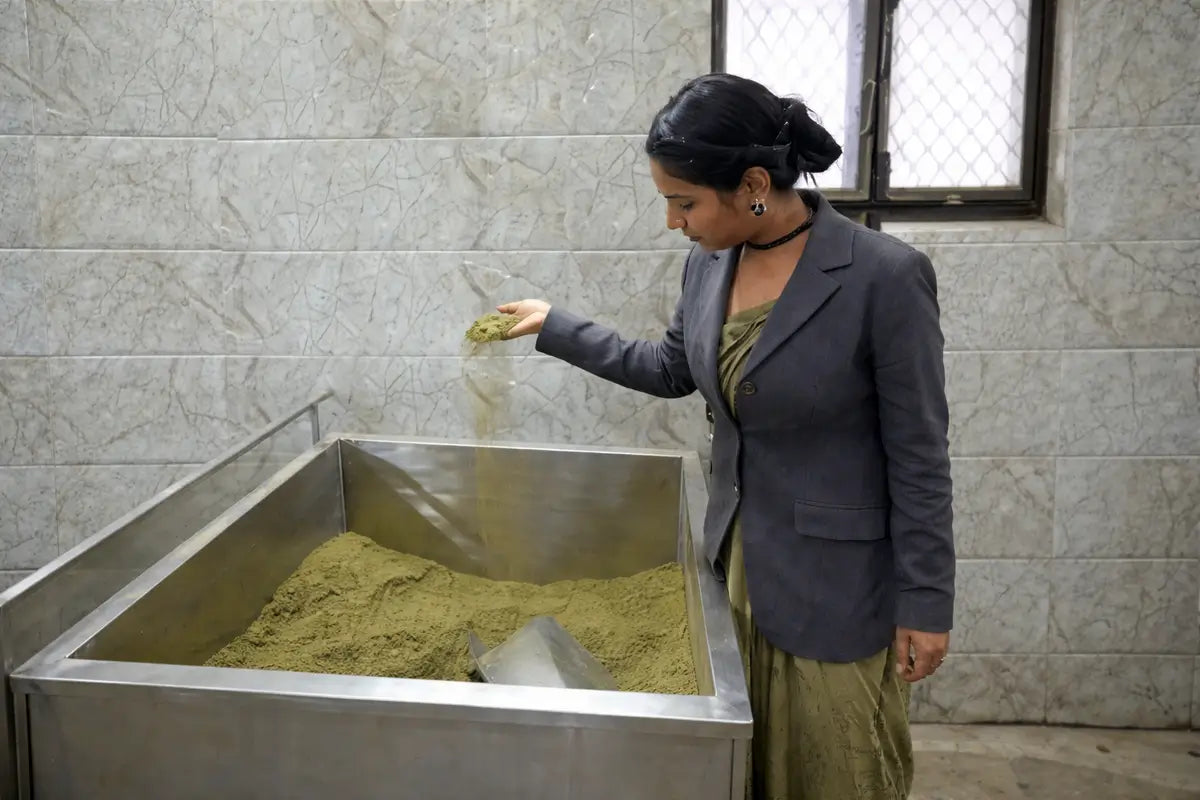
After drying, the leaves are placed in special machines that crush them. The next step is to clean the raw material of dust, twigs, and other impurities.
The plant material is then ground to a very fine powder. The finer the grind, the better the quality of the henna when applied to the hair.
The powder prepared in this way constitutes the base for natural hair dye.
Why is the fineness of henna so important?
One of the most important elements of henna quality is the fineness of the powder.
Very finely ground henna:
- combines more easily with water
- creates a smooth paste
- covers the hair evenly
- allows you to obtain a more intense color
That is why professional factories use modern cyclone mills, which allow obtaining powder with a very fine structure.
Why is henna so popular in natural hair care?
Henna has gained enormous popularity among people looking for natural hair coloring methods.
Unlike chemical dyes, henna:
- does not contain ammonia
- does not contain oxidants
- does not damage the hair structure
Additionally, it can improve the appearance of hair because it creates a protective plant layer on its surface.
Thanks to this, hennaed hair is often:
- more shiny
- thicker to the touch
- more resistant to damage.
Why does the quality of henna depend on the manufacturer?
Not all henna available on the market is of the same quality. Much depends on the manufacturer and whether they control the entire production process—from plantation to finished product.
High-quality henna should come from controlled crops and undergo thorough quality testing.
That is why it is worth choosing products from manufacturers who:
- they know the origin of the raw material
- they cooperate directly with growers
- they control the production process
- perform raw material quality tests.

How to distinguish real henna from fakes
Although henna is often associated with a natural plant product, there are many products on the market that only resemble real henna in name. Therefore, it's important to know how to recognize high-quality henna and how it differs from products of unknown origin.
Check the product composition
The easiest way to recognize real henna is to analyze its INCI composition. Natural henna should contain, above all:
Lawsonia inermis leaf powder
i.e., powdered leaves of the henna plant. Depending on the color, the composition may also include other plants, such as:
- Indigofera tinctoria - gives darker shades
- Cassia obovata - used in lighter blends
- Amla, bhringraj or shikakai - herbs for hair care.
If the ingredients contain synthetic dyes or chemicals, the product is not pure henna.
Pay attention to the color of the powder
Natural henna has a characteristic greenish or olive color . If the powder is very dark or has an unusual shade, it may have been mixed with other ingredients.
Once mixed with water, the henna paste should have a smooth consistency and a herbal scent .
Check the origin of the product
One of the most important elements of henna quality is its origin. The best products are made from raw material grown in regions where henna grows naturally – primarily in India.
The manufacturer who controls the production process usually clearly informs about:
- place where plants are grown
- production process
- raw material quality tests.
The lack of such information may mean that the product comes from an unknown source.
Pay attention to the degree of grinding
Good quality henna should be very finely ground . This allows it to form a smooth paste when mixed with water, which spreads easily on the hair.
If the powder is coarse-grained or contains twig particles, this may indicate low-quality raw material.
Avoid products of unknown origin
Sometimes henna is sold as a product brought back from travel or purchased at local markets. While this may sound exotic, such products do not always meet European safety standards.
Professional producers examine the raw material for, among other things:
- microbiological contamination
- presence of heavy metals
- quality of the coloring pigment.
Therefore, when choosing henna for hair, it is worth choosing products from proven producers who control the entire production process – from plant cultivation to the finished cosmetic.
Why does henna quality matter?
High-quality henna allows for even color and comfortable application. Importantly, the high quality of the raw material also ensures the product's safety.
Therefore, in the case of natural hair coloring, it is worth paying attention not only to the color of henna, but also to its origin, composition and method of production .
FAQ - frequently asked questions about henna for hair
1. Where does henna for hair come from?
Henna comes from the leaves of the Lawsonia inermis plant, which grows mainly in India, Pakistan, Egypt and North African countries.
2. What is henna for hair made of?
Henna is made from the dried and ground leaves of the Lawsonia inermis shrub.
3. Is henna a natural hair dye?
Yes, henna is an all-natural plant dye.
4. Does henna damage hair?
No, henna does not damage hair – on the contrary, it often strengthens its structure.
5. How does henna work on hair?
Henna binds to the keratin of the hair and creates a natural protective layer.
6. Does henna cover gray hair?
Yes, henna can cover gray hair, although the color result depends on the initial hair shade.
7. How long does the color of henna last?
The color of henna usually lasts from several weeks to several months.
8. Does henna dye hair red?
Pure henna gives shades ranging from copper to red.
9. Can henna come in different colors?
Yes, if it is mixed with other herbs, different shades can be obtained.
10. Is henna safe for the scalp?
Natural henna is usually well tolerated by the skin.
11. How to prepare henna for hair dye?
Henna powder is mixed with water to form a thick paste.
12. How long should I keep henna on my hair?
Most often from 1 to 3 hours.
13. Can henna be used on chemically dyed hair?
Yes, but it is worth testing it on a strand of hair first.
14. Does henna thicken hair?
Yes, henna creates a coating on the hair, which gives the effect of greater volume.
15. Can henna dry out hair?
In some people it can slightly dry out the hair, which is why it is often combined with conditioners.
16. How often can henna be used?
Most often every 4–6 weeks.
17. Does henna strengthen hair?
Yes, many people notice an improvement in the condition of their hair after henna.
18. Can henna cause allergies?
Rarely, but as with any cosmetic product, it is worth doing an allergy test.
19. Can henna lighten hair?
No, henna does not lighten hair.
20. Does henna work like a chemical dye?
No – it works by covering the hair with natural pigment.
21. Can henna darken hair?
Yes, especially when used repeatedly.
22. Can henna stain the skin?
Yes, that's why it's worth protecting the skin around the hair during application.
23. What does the henna plant look like?
It is a shrub with small leaves and tiny flowers.
24. Where does henna grow?
In regions with a hot climate – mainly in India and North Africa.
25. Was henna used in ancient times?
Yes, it was already used in ancient Egypt.
26. Is henna vegan?
Yes, it is a plant product.
27. Does henna have a scent?
Yes, natural henna has a characteristic herbal scent.
28. Does henna make hair shiny?
Yes, it often increases the shine of hair.
29. Can henna help with thin hair?
It can visually increase hair volume.
30. Can henna improve the condition of hair?
Yes, many people notice an improvement in their appearance.
31. Does henna work on damaged hair?
It can help improve their appearance and structure.
32. Can henna cover roots?
Yes, it can be used on regrowth.
33. Is henna ecological?
Henna is a plant product and can be grown organically.
34. Does henna contain chemical dyes?
Natural henna does not contain synthetic dyes.
35. How to store henna?
In a cool and dry place.
36. Is henna permanent?
Yes, its pigment binds to the keratin of the hair.
37. Can henna be used on the beard?
Yes, many men use it to color their beards.
38. Can henna be used on eyebrows?
Yes, but you should use special products designed for eyebrows.
39. Can henna dye clothes?
Yes, that's why it's worth protecting your clothing during application.
40. Why is it worth choosing good quality henna?
Because the quality of the raw material influences the coloring effect and safety of use.
Summary
Henna for hair is a natural plant dye obtained from the leaves of the Lawsonia inermis shrub. The best quality henna comes from regions with hot and dry climates, such as India and Pakistan.
The process of creating henna involves many stages – from growing the plant, through harvesting and drying the leaves, to their fine grinding.
The quality of the final product depends on many factors: the place of cultivation, the harvest date, the processing method and the quality control of the raw material.
Therefore, when choosing henna for hair, it is worth paying attention not only to the color, but also to the origin and manufacturer of the product .