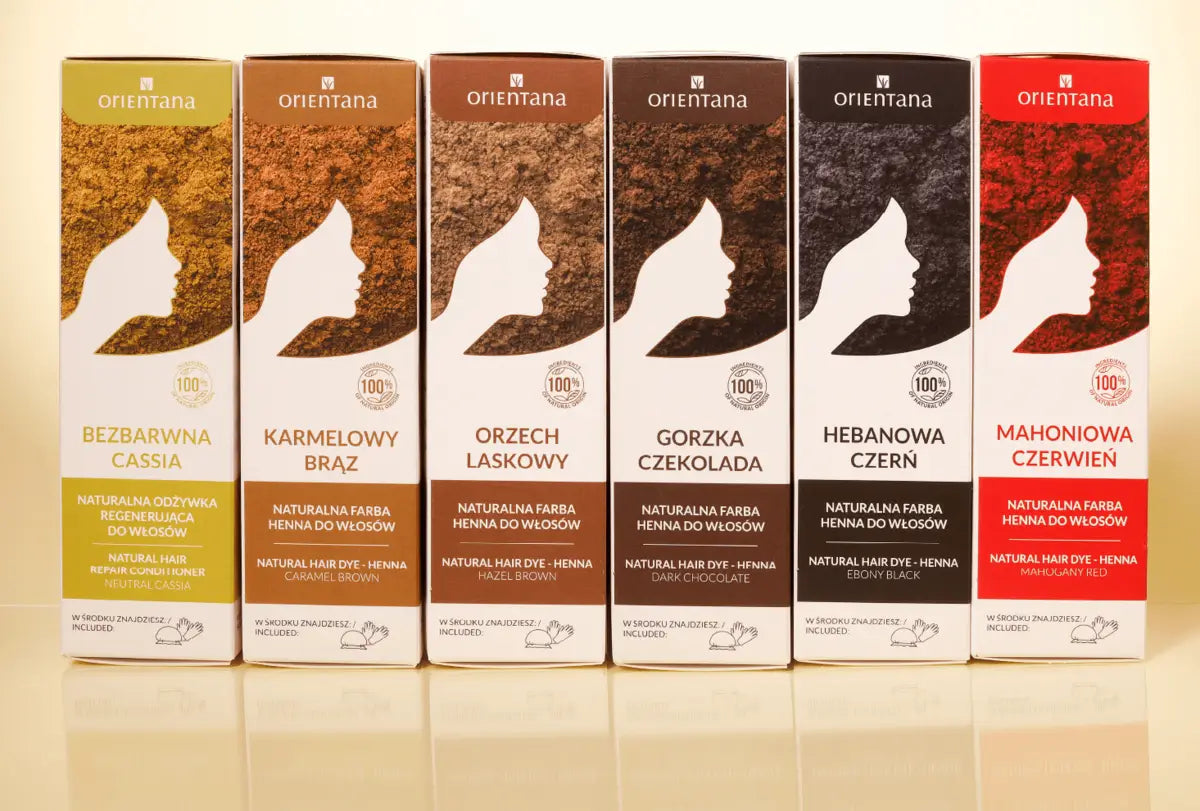
Natural hair coloring with henna has been making a comeback in recent years. More and more people are seeking an alternative to chemical dyes, which can weaken hair structure and irritate the scalp. Henna is perceived as a safe, natural, and nurturing hair coloring method.
However, not all henna available on the market is of the same quality. Stores offer both pure, herbal powders made from plant leaves and mixtures containing synthetic additives, dyes, and preservatives. Therefore, it's important to know how to recognize good henna for hair and what to look for before purchasing it.
Below you will find the most important features of high-quality henna that determine the coloring effect and safety of use.
For more information, see Henna for hair - natural plant dye, colors, effects and how to use
What exactly is henna for hair?
Henna is a natural plant dye obtained from the leaves of the Lawsonia inermis plant. This plant grows primarily in warm climates – in India, Pakistan, Iran, and North African countries.
Henna leaves contain a natural pigment, lawsone , which binds to hair keratin, giving it a characteristic red or copper shade. Unlike chemical hair dyes, henna doesn't lighten hair; instead, it coats it with natural pigment and strengthens its structure .
Additionally, henna has a conditioning effect – it can increase hair volume, improve its shine and strengthen the hair shaft.
Why is the quality of henna so important?
The quality of henna directly affects:
- color intensity
- durability of the coloring effect
- safety for the scalp
- hair care effect
Low quality raw materials may result in poor color results, uneven hair coverage, or difficulties in preparing the mixture.
That is why it is so important to choose henna produced from high-quality plants, properly processed and controlled at every stage of production.
7 features of good henna for hair
1. It consists only of plants
The best henna for hair is a 100% plant-based product that contains only powdered plant leaves.
Depending on the color, the mixture may also contain other coloring plants, such as:
- indigo (Indigofera tinctoria)
- cassia (Cassia obovata)
- amla (Phyllanthus emblica)
High-quality henna should not contain:
- ammonia
- oxidants
- synthetic dyes
- preservatives
A simple, plant-based composition is one of the most important determinants of product quality.

2. It is in the form of a finely ground powder
Good henna should be in the form of a very finely ground powder .
Fine grinding is important because:
-
makes it easier to prepare a smooth paste
-
allows you to evenly distribute henna on your hair
-
improves pigment release
If the powder is too thick or contains visible plant particles, the paste may be difficult to apply and will not cover the hair evenly.
3. It is made from fresh harvests
The freshness of the raw material is one of the key factors influencing the quality of henna.
After harvesting, henna leaves are dried, ground, and packaged. The shorter the time from harvest to processing, the better the powder quality and the stronger the dyeing properties.
Lawsonia inermis is ready to harvest about three years after planting . A warm, sunny climate provides the best conditions for its growth.
Henna is usually harvested twice a year, and each harvest may vary in pigment intensity depending on weather conditions.

4. It comes from controlled cultivation
High-quality henna should come from controlled crops , where both the plant growing conditions and the soil quality are monitored.
When using henna for cosmetics, it is very important that the soil is free of contaminants such as heavy metals.
Some companies work with specific plantations, controlling the cultivation and harvesting process.
5. Passes heavy metal testing
Henna is a plant product, so it is very important to control the heavy metal content.
High-quality manufacturers test:
- the soil in which plants grow
- plant raw material
- finished product
Specialized laboratory equipment, such as absorption spectrometers , is used for analysis to accurately determine the content of heavy metals.
6. It is microbiologically tested
Every cosmetic introduced for sale in Europe must undergo specific safety tests.
In the case of henna, this includes, among others:
- microbiological tests
- control of the presence of microorganisms
- dermatological assessment
This ensures that the user is certain that the product is safe for the scalp.
7. Gives natural, multi-dimensional color
One of the biggest advantages of natural henna is that it does not produce a flat color , as is often the case with chemical dyes.
The plant pigment combines with the natural hair color, making the effect multidimensional and very natural looking.
Color may vary depending on:
- natural hair color
- hair structure
- the time of keeping the mixture on the hair
Therefore, henna gives an individual coloring effect.
Is every henna on the market natural?
Not all products labeled as henna are actually pure plant powders.
On the market you can find products in the form of:
- creams
- past
- ready-made mixtures
Such formulas often contain additional chemical ingredients that may alter the performance of the product.
Therefore, before purchasing, it is always worth checking the composition of the product and making sure that it contains only plant-based ingredients.

Why is henna gentler on hair than chemical dye?
Chemical dyes work by opening the hair cuticle and injecting synthetic pigment into the hair . This process requires the use of oxidants and other chemicals.
Henna works differently.
The plant pigment bonds with the outer layer of the hair, creating a natural coating. This allows the hair to become:
- thicker
- more shiny
- less susceptible to damage
This is one of the reasons why many people choose natural coloring.
Summary
Good henna for hair should be a fully plant-based product, free of synthetic additives and properly controlled at every stage of production.
The most important features of high-quality henna are:
- plant composition
- finely ground powder
- freshness of the harvest
- controlled crops
- heavy metal testing
- microbiological tests
- natural coloring effect
By choosing high-quality henna, you can not only change the color of your hair, but also improve its condition and appearance.
FAQ - frequently asked questions about henna
Does henna damage hair?
No. Natural henna usually strengthens the hair and improves its condition.
Can henna lighten hair?
No. Henna does not lighten hair – it can only give it a warmer shade.
Does henna cover gray hair?
Yes, although the color effect depends on your natural hair color.
How long does the henna color last?
Usually 4 to 8 weeks.
Can henna be used on dyed hair?
Yes, but it is worth doing a color test on a single strand.